


ABB Advances DCS, Robotics, and Global Expansion Strategy in 2026
ABB strengthens its automation portfolio with Symphony Plus DCS upgrades, Nvidia Omniverse integration for digital twins, and major investments in India, signaling a push toward AI-driven and scala...
ABB connects control systems, AI, and global manufacturing
ABB has unveiled a coordinated set of developments spanning control systems, robotics software, and global manufacturing expansion. The updates reflect a broader strategy to unify automation, digitalization, and AI-driven engineering workflows.
From DCS modernization to digital twin simulation and regional investment, ABB is positioning its ecosystem for long-term scalability across process and discrete industries.

Symphony Plus SPR2025 enhances system performance, cybersecurity, and interoperability across industrial control environments.
Modernizing DCS architecture for connected operations
ABB’s Symphony Plus SPR2025 release introduces system-wide OPC UA communication, enabling standardized data exchange between controllers, sensors, and higher-level systems.
This capability allows plants to integrate modern IoT-ready devices without redesigning existing control architectures, improving interoperability across legacy and new installations.
Separating control from digital workloads
A key engineering shift in SPR2025 is the separation of control execution from digital services. This allows analytics, monitoring, and AI models to run independently without interfering with deterministic process control.
Such architecture reduces operational risk during system updates while enabling continuous optimization of plant performance.
For engineers working with legacy and modern control platforms, ABB’s broader DCS ecosystem can be explored here: distributed control system solutions.
Digital twin simulation enables accurate robot programming and system validation before physical deployment.
Digital twins move closer to real-world accuracy
ABB’s partnership with Nvidia integrates Omniverse libraries into RobotStudio, creating a new simulation layer known as HyperReality. This platform enables near real-world accuracy in robotic system modeling.
Engineers can now simulate complex robotic interactions with up to 99% accuracy, reducing commissioning time and minimizing integration risks.
From offline programming to predictive deployment
Traditional offline programming focused on basic motion paths. HyperReality extends this capability by incorporating physics-based simulation and real-time feedback loops.
This allows engineers to validate entire production scenarios before deployment, reducing costly downtime during system startup.
For further insight into robotic automation platforms aligned with these developments, see: ABB robotics systems and solutions.
Investment strategy aligned with industrial demand
ABB’s $75 million investment in India targets expansion of manufacturing capacity and R&D capabilities. The initiative supports growth in electrification, motion control, and automation technologies.
The expansion includes facilities for electrical protection systems, uninterruptible power supplies, and low-voltage drives, along with new innovation labs and training centers.
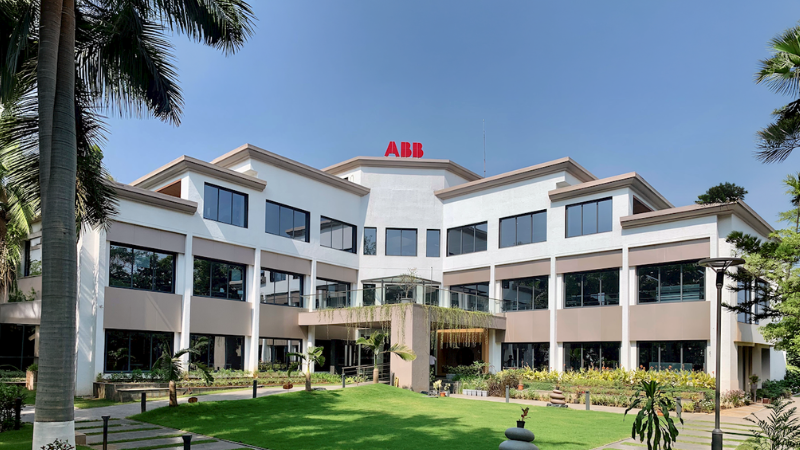
ABB expands manufacturing and R&D footprint to support infrastructure and industrial growth in emerging markets.
Application impact across industries
The combined upgrades influence multiple sectors, including energy, transportation, and manufacturing. In process industries, enhanced DCS capabilities improve operational visibility and control precision.
In robotics, advanced simulation tools reduce integration time for automotive, electronics, and logistics applications.
ABB’s broader automation portfolio, including controllers, drives, and system components, can be referenced here: ABB automation components.
Industry direction: convergence of control, simulation, and AI
ABB’s announcements highlight a clear industry trajectory. Control systems, simulation environments, and AI are no longer separate domains. They are merging into unified engineering platforms.
This convergence enables faster deployment cycles, improved system reliability, and more adaptive industrial processes.
Engineering perspective on ABB’s strategy
ABB is not introducing isolated innovations. It is aligning control architecture, simulation capability, and global manufacturing into a cohesive strategy.
The separation of control and digital layers within DCS systems, combined with high-fidelity digital twins, represents a critical step toward autonomous industrial operations.
This direction will likely define the next generation of industrial automation, where systems continuously optimize themselves using real-time data and predictive modeling.
Daniel Foster, Industrial Automation Analyst — 16 years of experience in DCS engineering, including ABB Symphony systems, Siemens PCS7 deployments, and large-scale process automation integration projects.