


Robotics-as-a-Service (RaaS): Transforming Industrial Automation from Capital Expense to Operational Advantage
Robotics-as-a-Service (RaaS) is changing how manufacturers adopt automation. Instead of investing heavily in robotic equipment and integration, companies can deploy robots through flexible subscrip...
The manufacturing sector has entered a period where automation is no longer a competitive advantage—it is becoming a requirement for survival.
Rising labor costs, workforce shortages, supply chain volatility, and increasing customer expectations are forcing manufacturers to automate processes that were traditionally performed by human operators. The challenge is no longer deciding whether automation is necessary. The real challenge is determining how to deploy automation quickly, cost-effectively, and with minimal risk.
For decades, implementing industrial robotics required significant capital investment. Companies needed to purchase robots, engineering services, safety systems, controls hardware, integration support, training programs, and long-term maintenance resources. Even after making these investments, success was not guaranteed.
Many automation projects exceeded budgets, experienced deployment delays, or failed to achieve expected productivity improvements.
Robotics-as-a-Service (RaaS) introduces an alternative approach. Instead of purchasing robotic systems outright, manufacturers subscribe to robotic automation through a service model that shifts technical and financial risks away from the end user.
This business model is rapidly gaining traction across manufacturing, warehousing, logistics, packaging, food processing, injection molding, and material handling operations.
Rather than treating automation as a major capital project, RaaS transforms robotics into a scalable operational service.

Figure 1. A Robotics-as-a-Service palletizing solution deployed in an industrial production environment.
What is Robotics-as-a-Service (RaaS)?
Robotics-as-a-Service applies the same subscription philosophy that transformed software through Software-as-a-Service (SaaS).
Instead of purchasing automation assets, manufacturers pay a recurring fee for robotic productivity.
The provider supplies the robot, integration services, deployment support, optimization, monitoring, maintenance, upgrades, and ongoing technical assistance.
The customer pays only for the delivered operational value.
In many modern RaaS agreements, payment structures are directly linked to measurable production performance.
Examples include:
- Parts processed per hour
- Pallets completed per shift
- Machine tending cycles completed
- Production throughput achieved
- Operating hours delivered
- Successful inspections completed
This creates a unique alignment between customer and provider.
Traditional system integrators receive payment after installation. RaaS providers continue earning revenue only when automation continues delivering measurable results.
The provider therefore becomes heavily invested in long-term system performance.
Why Traditional Automation Projects Often Struggle
Understanding the growth of RaaS requires examining the challenges associated with conventional automation projects.
A typical robotic deployment may require:
- Capital expenditure approval
- Vendor selection
- Robot specification development
- Controls engineering
- PLC integration
- Safety validation
- Production testing
- Operator training
- Maintenance planning
- Spare parts inventory
These activities consume significant engineering resources.
For many manufacturers, engineering teams already manage multiple responsibilities simultaneously, including production support, maintenance projects, quality improvements, safety initiatives, and facility upgrades.
Adding a major automation project can overwhelm available resources.
Even when projects receive approval, changing business conditions often create additional risks.
A robotic cell designed today may no longer align with production requirements twelve months later.
Market demand shifts rapidly.
Product mixes change.
Supply chains evolve.
Customer expectations increase.
Traditional automation investments struggle to adapt to this level of uncertainty.
The Rise of Flexible Manufacturing
Modern manufacturing increasingly prioritizes flexibility over pure production volume.
Historically, factories optimized around long production runs with minimal product variation.
Today's manufacturers frequently produce dozens or even hundreds of product variants on shared production assets.
This trend has accelerated demand for flexible automation platforms.
RaaS providers typically design solutions that accommodate changing production requirements.
Software updates, process modifications, tooling adjustments, and system reconfigurations can often be implemented without requiring entirely new robotic installations.
This flexibility reduces long-term automation risk while improving responsiveness to market changes.
Manufacturers no longer need to maintain an "automation graveyard" filled with obsolete equipment that no longer supports current operations.
Instead, automation evolves alongside production requirements.
The Financial Shift: From CapEx to OpEx
One of the strongest drivers behind RaaS adoption is financial flexibility.
Traditional automation projects generally require substantial capital expenditure approval.
Depending on complexity, robotic systems can cost hundreds of thousands or even millions of dollars before generating any return.
Capital approval cycles frequently delay automation initiatives for months or years.
Meanwhile, production inefficiencies continue affecting profitability.
RaaS fundamentally changes this equation.
Because robotics becomes an operating expense rather than a capital asset, deployment decisions can often move faster through organizational approval processes.
Manufacturers gain access to advanced automation capabilities without large upfront investments.
This financial model is especially attractive for:
- Small manufacturers
- Mid-sized manufacturers
- Contract manufacturers
- Seasonal production facilities
- Rapid-growth organizations
- Multi-site operations
The ability to preserve capital while still improving productivity creates a compelling business case.
Many manufacturers can fund future automation projects using savings generated from initial RaaS deployments.
Engineering Advantages Beyond Cost Savings
While financial flexibility often receives the most attention, experienced engineers recognize that successful automation projects depend on much more than budget considerations.
The true value of Robotics-as-a-Service frequently emerges through faster deployment, reduced engineering workload, and access to specialized expertise that many manufacturers simply do not possess internally.
Industrial robotics has become increasingly sophisticated.
Modern robotic systems often incorporate:
- Machine vision systems
- Artificial intelligence algorithms
- Collaborative robot technologies
- Advanced motion control
- Industrial networking
- Real-time data analytics
- Cloud-based monitoring platforms
- Predictive maintenance tools
Maintaining expertise across all these technologies is difficult for even the largest manufacturing organizations.
RaaS providers specialize in these technologies and continuously improve their deployment methodologies across multiple industries.
As a result, manufacturers gain access to automation expertise that would otherwise require significant hiring and training investments.
The "Easy Button" for Manufacturing Engineering Teams
Most manufacturing engineers operate under constant resource constraints.
They support production equipment, troubleshoot quality issues, manage improvement projects, coordinate maintenance activities, and participate in safety initiatives.
Adding a complex robotic deployment often stretches engineering teams beyond practical limits.
RaaS addresses this challenge by transferring much of the implementation burden to a dedicated automation partner.
The provider assumes responsibility for:
- System design
- Technology selection
- Risk assessment
- Robot programming
- Controls integration
- Deployment planning
- Performance optimization
- Ongoing maintenance
This allows internal engineering resources to focus on core manufacturing objectives rather than managing every aspect of automation implementation.
For many facilities, this reduction in engineering workload becomes as valuable as the productivity gains generated by the robotic system itself.
24/7 Monitoring and Predictive Support
A significant weakness of traditional automation projects appears after commissioning.
Once an integrator completes installation, responsibility shifts entirely to the manufacturer.
Unexpected failures can result in lengthy downtime while internal teams diagnose problems and coordinate repairs.
Under a Robotics-as-a-Service model, providers remain directly invested in operational performance.
Many providers maintain remote monitoring systems that continuously track robotic cell health.
These monitoring platforms may evaluate:
- Robot operating status
- Cycle performance
- Error conditions
- Production throughput
- Equipment utilization
- Maintenance indicators
- Network connectivity
- Safety system status
Potential issues can often be identified before they impact production.
This proactive approach aligns closely with modern predictive maintenance strategies used throughout advanced manufacturing facilities.
As factories increasingly adopt connected automation architectures, robotic systems become valuable contributors to broader digital transformation initiatives.
Solving Labor Shortages Through Automation Subscription Models
Labor availability remains one of the most significant challenges facing global manufacturing.
Many facilities struggle to recruit and retain workers for repetitive, physically demanding, or ergonomically challenging tasks.
Positions involving palletizing, machine tending, packaging, and material handling often experience particularly high turnover rates.
These activities represent ideal opportunities for robotic automation.
Rather than competing in increasingly difficult labor markets, manufacturers can deploy robotic solutions that provide predictable and consistent productivity.
Unlike temporary labor, robotic systems do not require recruitment, onboarding, scheduling adjustments, or ongoing workforce management.
Through RaaS, manufacturers effectively gain access to a continuously available automation workforce without making major capital investments.
This model has become particularly attractive in industries facing persistent labor shortages.
Palletizing: One of the Fastest-Growing RaaS Applications
Palletizing remains among the most common applications deployed through Robotics-as-a-Service providers.
Manual palletizing operations create several challenges:
- Worker fatigue
- Repetitive strain injuries
- Inconsistent stacking quality
- Limited throughput
- High turnover rates
- Safety concerns
Robotic palletizing systems solve these issues while delivering highly predictable performance.
Modern palletizing robots can accommodate:
- Boxes
- Bags
- Cases
- Containers
- Mixed product loads
- Variable pallet patterns
When combined with modern PLC Control Systems and Industrial HMI Platforms, robotic palletizers become highly flexible automation assets capable of supporting changing production requirements.

Figure 2. Robotic automation applied to an injection molding operation through a Robotics-as-a-Service deployment.
Injection Molding Automation Opportunities
Injection molding facilities have emerged as another major beneficiary of the RaaS model.
Many molding operations require repetitive handling tasks that are ideally suited for robotics.
Examples include:
- Part extraction
- Gate trimming
- Part inspection
- Packaging
- Secondary assembly
- Sorting operations
Historically, many small and mid-sized molding companies lacked the capital required for comprehensive robotic automation.
RaaS significantly lowers this barrier.
Manufacturers can deploy robotic cells without committing substantial capital budgets while still benefiting from improved throughput, quality consistency, and operator safety.
Perhaps more importantly, the provider assumes responsibility for optimizing performance after deployment.
If production targets are not achieved, the provider remains motivated to improve system performance because revenue depends on successful operation.
This incentive structure creates a partnership model rarely found in traditional automation procurement approaches.
Technology-Agnostic Expertise Creates Better Automation Decisions
One of the most overlooked advantages of Robotics-as-a-Service is access to technology-agnostic engineering expertise.
Many manufacturers evaluate automation solutions only occasionally. As a result, internal teams may have limited exposure to the rapidly evolving robotics marketplace.
Today's automation ecosystem includes hundreds of vendors offering robots, vision systems, grippers, sensors, controllers, software platforms, and AI-powered inspection technologies.
Selecting the optimal combination requires extensive experience.
A quality RaaS provider continuously evaluates emerging technologies and deployment methodologies across multiple industries.
This experience allows providers to choose the most appropriate solution based on operational requirements rather than brand loyalty.
Instead of forcing a particular technology into every application, the provider can identify the best combination of:
- Industrial robots
- Collaborative robots
- Machine vision systems
- Industrial cameras
- Conveyor technologies
- PLC platforms
- Safety systems
- AI-based software tools
This technology-neutral approach frequently produces better long-term results than internally developed solutions constrained by existing vendor relationships.
Reducing Automation Risk Through Performance-Based Models
One of the primary reasons automation projects stall is uncertainty.
Management teams often ask difficult questions:
- Will the robot achieve the required throughput?
- Will quality improve?
- How much downtime will occur?
- Will operators accept the new process?
- How long will ROI take?
- What happens if production requirements change?
Under traditional procurement models, manufacturers assume most of these risks.
The robot is purchased regardless of whether projected performance improvements materialize.
RaaS changes the equation by shifting much of the implementation risk to the service provider.
Because revenue depends on delivered productivity, providers have strong incentives to ensure systems achieve performance targets.
This alignment of interests significantly improves project accountability.
Both parties share the same objective: maximizing production output while minimizing operational disruption.
Supporting Legacy Equipment Modernization
Many manufacturing facilities operate equipment that remains mechanically productive despite being decades old.
Replacing these machines entirely may not be financially practical.
However, integrating automation into aging production assets often presents significant engineering challenges.
RaaS providers frequently specialize in retrofitting robotics onto legacy equipment.
This capability allows manufacturers to extend asset life while improving productivity.
Common modernization opportunities include:
- Injection molding machines
- CNC machining centers
- Press systems
- Packaging lines
- Assembly equipment
- Material handling stations
Rather than replacing functioning machinery, manufacturers can enhance performance through robotic integration.
This approach delivers many benefits of modernization while avoiding the costs associated with complete equipment replacement.
Scalability: Automation That Grows With Production Demand
Manufacturing demand rarely remains constant.
Customer orders fluctuate.
New product launches occur.
Market conditions shift unexpectedly.
Traditional automation investments often struggle to accommodate this variability.
Once purchased, robotic systems become fixed assets regardless of utilization levels.
RaaS introduces a much more scalable framework.
As production requirements increase, additional robotic cells can often be deployed rapidly.
When production volumes decline, manufacturers avoid carrying the financial burden of underutilized capital equipment.
This flexibility is especially valuable for:
- Contract manufacturers
- Consumer goods producers
- Food processors
- Seasonal manufacturers
- E-commerce fulfillment operations
- Logistics providers
The ability to align automation investments with actual production demand creates a more resilient operational strategy.

Figure 3. Engineering teams evaluating and optimizing a Robotics-as-a-Service deployment.
How RaaS Supports Industry 4.0 Initiatives
Industry 4.0 extends beyond simple automation.
Modern manufacturers seek connected systems capable of generating operational intelligence.
Robotics-as-a-Service deployments often include advanced monitoring and analytics capabilities that contribute directly to digital transformation initiatives.
Data generated by robotic systems may include:
- Cycle times
- Equipment utilization
- Throughput rates
- Downtime events
- Error conditions
- Maintenance indicators
- Quality metrics
- Production trends
When integrated with modern industrial infrastructure such as Communication & Networking Systems, PLC & PAC Platforms, and Industrial Computing Solutions, these data streams become valuable decision-making tools.
Manufacturers gain visibility into operations that previously relied on manual observation and reporting.
This increased transparency supports continuous improvement initiatives and operational excellence programs.
Common RaaS Applications Across Manufacturing Industries
While palletizing and machine tending remain among the most visible examples, Robotics-as-a-Service now supports a wide range of industrial applications.
Common deployments include:
- Palletizing and depalletizing
- Machine loading and unloading
- Injection molding automation
- Packaging operations
- Case packing systems
- Automated inspection
- Quality verification
- Material handling
- Assembly processes
- Welding applications
- Pick-and-place operations
- Warehouse fulfillment
Advances in machine vision, artificial intelligence, and collaborative robotics continue expanding the range of tasks suitable for service-based automation.
Applications once considered too complex or expensive are increasingly becoming viable candidates for RaaS deployment.
Why Mid-Sized Manufacturers Are Driving Adoption
Large enterprises have deployed robotics for decades.
The most significant growth opportunity now exists among small and mid-sized manufacturers.
These organizations often face the same labor shortages and productivity pressures as larger competitors but possess fewer financial and engineering resources.
RaaS helps bridge this gap.
By lowering financial barriers and reducing technical complexity, the model enables mid-sized manufacturers to access automation capabilities previously reserved for larger enterprises.
As robotics technology becomes increasingly accessible, competitive advantages will depend less on company size and more on operational agility.
RaaS enables smaller organizations to participate in this transformation without assuming disproportionate financial risk.
Evaluating the Real ROI of Robotics-as-a-Service
When evaluating automation investments, many manufacturers focus exclusively on equipment acquisition costs. This approach often produces misleading conclusions because it ignores the full lifecycle costs associated with ownership.
A purchased robotic system involves much more than the robot itself.
Total ownership costs frequently include:
- Robot hardware
- End-of-arm tooling
- Safety systems
- PLC integration
- HMI development
- Electrical design
- Mechanical design
- Installation labor
- Programming services
- Training costs
- Spare parts inventory
- Maintenance support
- Software upgrades
- Future modifications
Many of these expenses continue throughout the life of the system.
As a result, the true cost of ownership often exceeds the original purchase price by a substantial margin.
RaaS simplifies financial analysis by consolidating these costs into a predictable operational expense model.
Instead of estimating future maintenance expenses and engineering support requirements, manufacturers can evaluate automation based on actual delivered productivity.
This creates a clearer relationship between investment and operational performance.
Calculating Automation Payback More Accurately
Traditional automation projects frequently rely on optimistic assumptions.
Projected savings may assume:
- 100% uptime
- Immediate productivity gains
- No commissioning delays
- Minimal maintenance requirements
- Stable production demand
Real-world conditions rarely match these assumptions.
Unexpected downtime, process adjustments, staffing changes, and production fluctuations often extend actual payback periods.
Under a Robotics-as-a-Service model, performance accountability remains largely with the provider.
Since providers earn revenue through successful operation, they have strong incentives to continuously optimize system performance.
This often results in more predictable operational outcomes compared to traditional ownership models.
Addressing Workforce Concerns About Automation
Whenever automation discussions occur, concerns about workforce displacement inevitably arise.
In practice, most manufacturers pursuing automation today are not replacing large numbers of existing workers.
Instead, they are attempting to fill positions that remain difficult to recruit and retain.
Many industrial facilities struggle to maintain staffing levels for repetitive manual tasks such as:
- Palletizing
- Machine tending
- Material handling
- Packaging
- Sorting operations
- Inspection activities
Rather than eliminating jobs, automation frequently allows employees to transition into higher-value roles involving:
- Quality improvement
- Equipment maintenance
- Production supervision
- Process optimization
- Technical support
- Continuous improvement initiatives
Organizations that successfully deploy robotics often discover that automation enhances workforce productivity rather than simply reducing headcount.
The Role of PLCs and Industrial Control Systems in RaaS Deployments
Although robotic hardware receives most of the attention, control systems remain the foundation of successful automation.
Every robotic deployment must communicate with production equipment, safety systems, sensors, conveyors, and operator interfaces.
This integration typically relies on industrial control platforms.
Common systems include:
- Allen-Bradley Automation Solutions
- Siemens Industrial Automation
- Schneider Electric Control Systems
- Omron PLC Platforms
- Mitsubishi Electric Automation
Many RaaS providers design solutions around widely adopted industrial platforms to simplify maintenance and future expansion.
This strategy ensures manufacturers retain compatibility with existing automation infrastructure.
Rather than creating isolated robotic islands, modern RaaS deployments become integrated components within larger production ecosystems.
Cybersecurity Considerations for Connected Robotics
As robotic systems become increasingly connected, cybersecurity becomes a critical consideration.
Remote monitoring, cloud analytics, predictive maintenance platforms, and digital support services all require secure communication pathways.
Leading RaaS providers invest heavily in cybersecurity architectures designed to protect customer operations.
Best practices typically include:
- Encrypted communications
- Role-based access controls
- Network segmentation
- Continuous monitoring
- Secure remote access procedures
- Regular software updates
Manufacturers evaluating RaaS providers should carefully assess cybersecurity capabilities alongside productivity metrics and financial considerations.
Connected automation delivers tremendous value, but secure implementation remains essential.
Why RaaS Aligns with Modern Manufacturing Trends
Several major industrial trends continue accelerating demand for Robotics-as-a-Service.
These include:
- Labor shortages
- Nearshoring initiatives
- Reshoring strategies
- Industry 4.0 adoption
- Operational resilience programs
- Digital transformation efforts
- Energy efficiency initiatives
- Supply chain modernization
Manufacturers increasingly require solutions that can be deployed rapidly while minimizing financial risk.
Traditional automation procurement methods often struggle to satisfy these requirements.
RaaS offers a more flexible framework that aligns closely with modern operational priorities.
By reducing upfront investment requirements and accelerating implementation timelines, service-based robotics enables organizations to respond more quickly to changing market conditions.
This agility has become a major competitive differentiator.
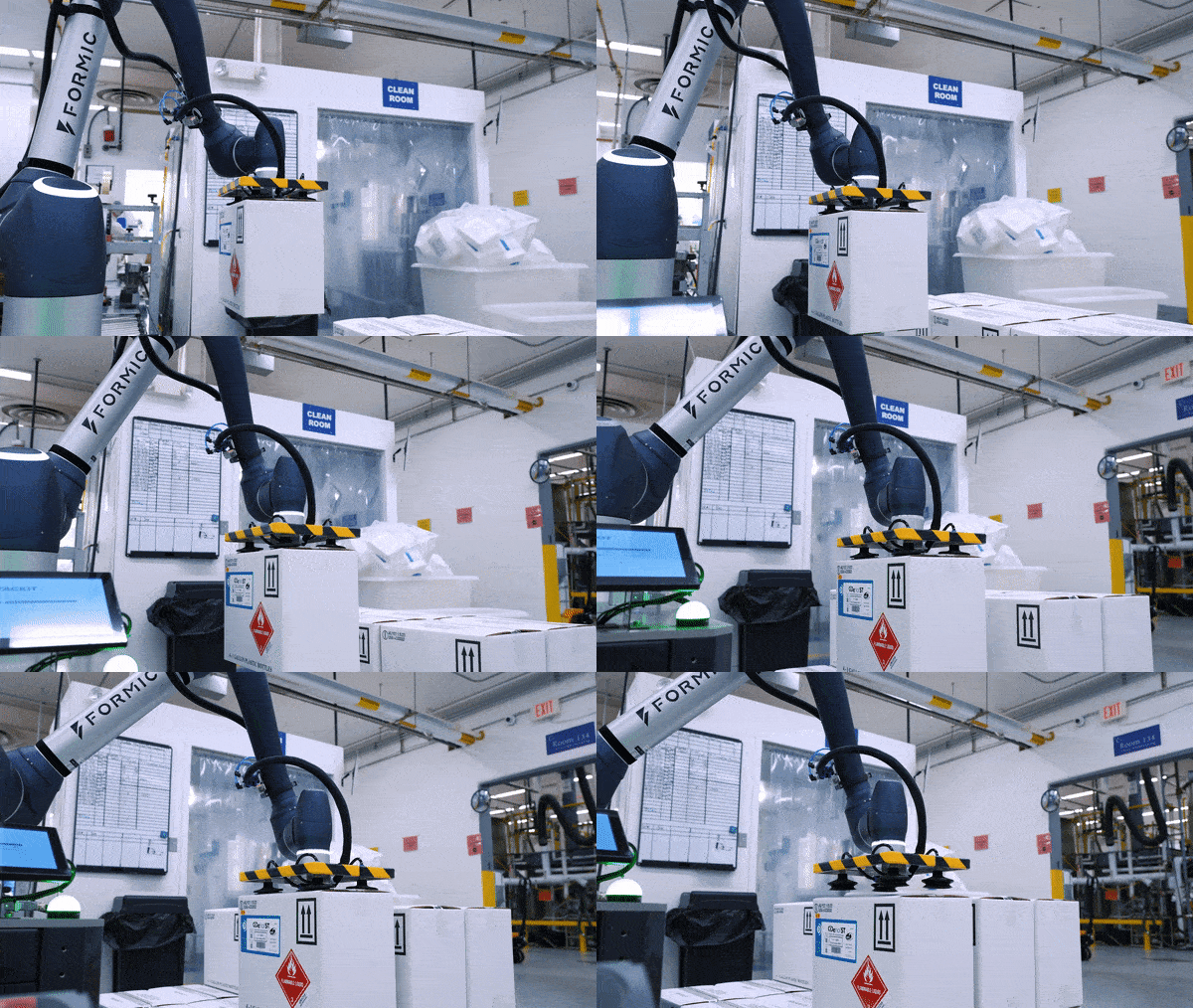
Figure 4. Robotic palletizing remains one of the most widely adopted Robotics-as-a-Service applications across manufacturing and logistics industries.
The Future of Robotics-as-a-Service
The Robotics-as-a-Service market remains in its early stages, but growth continues accelerating across virtually every industrial sector.
Advances in artificial intelligence, machine vision, autonomous robotics, cloud computing, and industrial networking are expanding the range of tasks that can be automated through subscription-based models.
Future RaaS deployments will likely include:
- AI-powered quality inspection
- Autonomous material transport
- Adaptive machine tending
- Collaborative robotic assembly
- Predictive process optimization
- Real-time production analytics
As these technologies mature, manufacturers will gain access to increasingly sophisticated automation capabilities without requiring massive capital investments.
The distinction between automation ownership and automation consumption will continue to blur.
Manufacturers will increasingly focus on purchasing productivity outcomes rather than purchasing equipment.
Conclusion
Robotics-as-a-Service represents more than a new financing model. It fundamentally changes how manufacturers approach automation strategy.
By shifting financial, technical, and operational risks to specialized automation providers, RaaS enables organizations to deploy robotics faster, reduce implementation complexity, and improve operational flexibility.
For manufacturers facing labor shortages, rising costs, and increasing competitive pressures, the ability to access advanced automation through a subscription model can provide significant advantages.
Whether applied to palletizing, machine tending, packaging, injection molding, inspection, or material handling, Robotics-as-a-Service offers a practical pathway toward modern industrial automation.
As Industry 4.0 initiatives continue expanding and workforce challenges persist, RaaS is positioned to become one of the most influential automation models shaping the future of manufacturing.