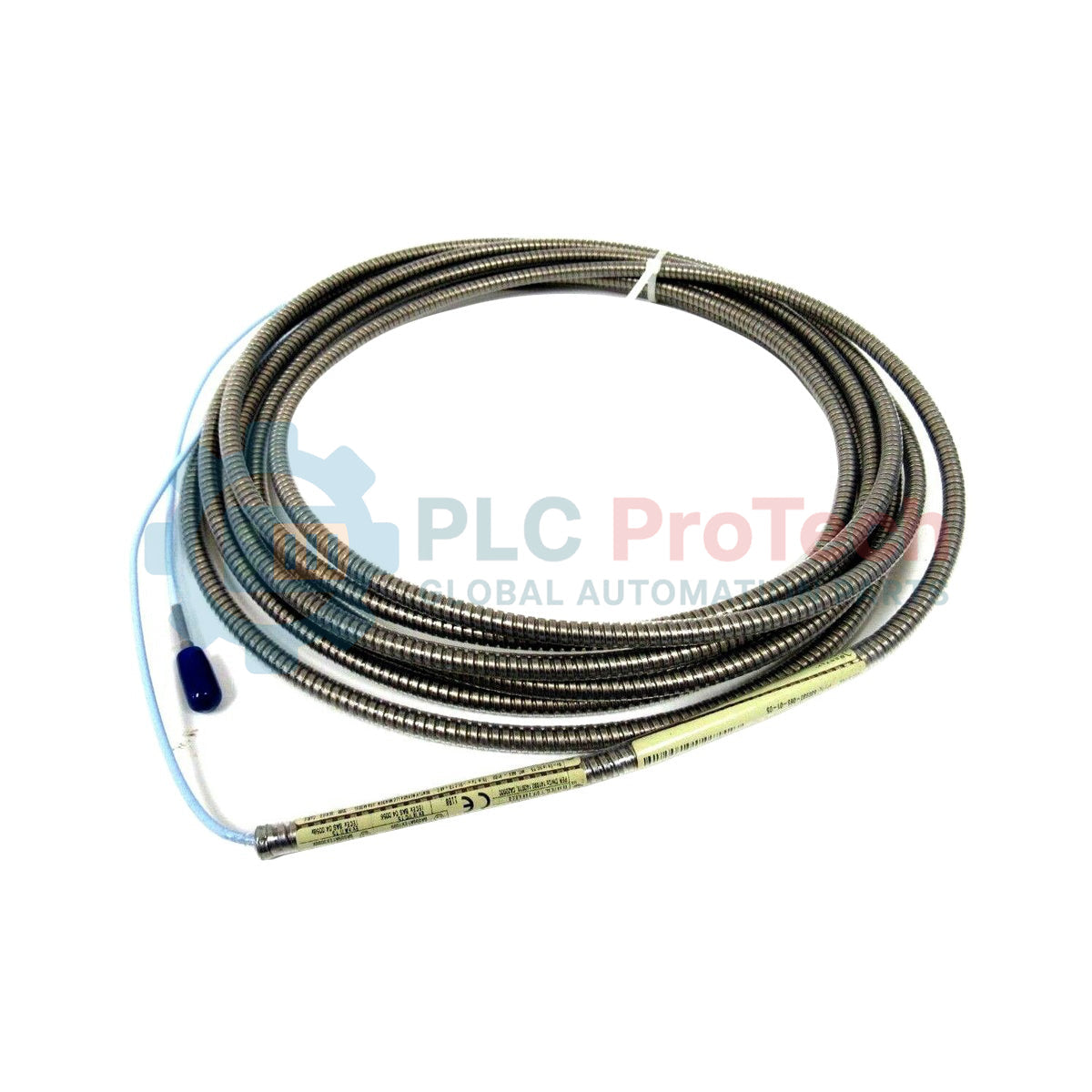
The 3300 NSv Extension Cable provides vital electrical connection and signal path routing within the 3300 XL NSv Proximity Transducer System. This specialized coaxial line interfaces between a non-contacting 3300 NSv proximity probe and its matching 3300 XL NSv Proximitor Sensor to accurately relay eddy-current displacement signals. The 3300 XL NSv system is specifically intended for compact machinery applications, including centrifugal process air compressors, refrigeration compressors, and high-density installations exhibiting narrow side-view or counterbore clearances where standard systems face space constraints.
This specific product number 330930-065-00-CN designates a 6.5-metre layout variant built without defensive stainless steel armor plating, featuring hazardous area certification compliant with specialized regulatory standards for the China regional market. To maintain robust signal path integrity without physical shifting, the hardware features integrated gold-plated brass ClickLoc coaxial connectors on both terminal points that click-lock securely to prevent connections from loosening under sustained machine resonance. Utilizing a tailored 75-ohm impedance profile coupled with fluoroethylene propylene insulation, this component acts as a highly stable data transmission channel for precise mechanical vibration loops within safety and critical asset-monitoring infrastructure.
Features
ClickLoc Coaxial Connectors: Uses premium gold-plated brass hardware that positive-locks into place, ensuring continuous contact and preventing separation in high-vibration fields.
High-Grade FEP Insulation: Formulated with fluoroethylene propylene shielding to provide superior chemical and thermal resilience within challenging industrial oil and gas environments.
Matched System Impedance: Features an engineered 75-ohm characteristic design that matches the baseline requirements of the proximity probe to protect signal linearity across the loop.
Broad Temperature Stability: Rated to withstand demanding environmental swings without altering electrical capacitance or inducing scale-factor drifts.
Applications
Centrifugal air compressors, process gas machinery, and refrigeration compression units.
High-density rotating machinery instrumentation featuring tight physical constraints or narrow shaft targets smaller than 51 mm.
Machinery monitoring networks measuring radial vibration, axial thrust positioning, or zero-speed tachometer inputs within hazardous industrial zones requiring localized country-specific compliance.
Ordering Information
Model Code
Description
330930
3300 NSv Extension Cable
-065
Cable Length Option: 6.5 metres (21.3 feet)
-00
Connector and Cable Option: Without stainless steel armor
-CN
Agency Approval Option: Approvals country specific (China Approvals covering CCC/NEPSI requirements)
Technical Specifications
Category
Parameter
Specification
Electrical
Extension Cable Impedance
75 ohm
Center Conductor DC Resistance
0.220 ohms/m (0.067 ohms/ft)
Shield DC Resistance
0.066 ohms/m (0.020 ohms/ft)
Extension Cable Capacitance
69.9 pF/m (21.3 pF/ft) typical
Environmental
Operating Temperature
-51 Celsius to +177 Celsius (-60 Fahrenheit to +351 Fahrenheit)
Storage Temperature
-51 Celsius to +177 Celsius (-60 Fahrenheit to +351 Fahrenheit)
Relative Humidity
100% condensing, non-submersible when connectors are protected
Mechanical
Extension Cable Material
Coaxial, fluoroethylene propylene (FEP) insulated
Connector Material
Gold-plated brass
Connector Type
ClickLoc miniature coaxial connectors
Cable Length
6.5 metres (21.3 feet)
Minimum Bend Radius
25.4 mm (1.0 in)
Maximum Rated Tensile Strength
220 N (50 lb) at lead-to-extension cable connectors
Cable Weight (Typical)
45 g/m (0.5 oz/ft)
Shipping Weight
1.5 kg
Manufacturer
Bently Nevada (A Baker Hughes Company)
Country of Origin
USA
Installation Guidelines
Total Length Matching: Ensure that the combined physical length of your chosen extension cable and proximity probe equals the pre-calibrated baseline of the associated Proximitor Sensor (typically 5 or 7 meters total system length).
Connector Care and Protection: Keep the miniature ClickLoc terminals clear of grease, solvents, and ambient dust before clicking them shut. It is recommended to apply a connector protector or wrap the joint in specialized silicone tape to block industrial moisture entry.
Avoid Turbine Oil Submersion: Do not deploy standard silicone-taped connections in internal machinery zones where the junctions are continuously exposed to moving turbine lubricating fluids.
Bend Radius Constraints: Maintain a clean routing path that adheres strictly to the minimum bend constraint of 25.4 mm to prevent kinks, shielding cracks, or conductor attenuation.
Cable Routing Separation: Separate the sensor signal line from adjacent high-voltage or variable-frequency drive power conduits to minimize stray electromagnetic or electrostatic background noise cross-talk.
Compliance and Certifications
Hazardous Area Approvals: Authorized under option code -CN to cover specialized NEPSI/CCC requirements for installation in hazardous industrial zones.
Additional Standards: Incorporates underlying ATEX/IECEx hazardous area markings and rating frameworks on the product nameplate as applicable.
FAQ
What does the -CN suffix indicate for this proximity extension cable?
The -CN suffix indicates a specialized regional approval variant tailored for the China market. It ensures compliance with mandatory CCC and NEPSI hazardous area safety standards while maintaining core alignment with international ATEX/IECEx parameters.
Can this unarmored cable version be substituted directly into a layout requiring stainless steel armor?
The underlying electrical properties are identical, but this model lacks the physical armor spiral shroud. If your application paths leave the cable bare to falling debris or sharp metal edges, an armored variant or a standalone protective conduit path is required.
What happens if the combined length of my probe and extension cable exceeds the calibrated sensor specification?
Using unmatched total system lengths will alter the baseline electrical capacitance and inductance properties of the instrumentation loop. This skews the Average Scale Factor, leading to inaccurate machine displacement and vibration readings.
Modern robotic grippers are evolving beyond traditional mechanical jaws. From gecko-inspired adhesive systems and soft food-grade grippers to AI-powered warehouse tools, advanced gripping...
From rope-driven DC compressors to battery-powered mine carts, early mining operations marked a turning point in industrial electrification. This article explores how electric motors transformed...
Factory I/O is transforming PLC education by delivering immersive 3D industrial simulations for students, engineers, and maintenance teams. The platform bridges the gap between theory and real-world...
This tutorial examines how onboard PLC functionality inside a CMZ SBD servo drive can execute standalone motion programs, including homing logic, position control, and cyclic axis movement without an...
This tutorial explores the commissioning of a single-axis servo motion system using a CMZ SBD drive, covering hardware setup, axis scaling, homing configuration, and safe motion verification for...
This tutorial explains how Mitsubishi FX PLCs integrate with FR-D700 VFDs and HMI panels for forward/reverse motor control. It covers wiring logic, parameter configuration, ladder programming, and...
Choosing a selection results in a full page refresh.