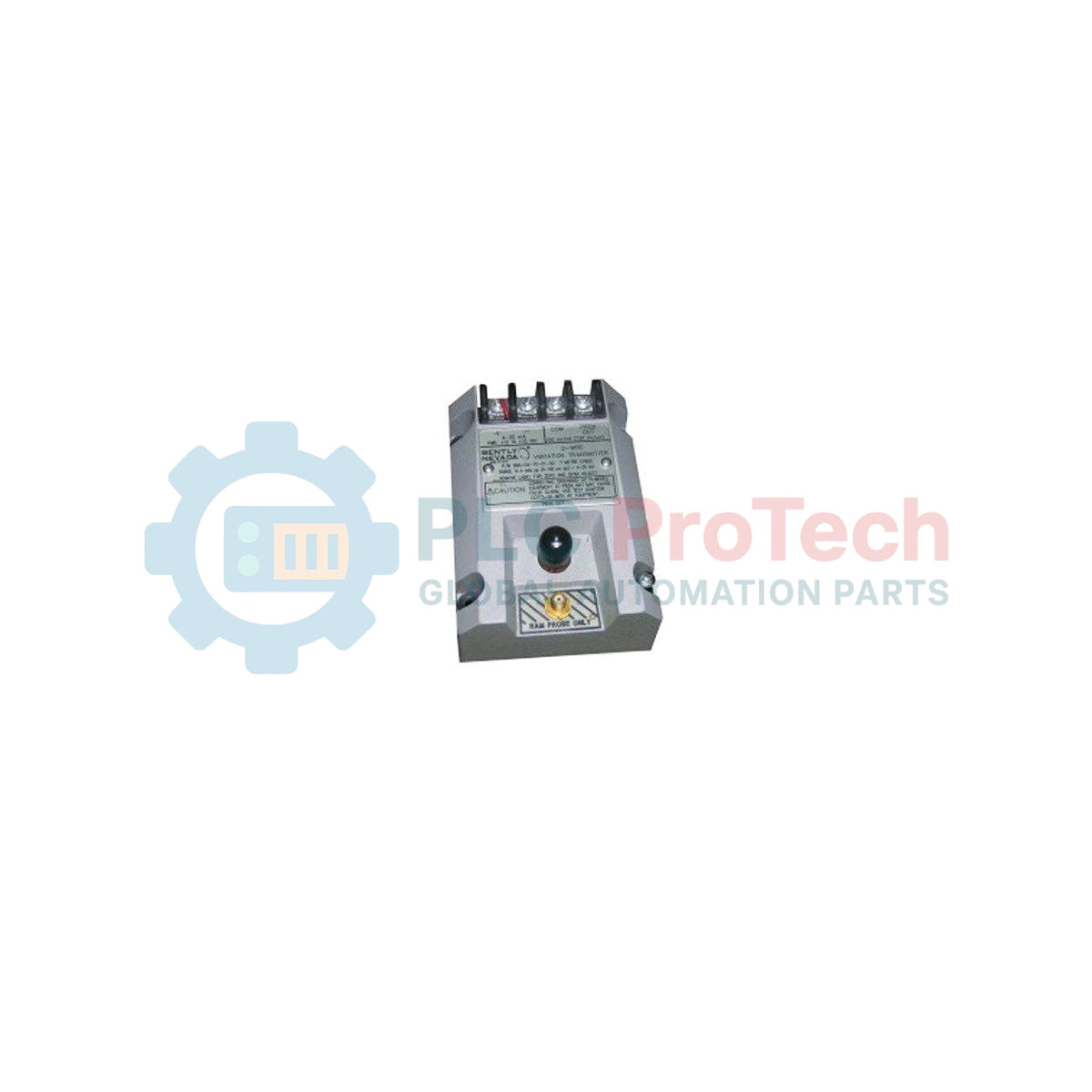
The 990 Vibration Transmitter is a loop-powered, two-wire vibration measurement device designed for direct integration with machinery protection or condition monitoring systems in rotating equipment applications such as compressors, pumps, motors, and fans. It converts radial vibration sensed by a 3300 NSv proximity probe system into a proportional 4–20 mA signal representing peak-to-peak vibration amplitude, enabling continuous monitoring at the control system level.
This transmitter is typically applied where simplified vibration indication is required without full diagnostic vibration analysis capability. It incorporates an internal Proximitor-style signal conditioning stage, eliminating the need for an external driver module.
The 990-05-50-01-CN configuration defines a 0–5 mils peak-to-peak measurement range, a 5.0 meter system length, DIN rail mounting hardware, and region-specific approval marking for installation in regulated environments.
A secondary diagnostic output is available via PROX OUT interface, allowing access to raw vibration signal for troubleshooting using compatible test equipment with proper isolation.
Features
Two-wire loop powered vibration transmitter (4–20 mA output)
Compatible with 3300 NSv proximity probe system
Internal signal conditioning (no external Proximitor required)
Peak-to-peak vibration amplitude output
PROX OUT diagnostic signal access available
Non-interacting zero and span adjustment
Power-up inhibit and NOT OK signal protection behavior
DIN rail mounting hardware included
Bulkhead mounting alternative available (variant dependent)
Potted housing for high humidity environments
Applications
Centrifugal air compressors
Small centrifugal pumps
Electric motors
Industrial cooling fans
OEM packaged rotating machinery
Auxiliary machinery vibration trending
Basic protection input to control systems
Technical Specifications
Parameter
Value
Manufacturer
Bently Nevada
Product Type
2-Wire Vibration Transmitter
Model
990-05-50-01-CN
Input
3300 NSv proximity probe system
Output Signal
4–20 mA proportional vibration
Measurement Range
0–5 mils pp (0–100 µm pp)
System Length
5.0 m (16.4 ft)
Power Supply
+12 to +35 Vdc
Loop Resistance
Up to 1000 ohm (including cable)
Frequency Response
5 Hz to 6000 Hz
Operating Temperature
-35 C to +85 C
Storage Temperature
-52 C to +100 C
Relative Humidity
100% condensing (non-submerged)
Transmitter Weight
0.43 kg
Total System Weight
0.82 kg
Housing Material
Potted industrial enclosure
Probe Case Material
AISI 303 / 304 stainless steel
Probe Cable
75 ohm FEP insulated coaxial
Tensile Strength
222 N (50 lbf)
Minimum Target Size
9.5 mm diameter
Connections / Interfaces
Connector / Terminal
Function
PROX OUT
Raw vibration signal output (diagnostic use)
COM
Common reference
Loop +
4–20 mA loop power input/output
Test Input
Signal verification input
Installation Guidelines
Install the transmitter on a stable panel or DIN rail with minimal mechanical vibration influence. Maintain correct probe gap between 0.5 mm and 1.75 mm to ensure linear operation. Use shielded coaxial cable routing for probe signal integrity. Avoid running probe cables parallel to high-voltage power lines to reduce EMI coupling.
For PROX OUT diagnostic usage, apply proper signal isolation when connecting to grounded test instruments. Ensure enclosure sealing is maintained in high humidity environments.
FAQ
Is this transmitter suitable for vibration diagnostics? It is designed for basic vibration monitoring and trending, not full diagnostic analysis.
Does it require an external signal conditioner? No, the signal conditioning is integrated inside the transmitter.
What probe type is supported? It is designed for use with the 3300 NSv proximity probe system.
Can PROX OUT be used directly on oscilloscope? Yes, but isolation is recommended when using grounded test equipment.
What happens during probe failure? The output enters NOT OK condition and drops below 3.6 mA to indicate fault.
Is this suitable for critical turbine monitoring? No, it is intended for non-critical or auxiliary machinery applications.
Maintenance data connects work orders, sensor signals, asset history, costs, and technician knowledge. Used well, it improves planning, reliability, predictive maintenance, spare-parts control, and...
This article explains how integrated electric actuators, such as SMC’s e-Actuator series, are transforming industrial motion control by replacing traditional pneumatic and hydraulic systems. It...
This article explains how PLC systems perform core mathematical operations such as addition, subtraction, multiplication, division, modulo, and exponentiation within industrial automation. It shows...
The article explains several advanced Boolean logic functions used in PLC programming beyond basic AND, OR, and NOT operations. It covers how tools like truth tables, multiplexers, pulse generators,...
Boolean logic is the foundation of every PLC program. From simple machine controls to complex industrial automation systems, logic gates determine how controllers respond to changing inputs and...
Industrial firewalls play a critical role in OT cybersecurity, protecting PLC, DCS, and SCADA networks through segmentation, ingress/egress control, and IDS/IPS integration aligned with IEC 62443...
Choosing a selection results in a full page refresh.