Product Overview
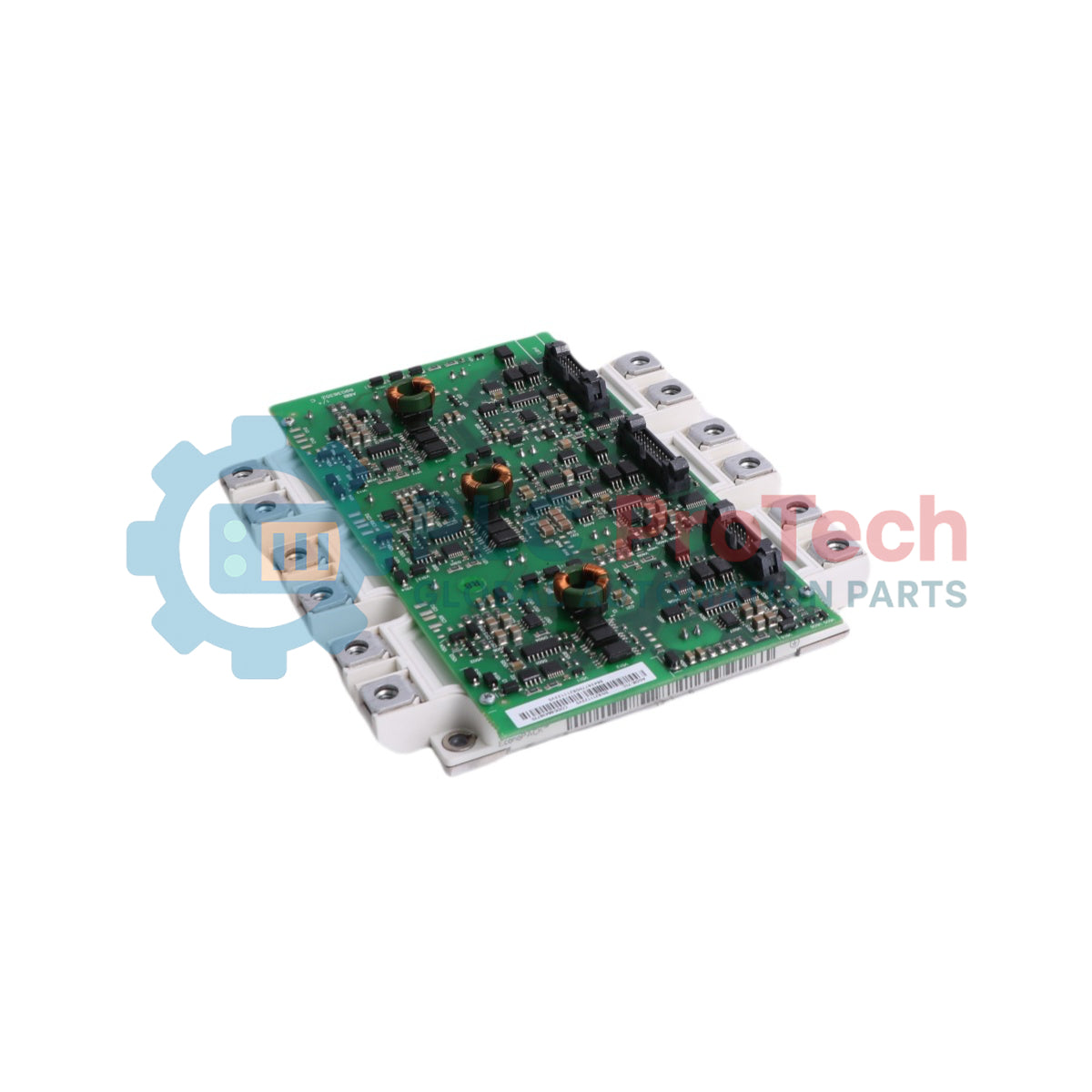
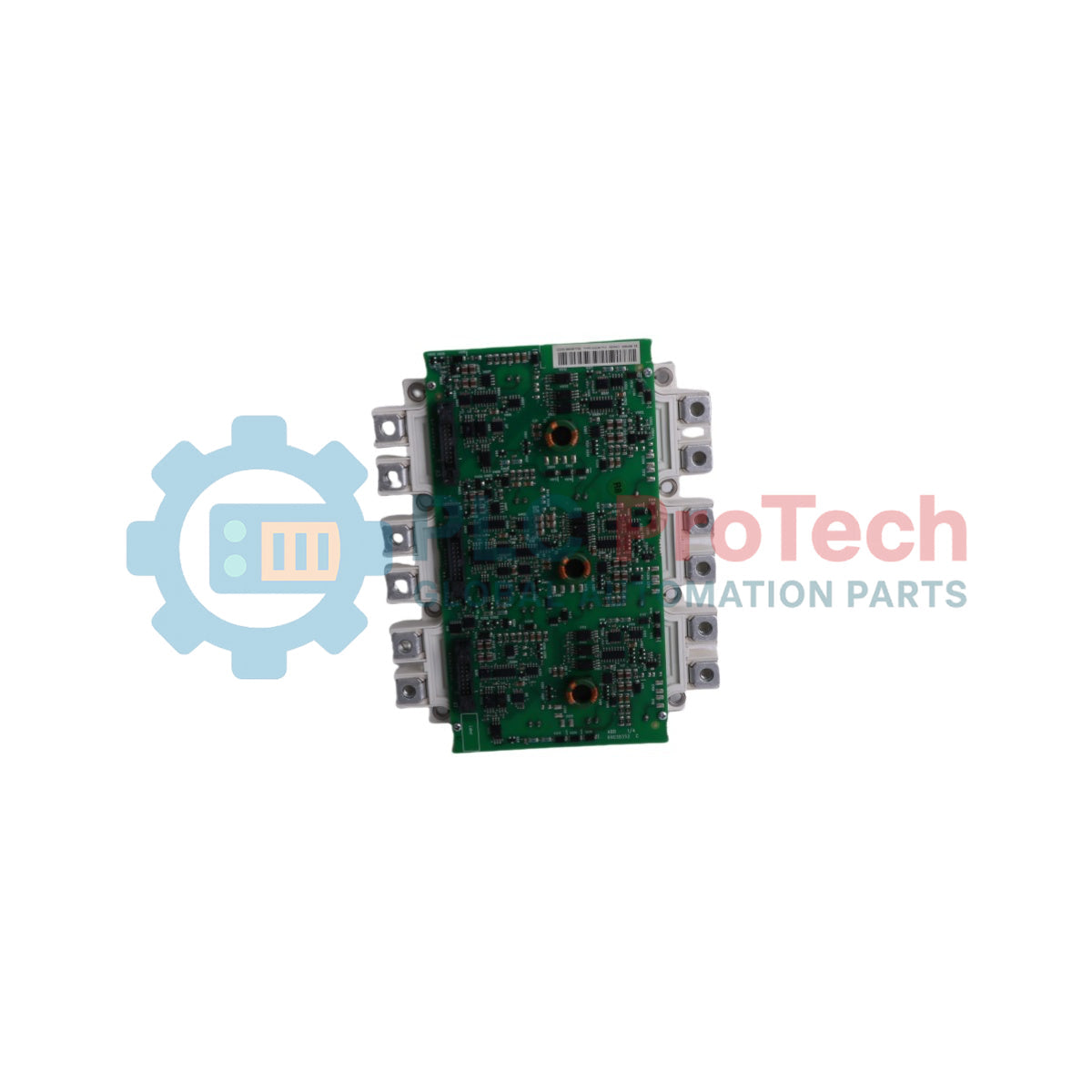
The FS450R17KE3/AGDR-72CS is a high-performance power semiconductor assembly designed for the ABB ACS800 series industrial frequency converters. This critical component functions as the "muscle and brain" of the inverter stage, pairing a high-capacity Infineon IGBT module with a precision-tuned ABB AGDR-72CS gate driver board. Engineered for heavy-duty 690 VAC industrial networks, the FS450R17KE3/AGDR-72CS is frequently utilized in high-demand sectors such as offshore oil and gas, deep-pit mining, and maritime propulsion. By providing 1700 V isolation and 450 A continuous current handling, this assembly ensures superior torque control and energy efficiency. Replacing aged or faulty modules with genuine ABB-integrated assemblies is vital for preventing catastrophic phase-to-ground faults and ensuring maximum uptime in critical process control applications.
Technical Configuration
The assembly utilizes a 6-pack topology, meaning a single unit houses the complete three-phase inverter bridge. The hardware configuration is optimized for high-speed switching with minimal electromagnetic interference:
-
Integrated Driver Interface: The AGDR-72CS board is directly "stitched" to the IGBT pins, eliminating parasitic inductance that typically causes voltage spikes.
-
Fiber Optic Communication: Utilizes V1 and V2 fiber optic connectors for control signaling, providing total electrical isolation between the high-voltage power stage and the low-voltage control unit.
-
Protection Logic: The driver board monitors the Collector-Emitter voltage (Vce) in real-time, executing an immediate hardware-level shutdown if a desaturation (short circuit) event is detected.
-
Tailored Gate Charge: Unlike generic boards, the AGDR-72CS is calibrated specifically for the 450 A gate charge (Qg) characteristics of the FS450R17KE3 module to optimize switching losses.
Technical Specifications
| Attribute |
Specification |
| Model |
FS450R17KE3/AGDR-72CS |
| Brand |
ABB |
| Collector-Emitter Voltage (Vces) |
1700 V |
| Continuous DC Current (Ic) |
450 A (at Tc = 80 deg C) |
| Peak Collector Current (Icrm) |
900 A |
| Total Power Dissipation (Ptot) |
2250 W |
| Gate-Emitter Voltage (Vges) |
+/- 20 V |
| Interface Type |
Fiber Optic (V1/V2) |
| Operating Temperature |
-40 to +125 deg C (Junction) |
| Origin |
Germany / Finland |
| Weight |
Approx. 1.2 kg |
Engineering Support FAQs
Why did my drive show a "Short Circuit" fault after replacing the module?
This typically indicates the AGDR board detected that the IGBT voltage (Vce) remained too high while in the "ON" state. This can be caused by an external load short, or more commonly, by "dry" thermal paste causing the module to overheat and fail almost instantly upon load application.
Can I reuse an existing AGDR-72CS board with a new FS450R17KE3 IGBT?
It is not recommended. When an IGBT fails, the high-voltage collector potential often leaks into the gate pins, causing collateral damage to the driver board's optocouplers and resistors. For reliability, always replace the assembly as a matched pair.
Is the AGDR-72CS interchangeable with the AGDR-61C?
No. Every driver board is specifically tuned to the gate charge (Qg) of its corresponding IGBT. Utilizing a mismatched board will result in incorrect switching times, leading to excessive heat generation and eventual module destruction.
Field Installation and Maintenance Guide
-
Thermal Interface Management: Surface preparation is the single most important step. Clean the heatsink with isopropyl alcohol until it is free of all residues. Apply a uniform layer of high-quality thermal grease to the module baseplate at a target thickness of 100 microns (0.1 mm). Excessive grease acts as an insulator rather than a conductor, leading to thermal runaway.
-
Mechanical Torquing: Place the module on the heatsink and tighten the mounting screws in a diagonal cross-pattern. Use a calibrated torque wrench set to 3.0 to 6.0 Nm. This ensures even pressure across the baseplate, preventing mechanical stress on the internal ceramic substrates.
-
Fiber Optic Handling: When connecting the V1/V2 fiber cables, ensure the ports are clean. Never bend fiber optic cables at a radius smaller than 25 mm. Sharp bends cause signal attenuation, which may lead to erratic switching or "Gate Driver" faults.
-
Preventative Replacement: If a drive unit has been in continuous service for more than 5 years, the thermal grease may have carbonized or dried. Periodic inspection of the grease and cleaning of the optical ports are essential maintenance tasks to prevent unexpected failures.