


Troubleshooting Beckhoff EPP2008-0001 Output Faults
A field checklist for EPP2008-0001 current limits, supply voltage, channel LEDs, connector coding and load-related output faults.
Manufacturer: Delta Electronics
Product No.: ASD-A2-0721-E
Country of origin:United States
Product Type: AC Servo Drive ASDA-A2 Series
Payment: T/T, Western Union
Weight: 2000g
Shipping port: Xiamen
Warranty: 12 months
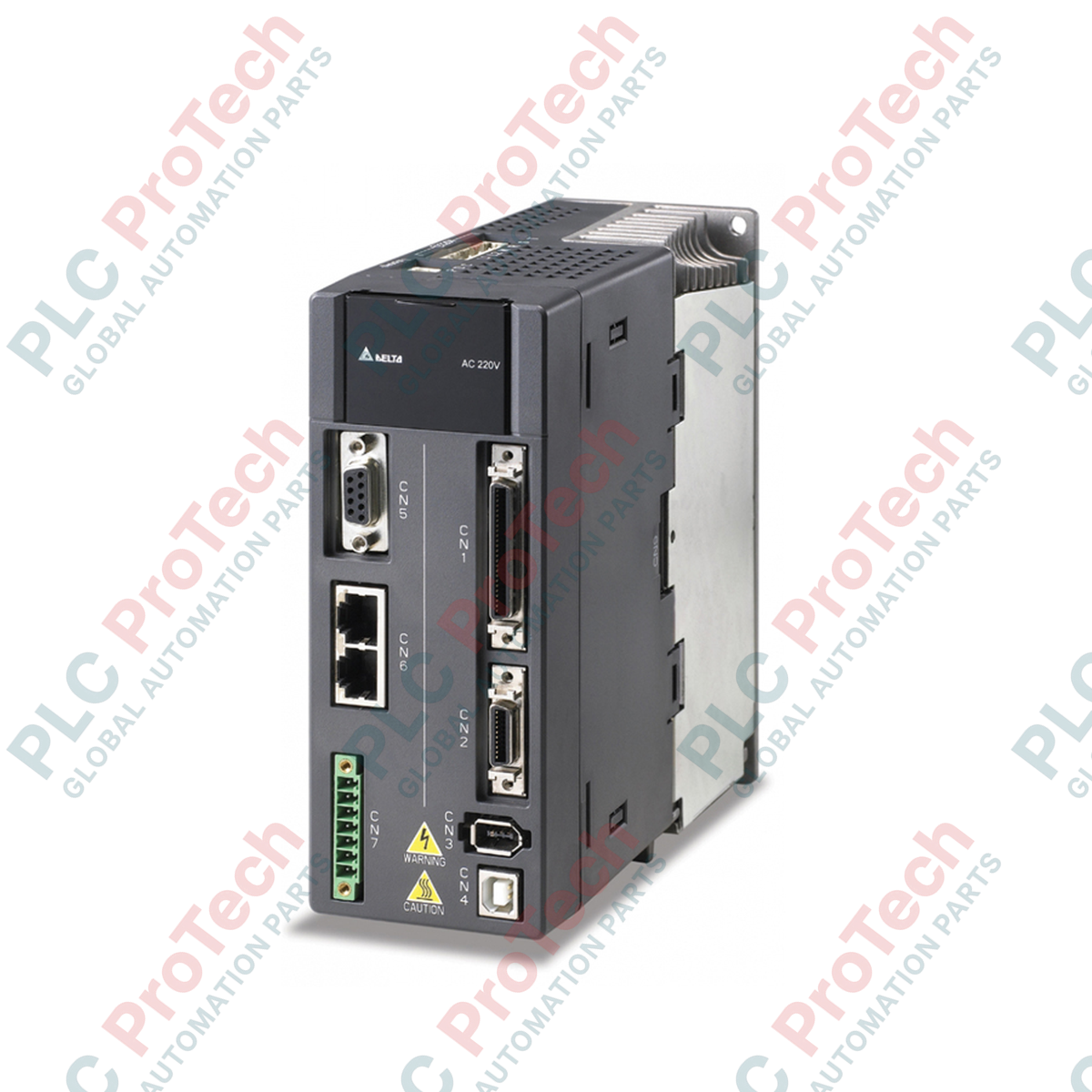
The ASD-A2-0721-E (ASDA20721E) is a premier 750 W AC Servo Drive from Delta’s high-performance ASDA-A2 series. Designed for precision motion control in 220 V single-phase or three-phase environments, the "E" type model is a specialized version featuring an integrated EtherCAT communication interface. This allows the drive to serve as a high-speed slave node in complex, synchronized multi-axis systems controlled by a PC-based or dedicated EtherCAT master. With advanced features such as electronic cam (E-CAM) profiles, high-resolution encoder support, and dual-loop control, the ASD-A2-0721-E is the industry standard for high-speed packaging, automated assembly, and semiconductor processing equipment.
The ASD-A2-0721-E is engineered for the demands of Industry 4.0. The EtherCAT interface supports the CoE (CANoverEtherCAT) protocol with a minimum cycle time of 250 $\mu s$, ensuring near-instantaneous response to master commands. The drive supports 20-bit resolution feedback (1,280,000 pulses/rev), providing the smoothness required for high-precision finishes and stable low-speed operation. It also includes an auxiliary encoder interface for Full-Closed Loop Control, which allows the drive to read position data directly from a linear scale to eliminate mechanical backlash. Built-in vibration suppression and notch filters automatically identify and neutralize mechanical resonance, ensuring stable performance even at high gains.
| Attribute | Specification Details |
| Model | ASD-A2-0721-E |
| Brand | DELTA |
| Series | ASDA-A2 Series |
| Rated Output Power | 750 W |
| Input Voltage | 200 to 230 VAC, 1-Phase / 3-Phase |
| Model Type | E (EtherCAT) |
| Communication | EtherCAT (CoE), RS-232 / RS-485 |
| Encoder Feedback | 20-bit (1,280,000 p/rev) |
| Control Mode | Position / Speed / Torque (via EtherCAT) |
| Digital Inputs/Outputs | 8 Inputs / 5 Outputs |
| Second Encoder | Supported (Full-Closed Loop) |
| Dimensions | 100 mm x 188 mm x 186 mm |
| Weight | 2.0 kg |
| Shipping Weight | 4.0 kg |
What are the specific advantages of the "E" type EtherCAT model?
The EtherCAT interface provides a massive leap in data throughput and synchronization compared to traditional pulse-train or Modbus control. It allows for "Distributed Clock" (DC) synchronization, ensuring that all axes in a multi-axis machine move at the exact same microsecond, which is essential for high-speed contouring and coordinated motion.
Can the ASD-A2-0721-E perform E-CAM functions over EtherCAT?
Yes. While the master controller typically handles trajectories, the ASD-A2-0721-E can store internal E-CAM tables. This is highly effective for "Flying Shear" or "Rotary Cut" applications where the drive can execute a complex slave curve based on an EtherCAT master position, reducing the communication load on the network.
Is it possible to use this drive with a third-party EtherCAT master?
Yes. Delta’s A2-E series follows the standard CiA402 drive profile. This makes it compatible with various EtherCAT masters, including Beckhoff (TwinCAT), OMRON (Sysmac), and PC-based controllers using specialized EtherCAT stacks.
EtherCAT Cabling: For stable high-speed communication, use Category 5e (or higher) shielded twisted-pair (SF/UTP) cables. Ensure the cable length between nodes does not exceed 100 meters. Always use the "IN" and "OUT" ports correctly to maintain the EtherCAT daisy-chain topology.
Backlash Compensation: If your system uses a gearbox or lead screw with play, utilize the Full-Closed Loop interface. Connect a linear scale to the CN6 port. This allows the drive to use the motor encoder for velocity control and the linear scale for final position verification, ensuring the 750 W output is applied precisely where the load needs it.
Grounding and Noise: Because EtherCAT is sensitive to high-frequency noise, ensure the drive is mounted to a grounded metal backplate. The motor power cable should be shielded, and the shield should be clamped 360° to the ground plate near the drive to prevent EMI from disrupting the Ethernet telegrams.

Global Express Shipping
Returns & Warranty


Global Express Shipping
Returns & Warranty
Orders are processed and delivered Monday-Friday (excluding public holidays).
For full eligibility, restocking fees, and international return details, please view our official Refund & Return Policy .
| Color pattern |
Greyish White
|
| Country of origin |
United States
|

A field checklist for EPP2008-0001 current limits, supply voltage, channel LEDs, connector coding and load-related output faults.

Before moving a TwinCAT 3 license with a Beckhoff C9900-L100, verify the TwinCAT build, XML device description, exact order code and cabinet limits.

A field checklist for replacing a Beckhoff EL4032, covering the ±10 V load, terminal map, power contacts, EtherCAT state, and watchdog behavior.

Before replacing a Yokogawa AAI835, verify the 4-in/4-out channel map, power-loss loop behavior, barrier type, output load, cable, and redundancy.

ABB PM891K01 article 3BSE053241R1 is the non-redundant AC 800M processor kit. Use this field checklist before replacement.

Replacement checks for ABB TP853 3BSE018126R1: identify the installed CI853, CI855, CI857, or CI861 interface, record wiring, and verify communication after installation.