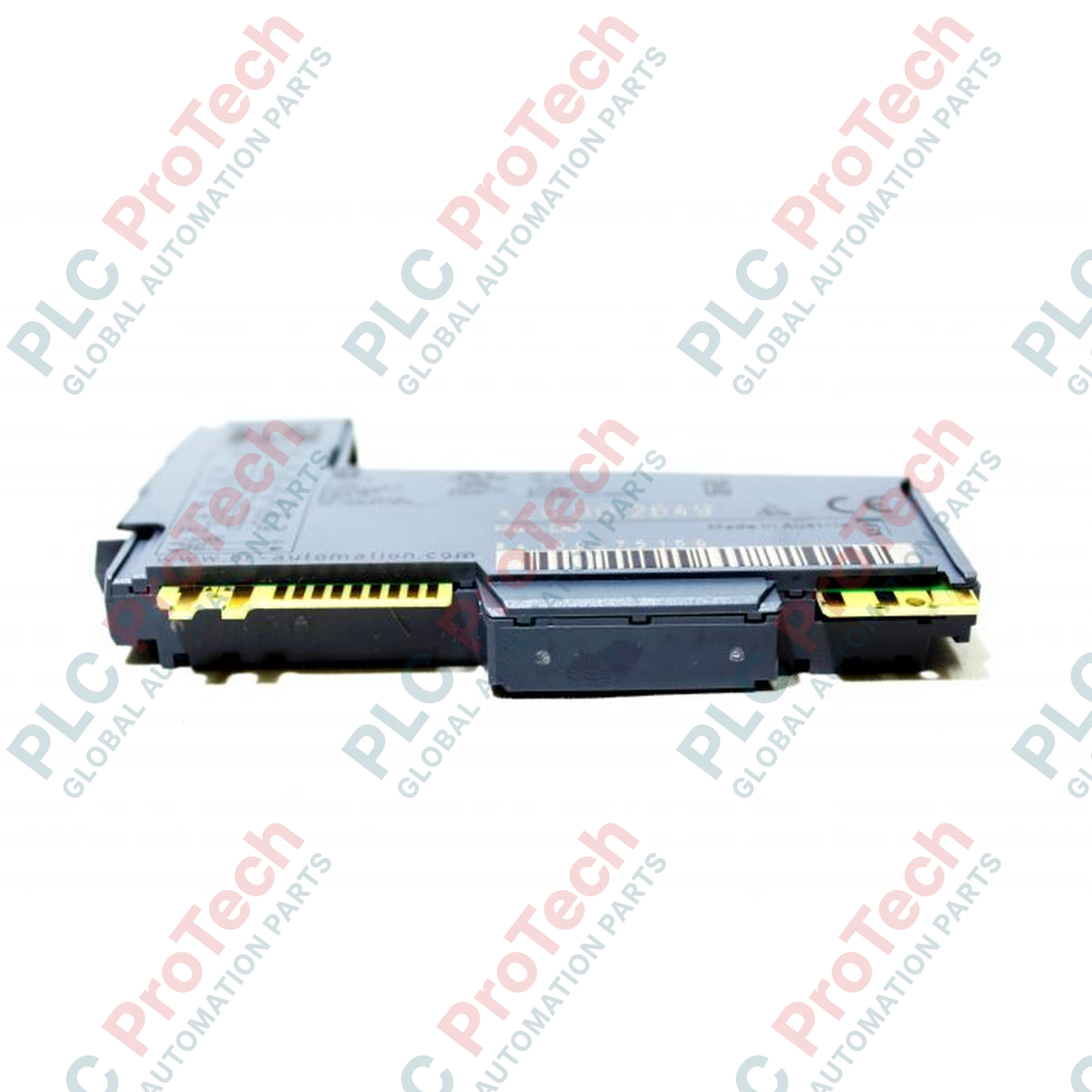
Technical Overview and Plant Value
The X20DO2649 (X20DO2649) functions as a highly reliable digital relay output expansion block within the modular B&R X20 control topology. Designed to handle electrical isolation between low-voltage processing logic and heavy-duty field actuators, this module controls discrete channels in power generation plants, water treatment facilities, and metallurgical processing lines. It features two independent relay outputs with change-over contacts, allowing it to switch load currents up to 5 A at 230 VAC or 30 VDC. This capability removes the need for external interposing relays when managing low-power motors, contactors, solenoid coils, or indicator arrays. Single-channel isolation cuts electrical noise transfer across the system backplane, ensuring stable system runtimes and reducing unplanned downtime caused by ground loop faults.
System Interface and Functional Architecture
Operating under the official B&R ID code 0x20DA, the hardware links directly to the local controller or decentralized node through the X20 backplane bus, drawing a low 0.45 W of internal bus power. The primary design highlights dual-channel electrical isolation, providing a separate circuit path for each switching contact to safely handle mixed voltages or independent phases on a single module slot. A group of physical diagnostic LEDs on the front interface provides real-time status updates, showing output switching status, continuous internal module health, and network communication states. The rugged physical housing installs onto standard DIN rails alongside standard X20 bus modules and terminal blocks.
Technical Engineering Specifications
| Parameter |
Specification Details |
| Model |
X20DO2649 |
| Brand |
B&R (Automation) |
| Origin |
Austria |
| Module Type |
Digital Relay Output Module |
| B&R ID Code |
0x20DA |
| Output Channels |
2 digital relay outputs |
| Contact Architecture |
Change-over (SPDT) configuration |
| Channel Isolation |
Single-channel galvanic isolation |
| Nominal Switching Voltage |
30 VDC / 240 VAC |
| Maximum Permissible Voltage |
110 VDC / 264 VAC |
| Continuous Current Rating |
5 A per channel |
| Bus Power Dissipation |
0.45 W |
| Internal I/O Consumption |
0 W (fully passive switching loops) |
| Diagnostic Indicators |
Local LED for I/O channel, run state, module fault |
| Housing Design |
Modular X20 inline structure |
| Ingress Protection |
IP20 |
| Net Structural Weight |
Approximately 0.09 kg |
| Shipping Weight |
1.5 kg |
| Operating Temperature Range |
0 to 55 deg C |
Common Operational Queries
Can this module switch a mix of 24 VDC control signals and 230 VAC mains loads simultaneously?
Yes. Because the two relay outputs feature single-channel isolation, their common lines are completely separate. This design allows you to run a 24 VDC pilot loop on channel 1 while switching an independent 230 VAC line contactor coil on channel 2 without electrical cross-talk or short circuits.
What precautions are required when switching highly inductive loads like solenoid valves?
Inductive loads generate high-voltage reverse EMF spikes during contact break cycles, which can cause arcing and shorten relay life. You must place an external snubber circuit across the load: use a freewheeling diode for VDC networks or an RC snubber network for VAC switching lines.
Does the module require configuration settings to adjust its internal I/O supply voltage?
No. The relay contacts are voltage-free and mechanically driven. The nominal 30 VDC / 240 VAC rating defines the physical contact constraints. The module switches any applied voltage within its zero to 110 VDC or zero to 264 VAC parameters without software modifications.
Field Engineering and Safety Directives
-
Arc Suppression and Contact Protection: When switching inductive coils at maximum rated current (5 A), add external protective components to prevent contact welding. For inductive AC circuits, connect a matched resistor-capacitor (RC) snubber directly parallel to the load. For DC circuits, use a fast-recovery flyback diode. This practice minimizes material migration on the gold-plated silver alloy contacts, ensuring long-term operational reliability.
-
Wiring Separation and Enclosure Noise Management: Keep high-voltage AC load lines separate from low-voltage DC communication wiring inside the wire ducting. Route the 230 VAC contact output wires away from the X2X Link backplane and nearby analog signal cables. This routing practice prevents electromagnetic noise from coupling into high-sensitivity measurement systems.
-
Terminal Torque and Visual Diagnostics: Use the matching B&R X20 front terminal block to land field conductors. Strip wires to the specified length and torque screw terminals properly to prevent localized overheating at high current draws. During commissioning, use the physical status LEDs to verify the output status against the PLC program logic, simplifying point-to-point wiring checks.