


Moving TwinCAT 3 Licenses with C9900-L100: Build and Device Checks
Before moving a TwinCAT 3 license with a Beckhoff C9900-L100, verify the TwinCAT build, XML device description, exact order code and cabinet limits.
Manufacturer: BECKHOFF
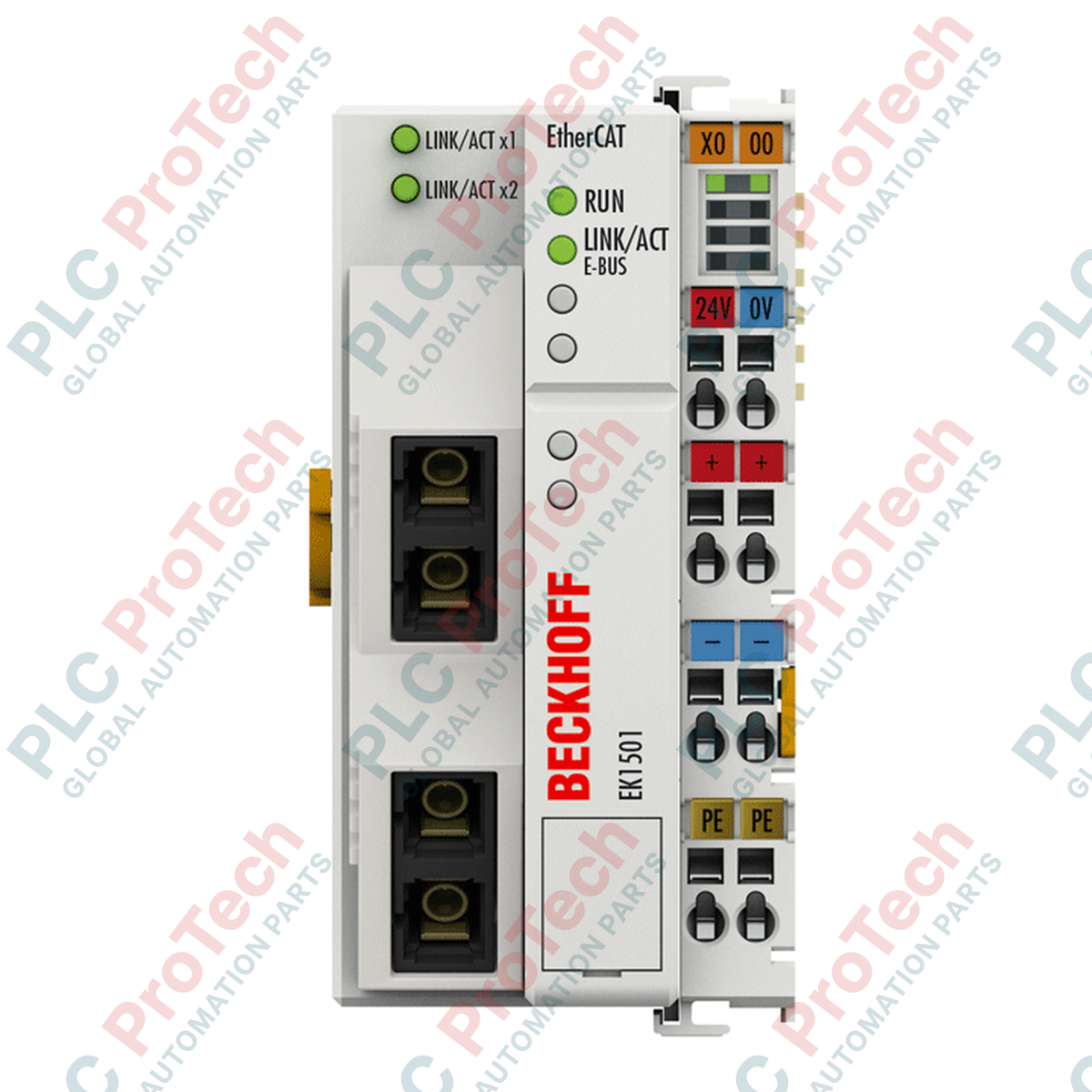
Product No.: EK1501
Country of origin:Germany
Product Type: EtherCAT Coupler with ID switch
Payment: T/T, Western Union
Weight: 2000g
Dimensions: 51 mm x 100 mm x 69 mm without connector
Shipping port: Xiamen
Warranty: 12 months
The EK1501 (EK1501) is a high-performance EtherCAT Coupler designed to bridge 100BASE-FX fiber optic networks with standard EtherCAT Terminals (ELxxxx). Engineered for large-scale industrial topologies, such as wind farms, sprawling logistics centers, and EMI-heavy manufacturing plants, this module utilizes multi-mode glass fiber (50/125 micrometers) to extend station distances up to 2000 m. The EK1501 features an integrated ID switch, allowing for the configuration of up to 4096 unique identities, which is essential for modular machine designs where the network topology may change dynamically. By utilizing fiber optic technology, it provides total immunity to electromagnetic interference and eliminates potential differences between distant segments, ensuring a robust and stable control architecture.
The EK1501 serves as the head station for an EtherCAT Terminal block, converting the optical 100BASE-FX signals to the internal E-bus signal representation. It features two SC Duplex interfaces, enabling flexible line or tree topologies. The hardware is equipped with three decimal rotary ID switches, enabling the assignment of a permanent "Hot Connect" group ID directly on the device. With an E-bus current supply of 2000 mA, the coupler can power a significant number of downstream I/O modules without requiring additional power feed terminals. Its 1-microsecond internal delay ensures that the high-speed deterministic performance of the EtherCAT protocol is maintained across long-distance fiber links.
| Feature | Specification |
| Model | EK1501 |
| Brand | BECKHOFF |
| Origin | Germany |
| Data Transfer Medium | Multi-mode glass fiber 50/125 micrometers (MM) |
| Max. Distance | 2000 m between stations |
| Bus Interface | 2 x SC Duplex |
| E-bus Current Supply | 2000 mA |
| Configurable IDs | 4096 (via rotary switch) |
| Power Supply | 24 VDC (-15 percent / +20 percent) |
| Data Transfer Rate | 100 Mbit/s |
| Dimensions (W x H x D) | 51 mm x 100 mm x 69 mm |
| Operating Temperature | -25 to +60 deg C |
| Weight | 0.19 kg |
How is the ID switch utilized in a TwinCAT environment?
The rotary switches on the EK1501 allow the user to set a unique identification value (0-4095). When the "Check Identification" feature is enabled in TwinCAT, the master verifies this ID before starting communication, ensuring the correct physical module is in the correct logical position in modular machine applications.
What is the advantage of SC Duplex fiber connections over standard RJ45?
Fiber optic connections provide complete galvanical isolation and are immune to electrical noise (EMI/RFI). This makes the EK1501 ideal for environments with heavy welding equipment, large frequency drives, or where cable runs must pass between different buildings with varying ground potentials.
Can I mix copper and fiber optic segments in the same network?
Yes. You can use an EK1100 (copper) at the main controller and transition to the EK1501 (fiber) for a long-distance run, or vice versa, provided the media converters or couplers match the 100BASE-FX standard.
Fiber Optic Handling: Ensure the SC Duplex connectors are kept clean. Use lint-free wipes and specialized optical cleaning fluid before insertion. Even microscopic dust on the fiber face can cause significant signal attenuation or link failure over long distances.
Bending Radius: When installing the multimode fiber in cable trays or conduits, adhere strictly to the manufacturer's minimum bending radius. Excessive bending can cause "micro-bends" in the glass core, leading to permanent signal loss and intermittent "CRC Error" flags in the EtherCAT master.
Power Distribution: The EK1501 provides up to 2000 mA to the E-bus. If your attached ELxxxx terminals exceed this total current draw (sum of E-bus currents), you must insert an EL9400 or EL9410 power supply terminal into the stack to refresh the E-bus power.
Thermal Management: When mounting on a 35 mm DIN rail, ensure vertical orientation to optimize airflow through the ventilation slots. If installed in an ATEX Zone 2 environment, ensure the enclosure meets the required IP54 rating as per EN 60079-15.

Global Express Shipping
Returns & Warranty
Global Express Shipping
Returns & Warranty
Orders are processed and delivered Monday-Friday (excluding public holidays).
For full eligibility, restocking fees, and international return details, please view our official Refund & Return Policy .
| Color pattern |
White
|
| Country of origin |
Germany
|

Before moving a TwinCAT 3 license with a Beckhoff C9900-L100, verify the TwinCAT build, XML device description, exact order code and cabinet limits.

A field checklist for replacing a Beckhoff EL4032, covering the ±10 V load, terminal map, power contacts, EtherCAT state, and watchdog behavior.

Before replacing a Yokogawa AAI835, verify the 4-in/4-out channel map, power-loss loop behavior, barrier type, output load, cable, and redundancy.

ABB PM891K01 article 3BSE053241R1 is the non-redundant AC 800M processor kit. Use this field checklist before replacement.

Replacement checks for ABB TP853 3BSE018126R1: identify the installed CI853, CI855, CI857, or CI861 interface, record wiring, and verify communication after installation.

Engineering checks for the Allen-Bradley 5069-L330ERMS2: controller capacity, separate RTB kits, local I/O limits, network-node limits, and motion-axis count.