Product Overview
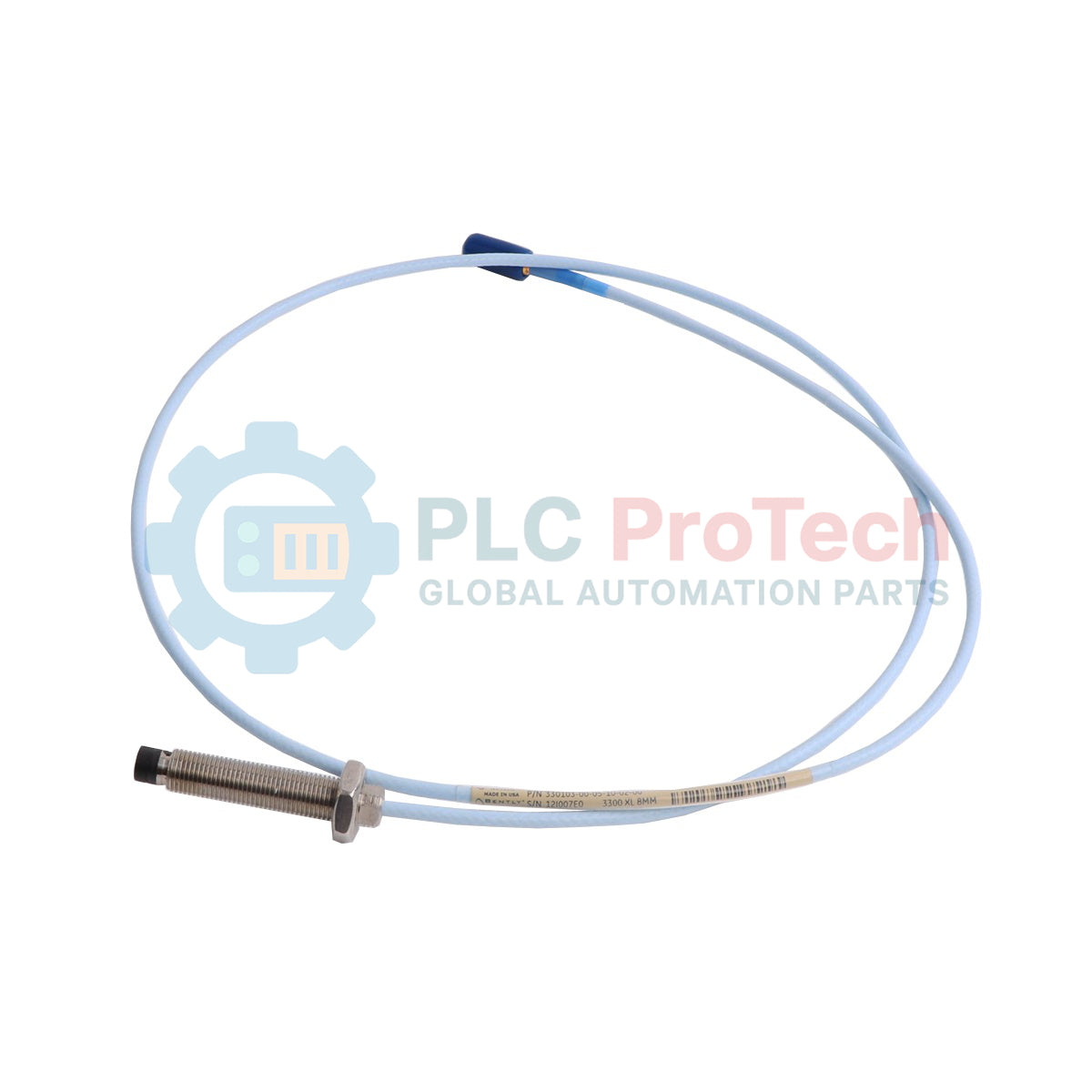
The Bently Nevada 330173-00-03-10-02-CN is a 5mm eddy current proximity transducer belonging to the 3300 series. This transducer is specifically engineered for applications where physical space constraints prevent the use of standard 8mm probes. It is primarily utilized in the monitoring of fluid-film bearing machines, including small turbines, compressors, and pumps, to measure radial vibration, axial thrust, and eccentricity.
The 5mm system is designed to provide a standard scale factor of 7.87 V/mm (200 mV/mil) when paired with a compatible 3300 XL Proximitor sensor and extension cable. This specific configuration features an M8 x 1 metric thread, a 30mm overall case length, and a 1.0-metre total cable length. The "CN" designation indicates compliance with country-specific hazardous area certifications, including NEPSI approvals for the Chinese market. It utilizes the Miniature coaxial ClickLoc™ connector to ensure signal stability in high-vibration environments.
Technical Configuration
| Attribute |
Details |
| Model |
330173-00-03-10-02-CN |
| Brand |
Bently Nevada |
| Product Type |
5mm Proximity Transducer |
| Series |
3300 |
| Thread Size |
M8 x 1 |
| Unthreaded Length |
0 mm |
| Overall Case Length |
30 mm |
| Total Cable Length |
1.0 Metre (3.3 feet) |
| Connector Type |
Miniature coaxial ClickLoc™ |
| Agency Approvals |
CN (NEPSI / Hazardous Area) |
| Operating Temperature |
-35°C to +177°C (-31°F to +350°F) |
| Pressure Rating |
70 psi (4.8 bar) |
| Origin |
Made in U.S.A |
| Shipping Weight |
2.0 kg |
Ordering Information
The part number is defined by specific mechanical and electrical options. Procurement must ensure suffix compatibility with the installed Proximitor and machine casing depth.
| Code |
Option |
Description |
| 330173 |
Base Model |
3300 5mm Transducer, M8 x 1 thread |
| -00 |
Unthreaded Length |
0 mm |
| -03 |
Case Length |
30 mm |
| -10 |
Total Length |
1.0 Metre (3.3 feet) |
| -02 |
Connector/Cable |
ClickLoc connector, standard cable |
| -CN |
Agency Approval |
China specific approvals (NEPSI) |
Engineering & Installation Guide
Mounting and Clearance:
Due to the 5mm tip diameter, this transducer has a smaller linear range than 8mm probes. Maintain a minimum side clearance of 7.6 mm (0.3 in) from surrounding metallic surfaces to prevent signal distortion. When installing in an M8 x 1 tapped hole, do not exceed the maximum torque of 4.5 N·m (40 in·lb) to avoid damaging the sensor tip or the internal sensing coil.
Calibration and Loop Length:
The 330173-00-03-10-02-CN is a 1.0-metre transducer. It must be paired with an extension cable (e.g., 4.0m or 8.0m) to reach the required total system length (5m or 9m) as specified by the Proximitor sensor. Using a mismatched total loop length will cause significant errors in the scale factor and DC gap voltage readings.
Grounding and Shielding:
Proper signal integrity relies on the coaxial cable shield being grounded at the monitor end only. Ensure the probe body is electrically bonded to the machine casing but that the cable shield remains isolated at the transducer end to prevent ground loops. In high-EMI environments, ensure the extension cable is routed through a dedicated grounded conduit.
Connector Care:
The ClickLoc™ connector must be kept clean and dry. In oil-mist environments, it is mandatory to use the connector protector or silicone heat-shrink tubing to prevent lubricant ingress into the coaxial junction, which can lead to signal "spiking" or false trips.
FAQ
Q: Can a 3300 5mm transducer be used with a 3300 XL Proximitor?
A: Yes, provided the Proximitor is specifically calibrated for the 5mm probe. Using a Proximitor calibrated for an 8mm probe will result in incorrect vibration data.
Q: What is the significance of the "CN" approval?
A: The "CN" suffix confirms that the product meets the legal regulatory requirements for hazardous area installations within China (NEPSI). It is functionally identical to the standard version but includes specific labeling and documentation.
Q: How do I handle unstable DC gap voltages during commissioning?
A: This often indicates a loose ClickLoc connector or a damaged cable. Check for continuity and ensure the connector is dry. Also, verify that the target material is AISI 4140 steel, as other alloys will shift the DC gap curve.