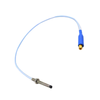
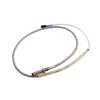
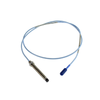
The PROXPAC XL Proximity Transducer Assembly integrates a 3300 XL 8 mm proximity probe and its associated Proximitor sensor directly into a self-contained, field-mountable thermoplastic housing. This streamlined architecture eliminates the need for an external extension cable between the probe and sensor, while allowing direct connection of field wiring between the monitoring system and the assembly.
Constructed from glass- and conductive-fiber-reinforced Polyphenylene Sulfide (PPS), the housing delivers robust mechanical strength and effective electrostatic charge dissipation. Engineered for severe industrial environments, it features an IP66 and Type 4X rating to resist moisture and harsh elements. This configuration 330881-28-04-105-00-02 specifically utilizes a metric configuration with specialized standoff, penetration, and fitting options tailored for rotating machinery vibration and position monitoring.
Features
Self-Contained Design: Combines the proximity probe and Proximitor sensor into a unified unit, removing intermediate extension cables and separate transmitter enclosures.
Advanced Material Housing: Molded PPS thermoplastic housing with conductive fibers replaces traditional aluminum or steel, boosting chemical resistance and durability.
Adjustable Deployment: The threaded stainless steel sleeve facilitates fine-tuning of the probe gap position by up to plus or minus 12.7 mm.
Environmental Protection: Certified to IP66 and Type 4X standards, ensuring robust seal performance against hose-directed water and condensing humidity.
Applications
Radial vibration monitoring on high-speed industrial rotating machinery shafts.
Axial position (thrust) measurements for turbines, compressors, and pumps.
Dynamic asset protection and condition monitoring within hazardous chemical or oil and gas processing facilities.
Ordering Information
Model Code
Description
330881
PROXPAC XL Proximity Transducer, Metric
-28
Probe and Approvals: 3300 XL 8 mm probe with Multiple Approvals
-04
Standoff Adapter Option (B Dimension): 40 mm
-105
Probe Penetration Option (C Dimension): 105 mm
-00
Fittings Option: No fittings; two plugs and two washers
3300 XL 8 mm Proximity Probe with a 1-metre cable length installed in the probe sleeve
Power Requirements
-17.5 Vdc to -26 Vdc without barriers at 12 mA maximum; -23 Vdc to -26 Vdc with barriers
Output Resistance
50 Ohm
Nominal Probe DC Resistance
Center conductor to outer conductor: 7.59 plus or minus 0.50 Ohm (for 1.0 m length)
Supply Sensitivity
Less than 2 mV change in output voltage per volt change in input voltage
Field Wiring Limits
0.2 to 1.5 mm2 (16 to 24 AWG); Maximum length of 305 metres (1,000 feet)
Performance
Linear Range
2 mm (80 mils); begins at approximately 0.25 mm (10 mils) from target
Recommended Gap Setting
1.27 mm (50 mils)
Incremental Scale Factor (ISF)
7.87 V/mm (200 mV/mil) +/- 5% over 80 mil linear range (0 to +45 Celsius)
Frequency Response
0 to 10 kHz: +0, -3 dB, with up to 305 metres of field wiring
Target Size Requirements
Minimum: 15.2 mm (0.6 in) diameter flat target
Shaft Diameter Limits
Minimum: 50.8 mm (2.0 in); Recommended minimum: 76.2 mm (3.0 in)
Mechanical
Probe Case Material
AISI 304 stainless steel
Probe Tip Material
Polyphenylene Sulfide (PPS)
Housing Material
UV-resistant, glass-reinforced PPS thermoplastic with conductive fibers
Retaining Nut Torque
29.5 N-m (260 in-lb)
Probe Sleeve Locknut Torque
39.3 N-m (350 in-lb)
Total System Weight
1.44 kg (3.2 lbm) typical with 0.3 metre sleeve length
Manufacturer
Bently Nevada (A Baker Hughes Company)
Country of Origin
USA
Environmental
Probe Operating Temperature
-52 Celsius to +177 Celsius
Housing & Sensor Operating Temp
-52 Celsius to +100 Celsius
Storage Temperature
-52 Celsius to +105 Celsius
Relative Humidity
100% condensing, non-submersible when connectors are protected
Housing Mechanical Protection
IP66 / Type 4X
Installation Guidelines
Probe Gap Adjustment: Ensure the default deployment is gapped close to the center of the linear range at 1.27 mm (50 mils) from the target shaft surface.
Sleeve Adjustments: Use the threaded outer sleeve to perform fine mechanical adjustments; the configuration permits an installation leeway of plus or minus 12.7 mm from the mid-setting point.
Resonance Mitigation: For combined "B" (Standoff) and "C" (Penetration) dimensions exceeding 305 mm, provide additional mechanical sleeve support near the probe assembly to eliminate resonance vibration errors.
Moisture Protection: Apply appropriate sealing to conduit entries to prevent liquid or condensation migration down the cable runs into the main housing cavity.
Torque Specifications: Fasten the main retaining nut to 29.5 N-m and tighten the probe sleeve locknut to 39.3 N-m to maintain standard environmental and mechanical seal integrity.
Compliance and Certifications
EMC: European Community Directive 2014/30/EU; Standards EN 61000-6-2 (Immunity) and EN 61000-6-4 (Emissions).
RoHS: European Community Directive 2011/65/EU.
FCC: Complies with Part 15 of FCC Rules.
Maritime: 2019 Rules for Conditions of Classification (Part 1) for Offshore Units and Structures.
Hazardous Area Approvals: Certified for Class I, Zone 0/2, Groups A, B, C, D intrinsically safe (Ex ia) and non-incendive (Ex nA/ec) installations when mounted per manufacturer installation drawings.
FAQ
What is the benefit of the integrated housing design over standalone proximity sensors?
The integrated layout contains both the probe sleeve assembly and the 3300 XL Proximitor sensor in one unit, bypassing the need for an intermediate extension cable or a separate remote junction box. Field wiring links directly from the monitor to the internal housing terminals.
Can this proximity transducer housing withstand outdoor or washdown installations?
Yes, the outer housing is molded from glass-reinforced polyphenylene sulfide and rated to IP66 and Type 4X, providing certified defense against hose-directed water and high-humidity environments when properly sealed.
What precautions apply if the standoff and penetration length options are long?
When the sum of the B and C dimensions is greater than 305 mm, it is mandatory to use external sleeve supports near the probe body to stiffen the mechanism and safeguard the components against resonance distortion.
Modern robotic grippers are evolving beyond traditional mechanical jaws. From gecko-inspired adhesive systems and soft food-grade grippers to AI-powered warehouse tools, advanced gripping...
From rope-driven DC compressors to battery-powered mine carts, early mining operations marked a turning point in industrial electrification. This article explores how electric motors transformed...
Factory I/O is transforming PLC education by delivering immersive 3D industrial simulations for students, engineers, and maintenance teams. The platform bridges the gap between theory and real-world...
This tutorial examines how onboard PLC functionality inside a CMZ SBD servo drive can execute standalone motion programs, including homing logic, position control, and cyclic axis movement without an...
This tutorial explores the commissioning of a single-axis servo motion system using a CMZ SBD drive, covering hardware setup, axis scaling, homing configuration, and safe motion verification for...
This tutorial explains how Mitsubishi FX PLCs integrate with FR-D700 VFDs and HMI panels for forward/reverse motor control. It covers wiring logic, parameter configuration, ladder programming, and...
Choosing a selection results in a full page refresh.