Product Overview
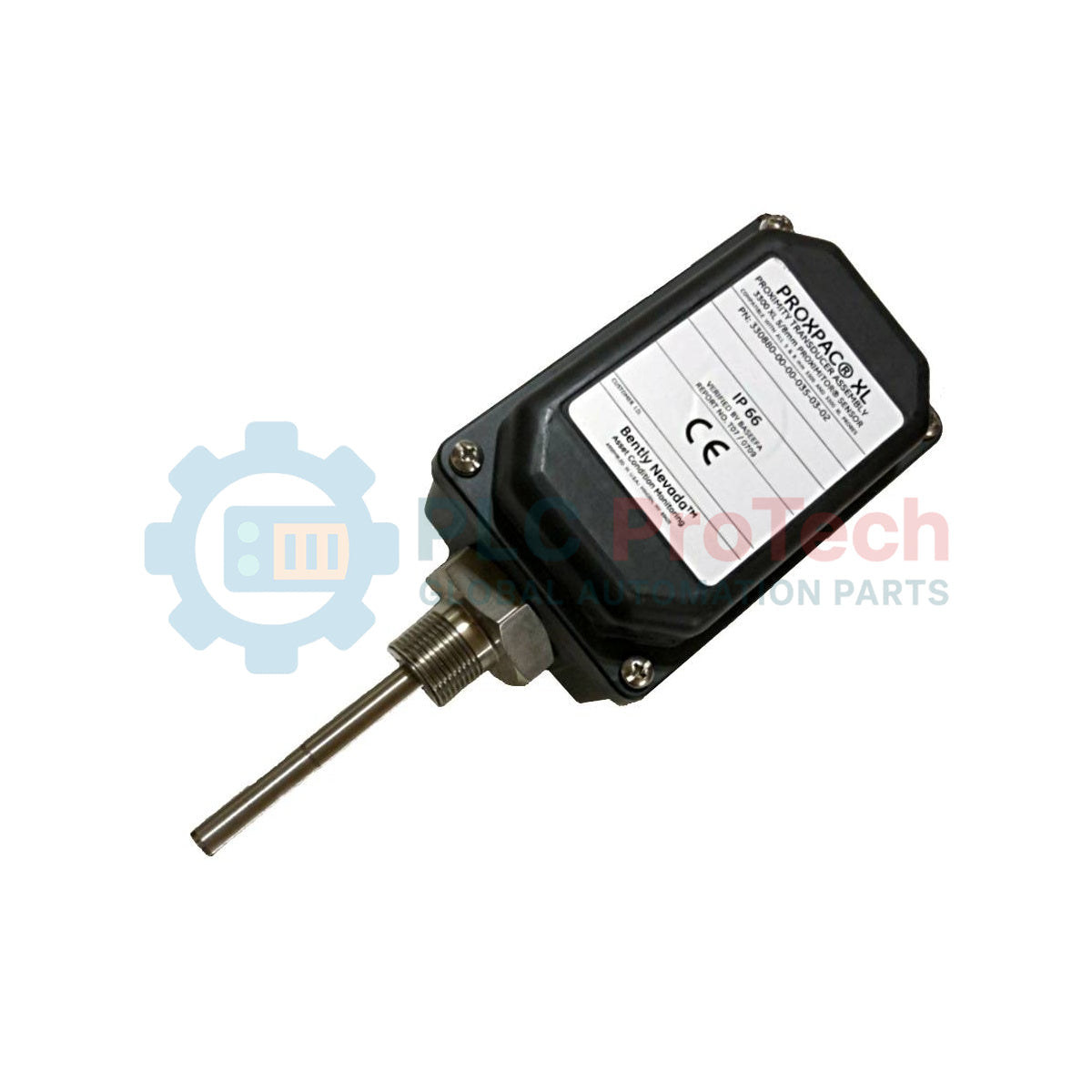
The 330881-28-04-180-06-02 is a ruggedized proximity transducer housing assembly designed for high-reliability vibration and position monitoring in demanding industrial environments. Integrating the 3300 XL 8 mm probe technology into a protected enclosure, this 330881-28-04-180-06-02 assembly is a staple in oil refineries, petrochemical plants, and power generation facilities. Its primary function is to protect critical sensors from mechanical damage and environmental contaminants while allowing for external probe adjustment without machine disassembly. By facilitating real-time monitoring of shaft vibration and thrust position on turbines and compressors, this transducer system plays a vital role in predictive maintenance, drastically reducing the risk of catastrophic asset failure and unplanned operational downtime.
Suffix Breakdown
The model code 330881-28-04-180-06-02 specifies a precise mechanical configuration for standardized installation:
-
28 (Probe and Approvals): Includes a 3300 XL 8 mm probe with multiple international hazardous area certifications for global compliance.
-
04 (Standoff Adapter): Features a 40 mm standoff adapter (B Dimension) to provide necessary clearance from the machine casing.
-
180 (Probe Penetration): Configured for a deep 180 mm probe penetration (C Dimension) into the machinery train.
-
06 (Fittings): Supplied as a comprehensive kit including one 3/4-14 NPT fitting, one 3/4-14 NPT to 1/2-14 NPT SST reducer, and two plugs for versatile conduit integration.
-
02 (Mounting Thread): Utilizes 3/4-14 NPT mounting threads, which is the required standard when a standoff adapter is utilized.
Technical Specifications
| Attribute |
Specification Details |
| Model |
330881-28-04-180-06-02 |
| Brand |
Bently Nevada (Baker Hughes) |
| Origin |
U.S.A. |
| Probe Type |
3300 XL 8 mm |
| Penetration Depth |
180 mm |
| Standoff Length |
40 mm |
| Mounting Thread |
3/4-14 NPT |
| Operating Temp |
-35 to +177 deg C (Probe head) |
| Linear Range |
2.0 mm (80 mils) |
| Shipping Weight |
5.0 kg |
Technical FAQs
How do I adjust the probe gap within the PROXPAC XL housing?
The PROXPAC XL design allows you to adjust the probe axially by loosening the internal locking mechanism. Use a voltmeter to monitor the "Gap" voltage at the Proximitor Sensor and turn the probe until you reach the target voltage (typically -10.0 VDC).
Is this assembly suitable for hazardous area installations?
Yes. The Option 28 indicates that the 3300 XL 8 mm probe included in the assembly carries multiple approvals (such as ATEX, IECEx, and CSA), making it suitable for use in zones where explosive gases may be present.
What is the purpose of the SST reducer in the fittings kit?
The 3/4-14 NPT to 1/2-14 NPT Stainless Steel (SST) reducer allows the housing to interface with standard 1/2-inch conduits commonly used in industrial wiring, providing flexibility during field installation.
Engineering & Installation Guide
Proper Gapping and Voltage Setup
When installing the 330881-28-04-180-06-02, ensure the shaft is at its normal operating position. The probe must be gapped to the center of its linear range (approximately -10.0 VDC for the 3300 XL system). Incorrect gapping can lead to signal clipping or "bottoming out" during shaft movement, which may trigger false alarms or prevent accurate vibration data collection.
Environmental Sealing and Conduit Integrity
The PROXPAC XL is designed to be weather-resistant. During installation, ensure all NPT threads are treated with a suitable thread sealant to prevent moisture ingress. The fittings kit (Option 06) should be used to create a liquid-tight seal with the electrical conduit. Moisture inside the housing can lead to corrosion of the ClickLoc connectors and signal drift.
Thermal Considerations for Standoffs
The 40 mm standoff adapter (Option 04) serves not only as a mechanical spacer but also as a thermal buffer. In high-temperature applications like steam turbines, ensure the standoff is properly secured to the machine casing to minimize heat transfer to the Proximitor Sensor or the external housing components, as excessive heat can degrade electronic performance over time.