Product Overview
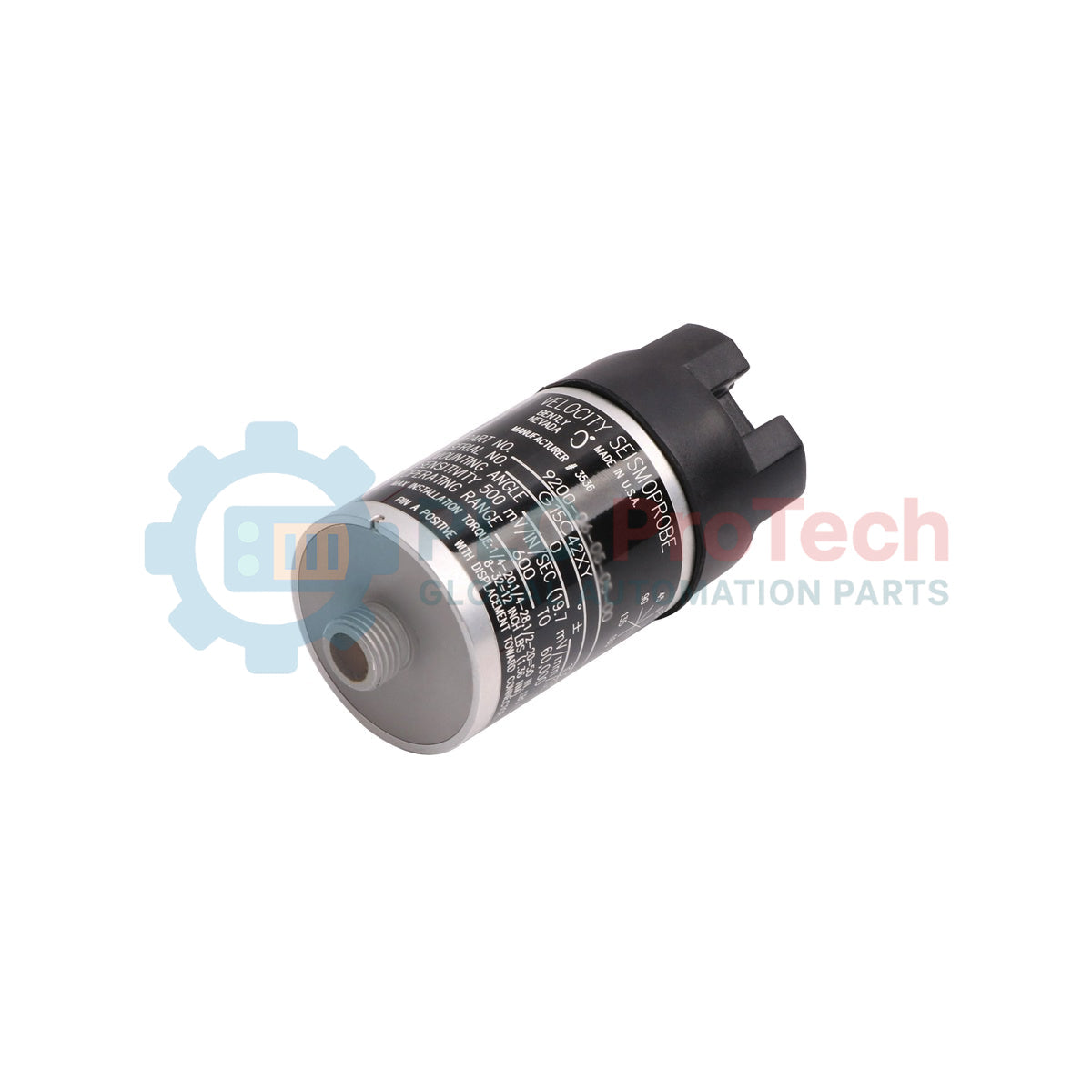
Bently Nevada 9200-01-02-02-00 is a two-wire vibration transducer designed for continuous measurement of machinery vibration in pumps, fans, compressors, and general-purpose industrial rotating equipment. It provides a compact and cost-effective monitoring solution for condition-based maintenance systems where full proximity probe architecture is not required.
This transducer is widely used in auxiliary machinery protection systems across power plants, water treatment facilities, and process industries. It converts mechanical vibration into a proportional electrical signal suitable for direct connection to monitoring and control systems.
The side-mount connector and circular 1/4 in 28 UNF stud base support flexible installation on standard machine housings, ensuring stable mechanical coupling and consistent vibration transmission.
Configuration Breakdown
| Segment |
Meaning |
| 9200 |
Two-wire vibration transducer series |
| 01 |
Mounting angle and minimum operating frequency option (0 ±2.5, 4.5 Hz) |
| 02 |
Side-mount connector configuration |
| 02 |
Circular base with 1/4 in 28 UNF stud |
| 00 |
No agency approval required |
Each parameter defines mechanical orientation, connector position, and mounting interface within the 9200 series transducer architecture.
Technical Specifications
| Parameter |
Specification |
| Model |
9200-01-02-02-00 |
| Brand |
Bently Nevada |
| Origin |
United States |
| Weight |
0.3 kg |
| Shipping Weight |
1.5 kg |
| Product Type |
Two-wire vibration transducer |
| Connector Type |
Side mount |
| Mounting Base |
Circular, 1/4 in 28 UNF stud |
| Operating Frequency |
4.5 Hz minimum (270 cpm) |
| Mounting Angle |
0 ±2.5 configuration |
| Power Requirement |
Two-wire loop powered system |
| Application |
Machinery vibration monitoring |
Engineering Interpretation Notes
The two-wire design simplifies installation by combining power supply and signal transmission in a single loop configuration. This reduces wiring complexity in distributed monitoring systems.
The circular stud mounting base ensures stable mechanical coupling to machine surfaces, which is critical for accurate vibration transmission.
Low-frequency response capability allows monitoring of slow-speed machinery where traditional high-frequency sensors may not provide sufficient sensitivity.
Field Application Notes
Where is this transducer typically used?
It is used in general industrial machinery such as pumps, fans, and auxiliary compressors.
Is it suitable for high-speed turbine monitoring?
No. It is designed for general-purpose machinery, not high-precision turbine proximity measurement systems.
What is the benefit of two-wire design?
It reduces wiring complexity by combining signal and power in a single loop.
Can it be used in legacy monitoring systems?
Yes. It is commonly used in retrofit and general-purpose condition monitoring applications.
Installation & Commissioning Notes
Ensure solid mechanical mounting using the 1/4 in 28 UNF stud to guarantee accurate vibration transmission from machine surface to sensor body.
Avoid loose mounting conditions, as poor mechanical coupling directly affects signal accuracy.
Route transducer wiring away from high-voltage and motor drive cables to minimize electrical noise interference.
Verify correct loop power configuration before commissioning to ensure stable signal output.
Engineering & Operational Guidance
Maintain proper surface preparation before installation to ensure flat and stable mounting contact.
Use torque-controlled tightening for stud mounting to prevent mechanical stress damage to the housing.
Avoid installing in areas with excessive structural resonance that may distort vibration readings.
Periodically inspect mounting integrity in high-vibration environments to ensure long-term measurement stability.