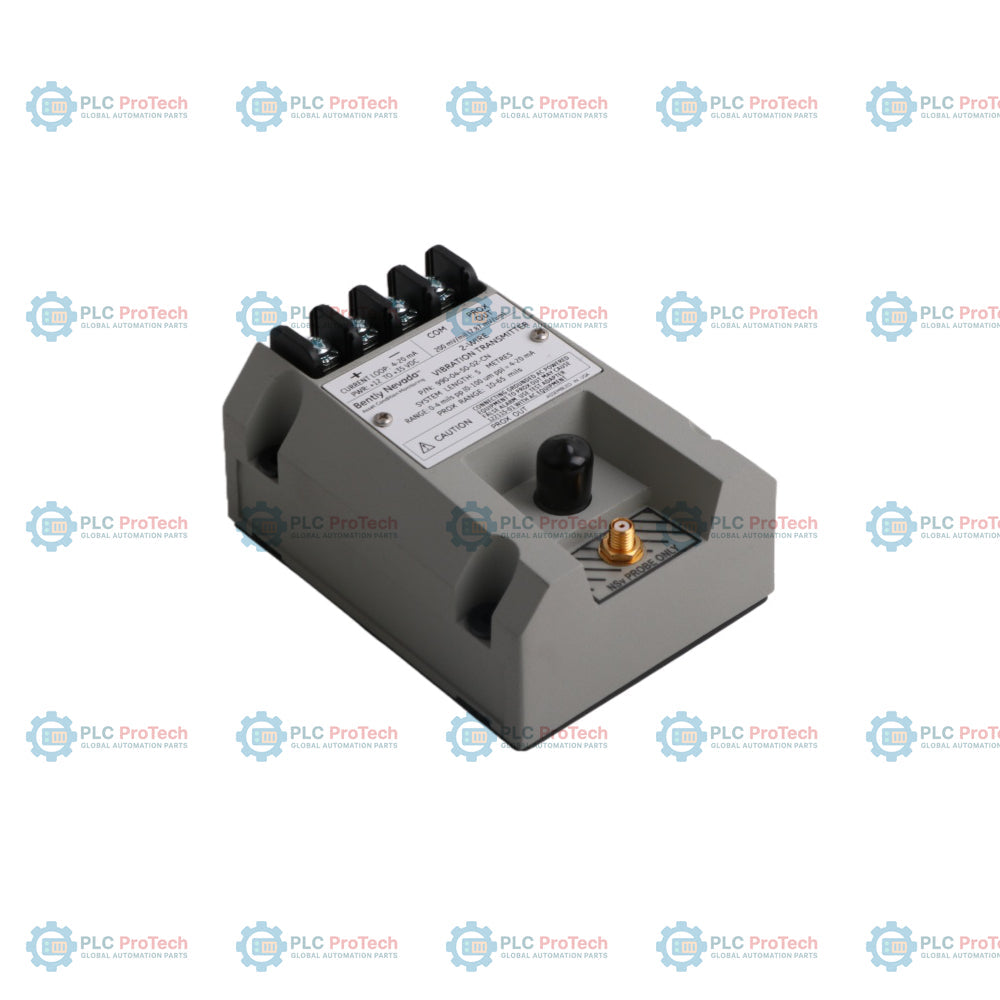
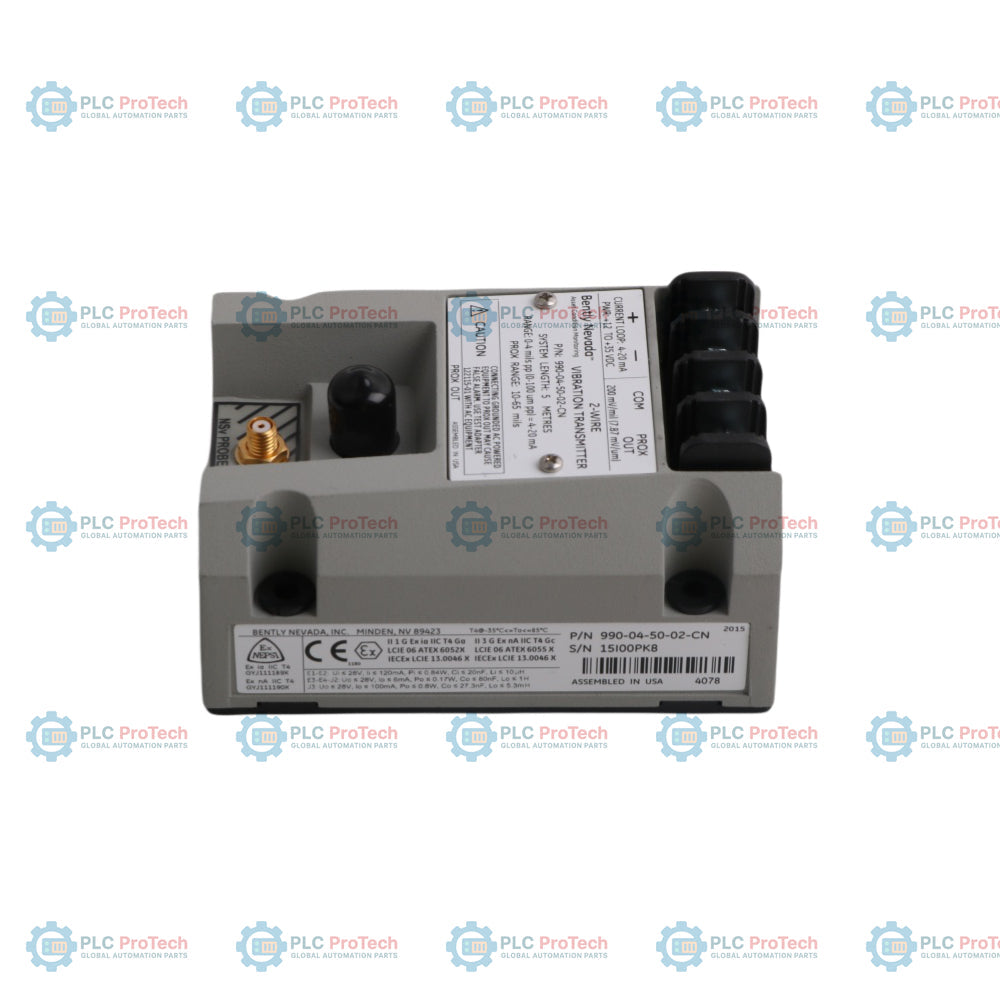
The 990-04-50-03-00 is a compact vibration transmitter used for integrating shaft vibration measurement into control systems without requiring a full monitoring rack. It is designed around a 2-wire loop-powered architecture and converts proximity probe displacement signals into a stable 4 to 20 mA output for PLC or DCS use.
In practical OEM installations, this model is often selected when engineers want a balance between wiring simplicity and mechanical flexibility. The 5.0 metre system length fits most skid-mounted rotating equipment layouts where probe routing distance is moderate but still needs stable signal integrity.
This configuration uses a combined DIN clip and screw mounting method, which gives technicians flexibility during panel layout. In many real-world builds, this hybrid mounting style is preferred because it allows both quick rail installation and additional mechanical reinforcement when vibration exposure is higher than normal.
The transmitter is typically used in basic protection or condition trending loops, where the goal is to detect changes in machine behavior early rather than perform deep diagnostic analysis.
Functional Notes
Converts proximity probe signal into 4 to 20 mA output
Designed for continuous vibration trending applications
Hybrid DIN rail + screw mounting for flexible installation
Integrated signal conditioning electronics
Provides access to raw vibration via PROX OUT
External calibration adjustment (zero/span)
Fault detection with output drop indication
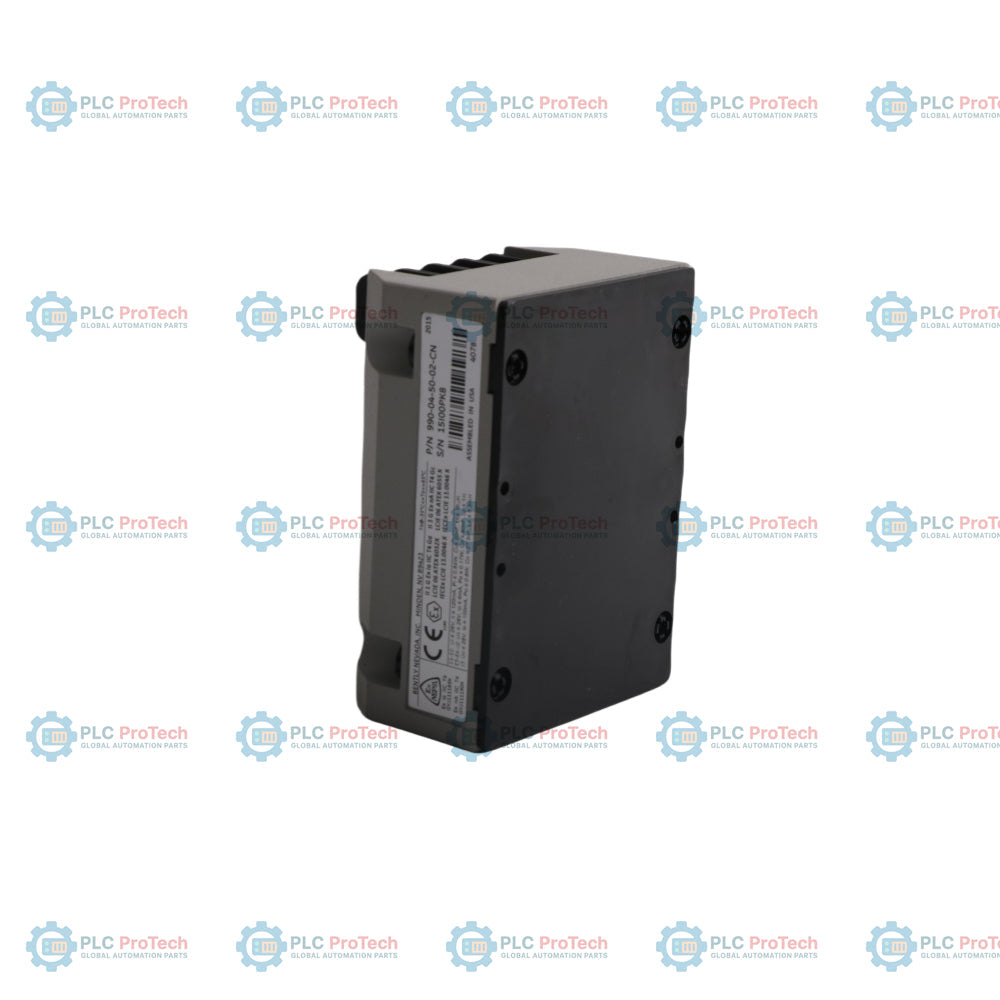
Compact encapsulated industrial housing
Where Engineers Typically Use It
Equipment Context
Why It Is Used
Compressor skids
Stable shaft vibration monitoring
Industrial pumps
Early detection of imbalance or wear
Fan systems
Continuous condition tracking
OEM packaged machines
Embedded vibration feedback loop
Auxiliary rotating equipment
Basic protection input to PLC
Retrofit panels
Easy integration into existing cabinets
Ordering Breakdown
Element
Code Meaning
Model
990 Vibration Transmitter
Full-scale Option
-04 = 0-4 mils pp (0-100 µm pp)
System Length Option
-50 = 5.0 metres (16.4 feet)
Mounting Option
-03 = DIN clips and screws
Agency Approval Option
-00 = Not required
Mechanical & Dimensional Data
Item
Value
Part Number
990-04-50-03-00
Manufacturer
Bently Nevada
Product Type
2-Wire Vibration Transmitter
Condition
New & Original in Factory Packing
Factory Warranty
12 Months
Minimum Target Size
9.5 mm (0.375 in)
Dimensions (H x W x D)
53.3 mm x 73.9 mm x 100.1 mm
Body Height (no DIN clip)
42.6 mm
Mounting Hole Distance
63.5 mm x 69.9 mm
Mounting Hole Diameter
5.8 mm
Net Weight
0.43 kg
Total System Weight
0.82 kg
Interface Overview
Interface
Function
Probe Input
Connection to 3300 NSv proximity probe
4-20 mA Output
Vibration signal to control system
Power Input
Loop-powered DC supply
PROX OUT
Raw vibration diagnostic signal
COM
Electrical reference
Installation Notes (Field Experience Perspective)
In cabinet installations, this model is usually mounted on DIN rail first, then mechanically secured with screws when vibration or cable tension is expected. This reduces long-term loosening in high-vibration environments such as compressor enclosures.
Probe cable routing is important on this model. Engineers typically keep low-level signal cables separated from motor power lines to avoid noise coupling, especially in 5-metre routing layouts where bundling is common.
During commissioning, the probe gap should be checked before energizing the loop. Once powered, allow the signal to stabilize under steady machine conditions before integrating it into alarm logic.
The PROX OUT point is useful during troubleshooting, but in practice it is often used only during startup or maintenance windows rather than continuous operation.
FAQ
Is this transmitter suitable for compact machinery skids? Yes, it is commonly selected for OEM skid-mounted rotating equipment.
What is the main advantage of the 5.0 m system length? It matches most medium-distance probe routing layouts without signal complexity.
Can it be installed only on DIN rail? It supports DIN rail installation but also allows screw reinforcement.
Does it provide raw vibration access? Yes, PROX OUT provides a diagnostic signal for external instruments.
What type of control system is it designed for? It is intended for PLC and DCS analog input integration.
Is this a diagnostic system or a transmitter? It is a simplified transmitter, not a full vibration analysis system.
What happens if the probe fails? The output drops to a low-current fault state to indicate NOT OK.
Is it suitable for compressors and pumps? Yes, it is widely used on compressors, pumps, and fans.
What makes this version different in installation? It uses a combined DIN clip and screw mounting arrangement.
Is it used for detailed vibration diagnostics? No, it is intended for trend-level monitoring only.
Maintenance data connects work orders, sensor signals, asset history, costs, and technician knowledge. Used well, it improves planning, reliability, predictive maintenance, spare-parts control, and...
This article explains how integrated electric actuators, such as SMC’s e-Actuator series, are transforming industrial motion control by replacing traditional pneumatic and hydraulic systems. It...
This article explains how PLC systems perform core mathematical operations such as addition, subtraction, multiplication, division, modulo, and exponentiation within industrial automation. It shows...
The article explains several advanced Boolean logic functions used in PLC programming beyond basic AND, OR, and NOT operations. It covers how tools like truth tables, multiplexers, pulse generators,...
Boolean logic is the foundation of every PLC program. From simple machine controls to complex industrial automation systems, logic gates determine how controllers respond to changing inputs and...
Industrial firewalls play a critical role in OT cybersecurity, protecting PLC, DCS, and SCADA networks through segmentation, ingress/egress control, and IDS/IPS integration aligned with IEC 62443...
Choosing a selection results in a full page refresh.