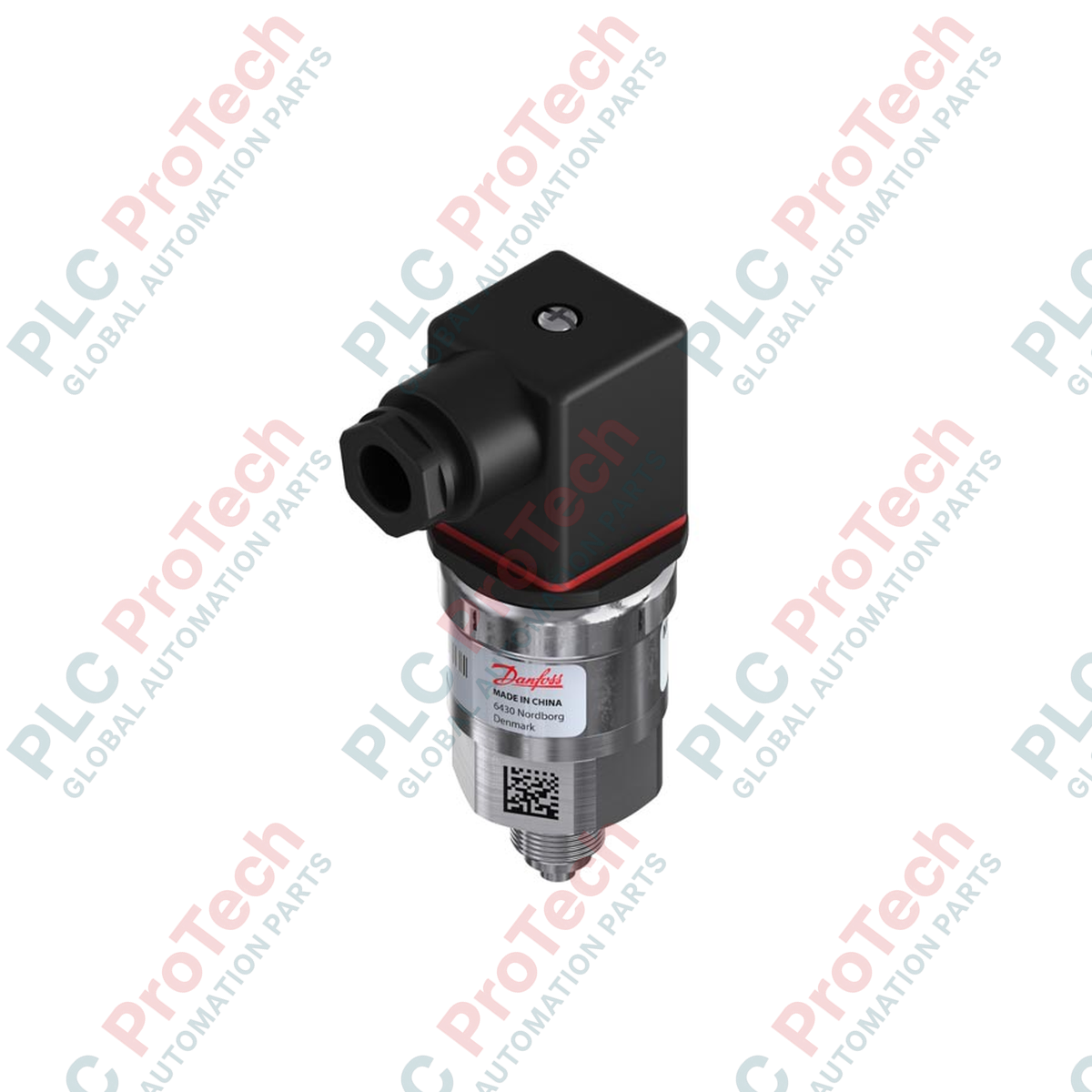
The Danfoss 060G1369 is a high-precision pressure transmitter designed for rigorous industrial monitoring and process control applications. Utilizing a current-based output signal (4 - 20 mA), this device ensures reliable signal transmission over long distances, making it an ideal choice for complex plant environments where electromagnetic immunity is critical. Built for endurance, the transmitter operates flawlessly in extreme thermal conditions—ranging from -40 deg C to 100 deg C—and is protected by an IP65-rated enclosure. It serves as a vital feedback component in hydraulic systems, industrial cooling loops, and automated process lines, effectively minimizing system downtime through accurate, repeatable pressure sensing.
Technical Configuration
The 060G1369 is engineered for straightforward integration into standard industrial architectures, emphasizing ease of installation and operational longevity.
Signal Integrity: The transmitter outputs a standard 4 - 20 mA current signal, which inherently allows for easy detection of open-circuit or short-circuit failures—a key safety feature in automated control loops.
Mechanical Robustness: The unit features a G 1/4 (EN 837) pressure connection with a 27 mm hexagonal interface, ensuring a secure and leak-proof fit in standard piping systems. It is capable of withstanding overload pressures up to 60 bar, providing a significant safety margin against pressure spikes.
Electrical Connectivity: The transmitter is equipped with an angular Pg 11 connector, facilitating a secure and weather-resistant termination. Pin 1 serves as the positive supply, while Pin 2 acts as the common, conforming to standard industry wiring practices for current-loop sensors.
Technical Specifications
Feature
Specification
Model
060G1369
Brand
Danfoss
Output Signal
4 - 20 mA
Pressure Conn.
G 1/4 (EN 837)
Max Overload
60 bar
Ambient Temp
-40 to 100 deg C
Enclosure
IP65
Accuracy (Max)
1.0 % FS
Weight
1.5 kg (Shipping)
FAQs
Why is a 4 - 20 mA output preferred over a voltage output for this transmitter?
Current signals (4 - 20 mA) are significantly more resistant to electromagnetic interference and voltage drops across long cable runs compared to voltage-based signals (e.g., 0 - 10 V). This makes them the industry standard for reliable feedback in expansive industrial facilities.
Does the 060G1369 require field calibration?
No, this unit is factory-calibrated. It does not feature manual zero or span adjustments, which ensures long-term stability and prevents unauthorized or accidental drift of the calibration settings during operation.
Is this transmitter suitable for outdoor use?
With an IP65 enclosure rating, the transmitter is protected against dust and low-pressure water jets. While it is suitable for many outdoor industrial environments, it should be protected from direct, prolonged exposure to severe weather or extreme sunlight to maintain the integrity of the seals and connector.
Engineering Guidelines and Best Practices
Installation Torque: Use the 27 mm hexagonal fitting to tighten the pressure connection. Ensure that compatible sealing materials are used for the G 1/4 thread to prevent leaks, but avoid over-tightening, which can distort the sensor body and degrade measurement accuracy.
Wiring Standards: Use shielded, twisted-pair cabling for the 4 - 20 mA loop. Terminate the shield at the control panel ground to ensure effective noise immunity. Since this is a current-loop device, ensure the power supply voltage at the transmitter is sufficient to overcome the loop resistance.
Clipping Levels: Note the factory-set clipping levels (3.6 mA low / 22.4 mA high). These levels are designed to indicate signal out-of-range conditions, allowing control systems to instantly identify if the sensor or cable has failed.
Maintenance data connects work orders, sensor signals, asset history, costs, and technician knowledge. Used well, it improves planning, reliability, predictive maintenance, spare-parts control, and...
This article explains how integrated electric actuators, such as SMC’s e-Actuator series, are transforming industrial motion control by replacing traditional pneumatic and hydraulic systems. It...
This article explains how PLC systems perform core mathematical operations such as addition, subtraction, multiplication, division, modulo, and exponentiation within industrial automation. It shows...
The article explains several advanced Boolean logic functions used in PLC programming beyond basic AND, OR, and NOT operations. It covers how tools like truth tables, multiplexers, pulse generators,...
Boolean logic is the foundation of every PLC program. From simple machine controls to complex industrial automation systems, logic gates determine how controllers respond to changing inputs and...
Industrial firewalls play a critical role in OT cybersecurity, protecting PLC, DCS, and SCADA networks through segmentation, ingress/egress control, and IDS/IPS integration aligned with IEC 62443...
Choosing a selection results in a full page refresh.