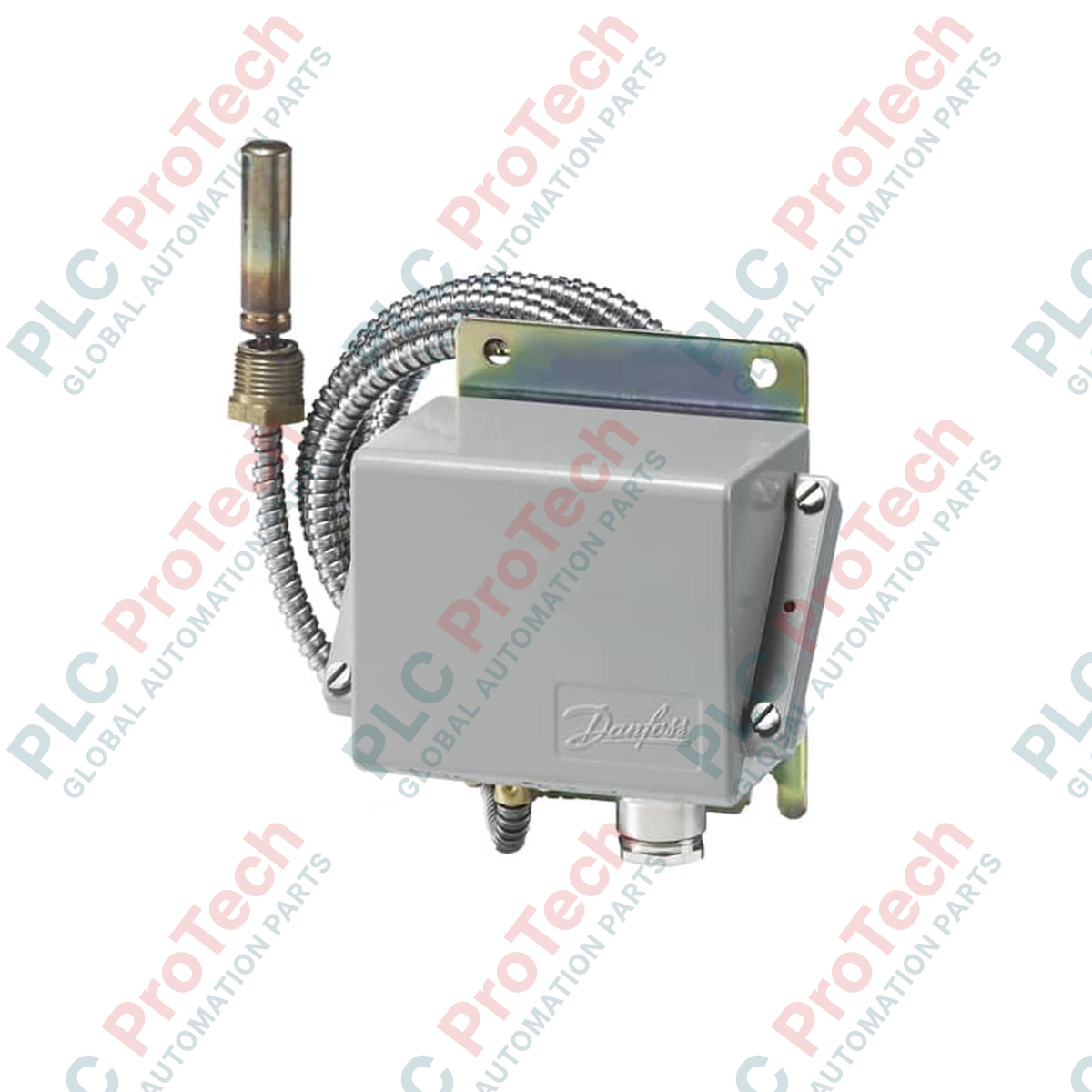
The Danfoss 060L312666 (KPS 80) is a heavy-duty, industrial-grade thermostat engineered for extreme environments and critical process control. Specifically designed for high-temperature applications, this thermostat provides reliable temperature regulation in industrial heating systems, steam generators, and process cooling loops. Its rugged construction and high sensor temperature limit (220°C) make it a standard solution for plant engineers who require a robust, mechanical fail-safe device that can withstand high vibration, shock, and harsh chemical environments without sacrificing switching accuracy.
Technical Configuration
The KPS series is renowned for its durability, featuring a robust housing and high-contact-load capacity that eliminates the need for external relays in many industrial control loops.
Temperature Regulation: The KPS 80 offers an adjustable setting range of 70 – 120°C, providing the versatility required for various thermal process stages.
Mechanical Differential: The unit features an adjustable mechanical differential (4.5 – 18°C), allowing for precise tuning of the "hysteresis"—the gap between the activation and deactivation temperatures—which prevents rapid cycling (chattering) of the connected equipment.
Sensor Integrity: Engineered to survive thermal excursions up to 220°C, the unit is compatible with standard 75 mm sensor pockets, ensuring high-fidelity heat transfer between the process media and the sensing element.
Technical Specifications
Feature
Specification
Model
KPS 80
Brand
Danfoss
Code No.
060L312666
Setting Range
70 – 120°C
Mechanical Diff.
4.5 – 18°C (Adjustable)
Max Sensor Temp
220°C
Sensor Pocket
75 mm
Weight
3.0 kg (Shipping)
FAQs
Why would I adjust the mechanical differential?
Adjusting the differential is critical for optimizing process stability. A narrower differential (e.g., 4.5°C) provides tighter temperature control, whereas a wider differential (up to 18°C) is preferred to prevent equipment damage caused by rapid cycling when the process load is inconsistent or prone to minor fluctuations.
Is this unit compatible with direct immersion in corrosive liquids?
The KPS 80 is designed to be used in conjunction with a thermowell (sensor pocket). For corrosive media, ensure that the material of the thermowell is chemically compatible with the process fluid to prevent premature failure of the sensor pocket.
Does the KPS 80 require external power for the switching function?
No. The KPS 80 is a mechanical switch. It operates as a dry-contact relay, meaning it simply opens or closes an existing electrical circuit based on the temperature setpoint. This makes it an ideal, low-maintenance safety device that can be integrated into high-voltage control circuits directly.
Engineering Guidelines and Best Practices
Mounting Orientation: To ensure the sensing element responds correctly to temperature changes, mount the unit in a location where the fluid flow is representative of the process temperature. Avoid stagnant pockets in the piping.
Thermal Coupling: Ensure the sensor pocket is properly filled with a high-conductivity thermal paste or is fitted tightly to the sensor bulb. Poor thermal contact between the media and the thermostat bulb will lead to significant time delays in switching, causing temperature overshoot.
Maintenance: While the KPS 80 is built for long-term reliability, periodically verify the setpoint during scheduled plant shutdowns. Mechanical switches can be subject to minor drift over years of operation due to component wear or fatigue.
Maintenance data connects work orders, sensor signals, asset history, costs, and technician knowledge. Used well, it improves planning, reliability, predictive maintenance, spare-parts control, and...
This article explains how integrated electric actuators, such as SMC’s e-Actuator series, are transforming industrial motion control by replacing traditional pneumatic and hydraulic systems. It...
This article explains how PLC systems perform core mathematical operations such as addition, subtraction, multiplication, division, modulo, and exponentiation within industrial automation. It shows...
The article explains several advanced Boolean logic functions used in PLC programming beyond basic AND, OR, and NOT operations. It covers how tools like truth tables, multiplexers, pulse generators,...
Boolean logic is the foundation of every PLC program. From simple machine controls to complex industrial automation systems, logic gates determine how controllers respond to changing inputs and...
Industrial firewalls play a critical role in OT cybersecurity, protecting PLC, DCS, and SCADA networks through segmentation, ingress/egress control, and IDS/IPS integration aligned with IEC 62443...
Choosing a selection results in a full page refresh.