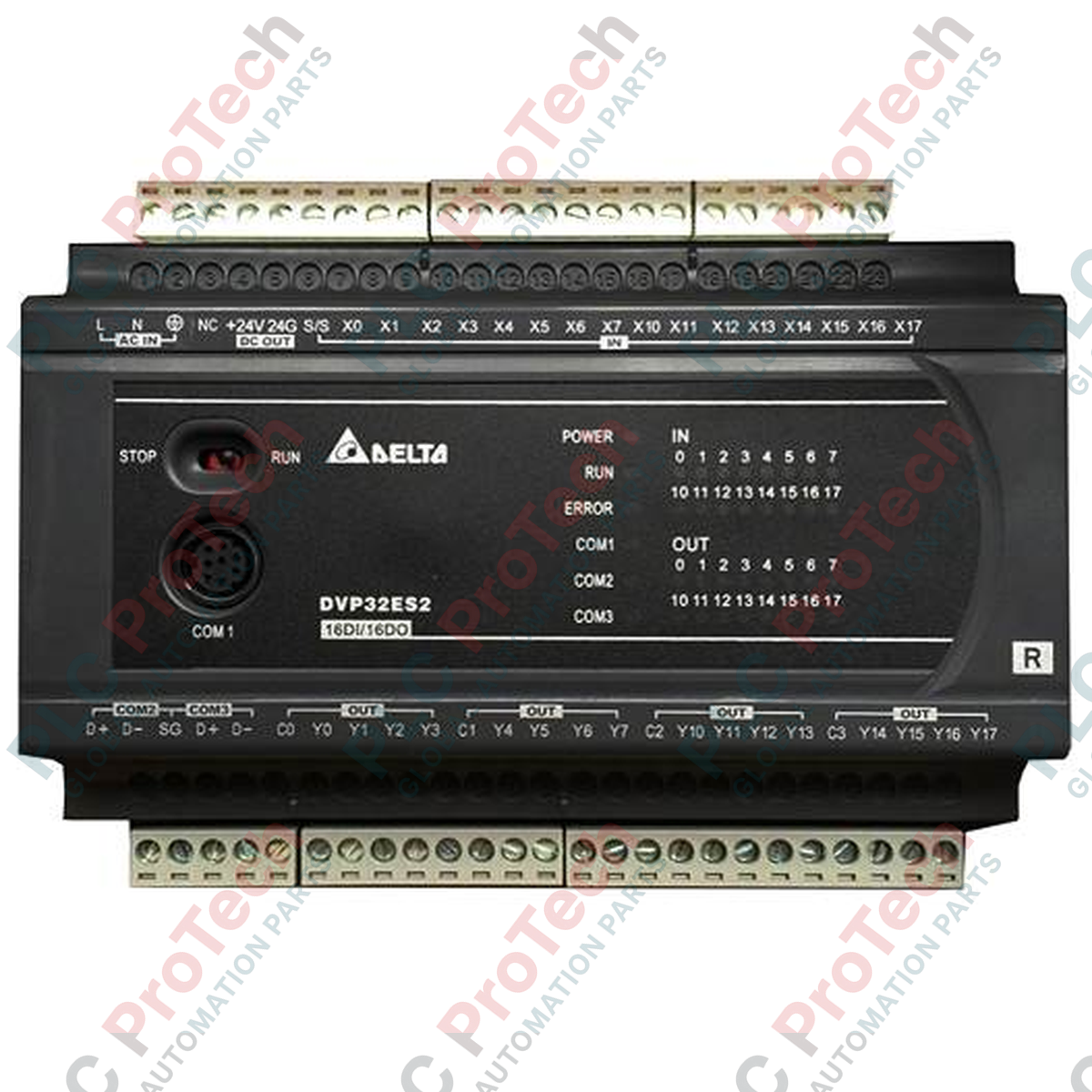
Product Overview
The DVP80ES200R (DVP80ES200R) is a high-density, integrated main processing unit from Delta’s DVP-ES2 series, designed to provide a cost-effective and robust solution for medium-to-large scale industrial automation. This "Standard PLC" stands out for its massive built-in I/O capacity, offering 80 total points (40 digital inputs and 40 relay outputs) in a single hardware base. Engineered for general-purpose control tasks—such as automated warehouse sorting, large-scale HVAC management, and industrial laundry equipment—the DVP80ES200R utilizes a universal AC power supply and mechanical relay outputs. This configuration makes it exceptionally versatile for switching diverse load types and voltages without the need for extensive interposing relay circuitry.
Technical Configuration
The hardware architecture of the DVP-ES2 series is optimized for high-efficiency processing and superior communication flexibility. The DVP80ES200R features three independent communication ports (1 x RS-232, 2 x RS-485), all capable of operating simultaneously to connect to HMIs, frequency drives, and other Modbus-compatible devices. The CPU supports a program capacity of 16k steps and is equipped with high-speed counters for basic positioning tasks. The relay output stage is designed for durability, providing physical isolation between the PLC logic and field loads. Unlike transistor models, the relay outputs can handle both AC and DC voltages, making it the preferred choice for systems using mixed-voltage actuators and indicators.
Technical Specifications
| Attribute |
Specification Details |
| Model |
DVP80ES200R |
| Brand |
DELTA |
| Series |
DVP-ES2 Series |
| Total I/O Points |
80 (40 DI / 40 DO) |
| Input Power |
100 to 240 VAC (-15 percent / +10 percent) |
| Output Method |
Relay (R) |
| Program Capacity |
16k steps |
| Data Registers |
10k words |
| Execution Speed |
0.54 us (Basic instruction) |
| Communication Ports |
COM1: RS-232, COM2: RS-485, COM3: RS-485 |
| High-Speed Counters |
2 x 100 kHz, 6 x 10 kHz (total 8 channels) |
| Protection Rating |
IP20 |
| Dimensions |
Standard ES2 Large Frame |
| Shipping Weight |
2.0 kg |
Technical FAQs
Can I switch 220 VAC loads directly with the DVP80ES200R?
Yes. Because the DVP80ES200R uses mechanical relay outputs, each output point acts as a physical dry contact. You can switch AC voltages (up to 250 VAC) or DC voltages (up to 30 VDC). However, ensure the current per point does not exceed the rated 2 A to prevent contact welding.
What is the advantage of having two RS-485 ports (COM2 and COM3)?
The dual RS-485 ports allow the PLC to act as a Modbus Master on one network (e.g., controlling a bank of VFDs) while simultaneously acting as a Modbus Slave to a higher-level SCADA system or another PLC on the second network. This significantly simplifies complex system architectures without requiring additional communication modules.
Is the DVP80ES200R suitable for high-speed servo pulse-train control?
No. For high-speed pulse output (used to drive servo or stepper motors), a transistor output model (such as DVP80ES200T) is required. Relay outputs have mechanical switching delays (approx. 10 ms) and finite life cycles, making them unsuitable for high-frequency pulse-width modulation or positioning.
Engineering & Installation Guide
-
Relay Contact Protection: When switching inductive loads (such as solenoid valves or contactor coils), mechanical relays generate an arc when opening. To extend the life of your PLC, install an RC snubber for AC loads or a flyback diode for DC loads across the field device to suppress these voltage spikes.
-
Power Supply Wiring: The unit is rated for 100 to 240 VAC. Ensure that the "L" and "N" lines are correctly connected to the power terminals. Use a dedicated circuit breaker for the PLC and ensure the "G" (Ground) terminal is connected to a low-resistance earth ground to minimize electrical noise interference on the 40 digital inputs.
-
Thermal Clearance: With 80 I/O points active, the module can generate internal heat. Mount the PLC horizontally on a 35 mm DIN rail and maintain at least 50 mm of vertical clearance for natural convection. Avoid placing the PLC directly above high-heat components like braking resistors or large power transformers.