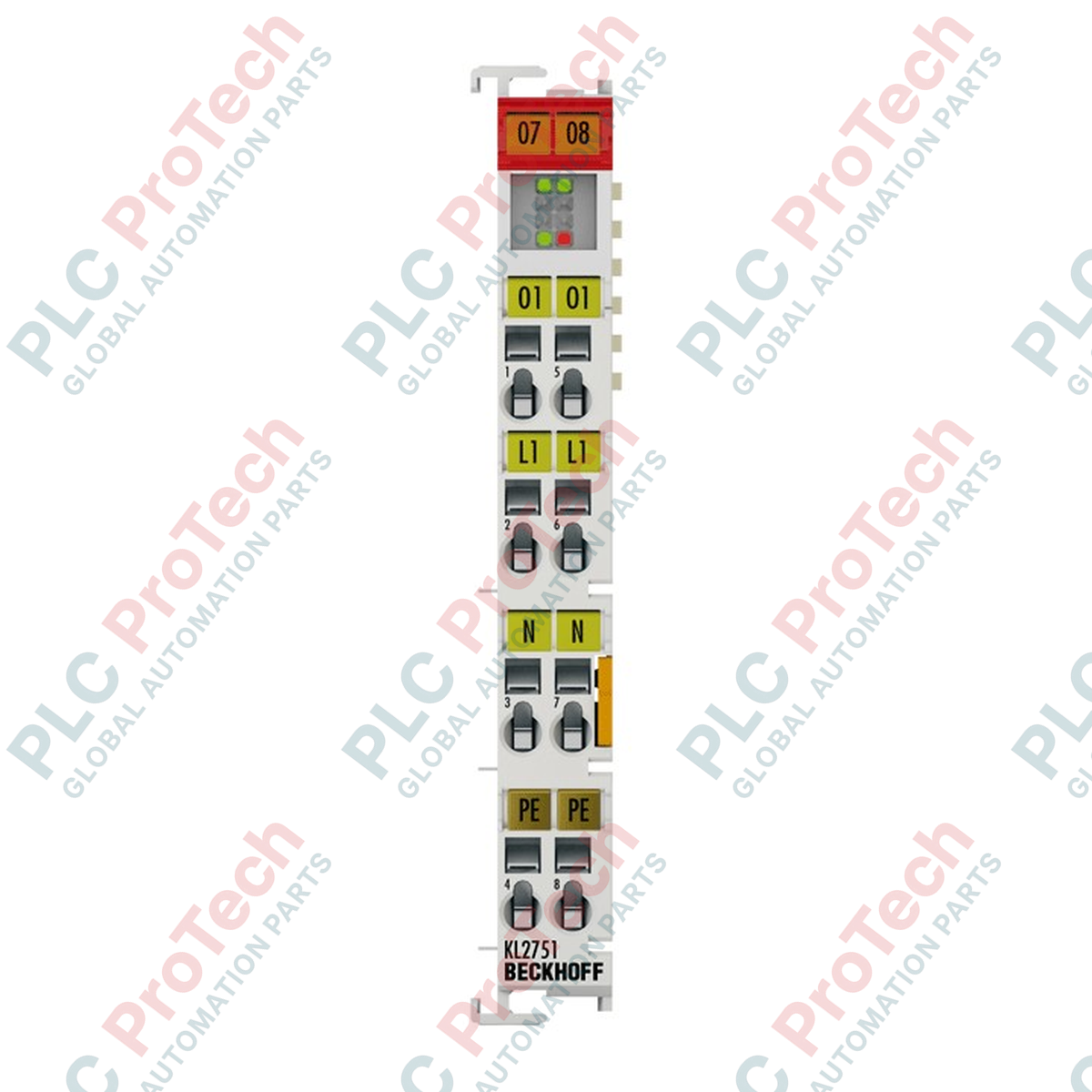
Product Overview
The KL2751 (KL 2751) is a compact 1-channel universal dimmer terminal designed for the precise power regulation of AC loads up to 300 VA (W). Operating at a nominal 230 V AC, this Bus Terminal integrates advanced fieldbus functionality into standard lighting and power control systems. In sectors such as commercial building automation, greenhouse climate control, and industrial lighting management, the KL2751 is essential for controlling ohmic, inductive, or capacitive loads. By utilizing automatic load detection and phase control technology, it ensures optimal dimming performance across various lamp types and actuators, reducing energy waste and mechanical stress on connected components.
Technical Configuration
The KL2751 utilizes a 4-wire connection technology to provide a high-resolution (1%) phase-cut dimming solution. The hardware is designed with a "smart" firing pulse logic that automatically identifies the characteristic of the connected load—whether leading-edge for inductive loads or trailing-edge for capacitive loads—protecting the power electronics from voltage spikes. Safety is a core feature of the KL2751 architecture, boasting a massive 3750 V AC dielectric strength for one minute and 500 V electrical isolation between the K-bus logic and the field potential. Despite its power-handling capabilities, the module maintains a slim 12 mm profile and draws only 95 mA from the K-bus, making it a highly efficient addition to any I/O segment.
Technical Specifications
| Attribute |
Specification Details |
| Model |
KL2751 |
| Brand |
BECKHOFF |
| Origin |
Germany |
| Number of Outputs |
1 |
| Nominal Voltage |
230 V AC (50 Hz) |
| Rated Output |
300 VA (W) |
| Max. Output Current |
1.35 A |
| Control Type |
Phase control (Automatic detection) |
| Resolution |
1 % |
| Electrical Isolation |
3750 V AC (1 min.) / 500 V (K-bus to field) |
| Current Consumption |
Typ. 95 mA (K-bus) |
| Bit Width |
1 x 16 bit data (Optional 1 x 8 bit control) |
| Operating Temperature |
0 to +55 deg C |
| Weight |
60 g |
| Shipping Weight |
2.0 kg |
Technical FAQs
Can the KL2751 dim LED lamps?
The KL2751 is compatible with dimmable LEDs that are rated for 230 V AC. Because of the automatic load detection, it will adjust its phase control to match the LED driver. However, due to a leakage current of < 1 mA in the OFF state, very low-wattage LEDs may exhibit a slight "glow" when turned off.
What happens if I accidentally connect an inductive and capacitive load in parallel?
This is explicitly prohibited. The KL2751 requires loads to be ohmic, inductive, or capacitive, but not mixed. Mixing load types prevents the automatic detection logic from functioning correctly, which can lead to improper phase firing and hardware damage.
How does the module handle short circuits?
The terminal is designed to withstand short-circuit currents between 10 and 20 A. In the event of a fault, the internal protection circuitry will interrupt the output. The status can be monitored via the process image to alert the control system of the failure.
Engineering & Installation Guide
Thermal Load and Spacing:
Operating a dimmer at its maximum 300 VA capacity generates internal heat. For installations where the KL2751 is used at full rated current (1.35 A) in ambient temperatures near 55 deg C, it is recommended to place a standard 12 mm potential feed terminal or a passive spacer next to the module to improve heat dissipation via convection.
Wiring for Signal Integrity:
Following the 4-wire connection technology is critical for both safety and performance. Ensure the neutral conductor is properly referenced as per the Beckhoff connection diagram. Use solid or stranded wire with a cross-section of up to 2.5 mm², stripped to 8–9 mm. The spring-actuated terminals provide a vibration-proof connection, but ensuring the wire is fully seated is vital for high-voltage AC applications.
Load Detection Protocol:
When commissioning the system, ensure the load is connected before the field power is applied. The KL2751 performs its load analysis during the initial power-up phase. If the load is changed, a power cycle of the field voltage is required to trigger a new detection sequence, ensuring the phase control (leading or trailing edge) is correctly calibrated for the new device.