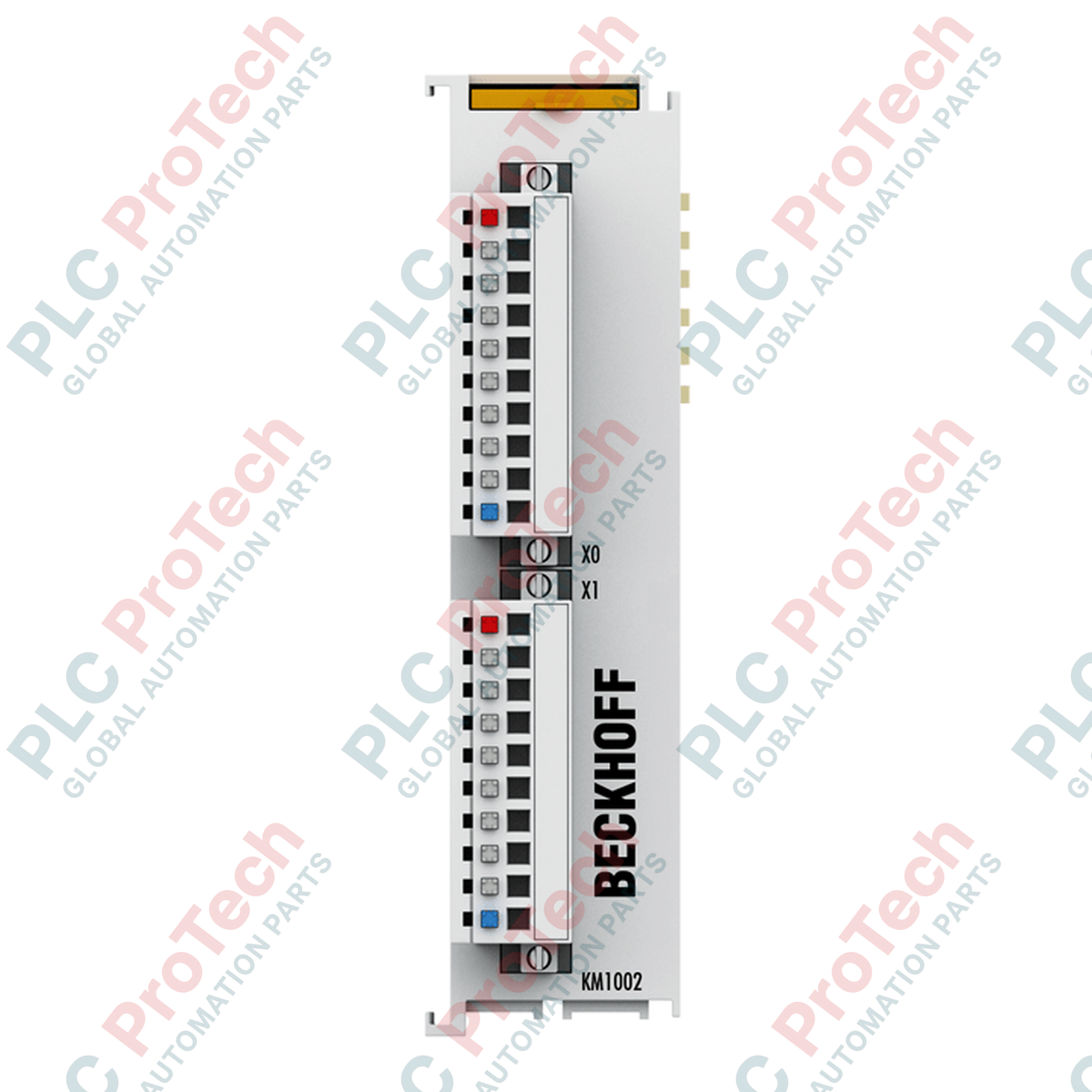
Product Overview
The KM1002-0002 (KM10020002) is a high-density Bus Terminal module designed to maximize space efficiency within the Beckhoff I/O system. By consolidating 16 digital inputs into a compact 26.5 mm housing, this module allows for a significant reduction in control cabinet size while maintaining high-performance signal processing. The KM1002-0002 specifically features 1-wire connection technology with integrated status LEDs, providing immediate visual diagnostics for each of its 16 channels. Engineered for reliability in industrial automation sectors such as building management, logistics, and general machine construction, it ensures the seamless transmission of 24 VDC control signals to the higher-level K-bus with 500 V electrical isolation.
Suffix Breakdown
The KM1002 series utilizes a standardized suffix logic to define the wiring interface and diagnostic features of the module:
-
-0000: Standard 16-channel digital input module supplied without the pluggable wiring connectors.
-
-0001: Version equipped with 1-wire pluggable connectors for basic signal termination.
-
-0002: Version equipped with 1-wire pluggable connectors and integrated diagnostic LEDs for channel-specific status monitoring.
-
-0004: High-density version featuring 3-wire connectors and LEDs, allowing for direct sensor power distribution (VCC/GND/Signal) at the terminal.
Technical Specifications
| Attribute |
Specification Details |
| Model |
KM1002-0002 |
| Brand |
BECKHOFF |
| Origin |
Germany |
| Number of Inputs |
16 (arranged in 2 x 8 blocks) |
| Nominal Voltage |
24 VDC (-15 percent / +20 percent) |
| Connection Technology |
1-wire pluggable connector |
| Status Indicators |
16 individual LEDs (Signal/Status) |
| Input Filter |
typ. 3.0 ms |
| "1" Signal Voltage |
15 to 30 V |
| "0" Signal Voltage |
-3 to +5 V |
| Current Consumption (K-bus) |
typ. 3 mA |
| Electrical Isolation |
500 V (K-bus / Field Potential) |
| Dimensions (W x H x D) |
26.5 mm x 100 mm x 71 mm |
| Operating Temperature |
0 to +55 Celsius |
| Weight |
approx. 90 g |
| Shipping Weight |
2.0 kg |
Technical FAQs
Does the KM1002-0002 support 3-wire sensor connections directly?
The KM1002-0002 is designed for 1-wire connection technology, meaning it receives the signal wire from the sensor. For sensors requiring 24 VDC and 0V power directly from the module, the KM1002-0004 variant (3-wire) is the appropriate choice. With the -0002, common power distribution must be handled via separate potential distribution terminals.
Can this module be used in systems experiencing high mechanical stress?
Yes. The module conforms to EN 60068-2-6 and EN 60068-2-27 standards for vibration and shock resistance. The pluggable wiring level is secured with a locking mechanism, and the module itself attaches to the 35 mm DIN rail with a robust double slot and key connection, ensuring stability side-by-side with other terminals.
What is the function of the 3.0 ms input filter?
The 3.0 ms filter is an integrated hardware debounce mechanism. It prevents the PLC from registering "false" signals caused by mechanical contact bounce or transient electromagnetic noise on the signal lines, ensuring that only valid state changes are processed by the automation unit.
Engineering & Installation Guide
-
Wiring Efficiency: The pluggable connector system allows for the wiring harness to be pre-assembled or replaced as a single unit. When inserting wires (0.08 to 1.5 mm squared), ensure a stripping length of exactly 8 mm to guarantee a secure gas-tight connection within the spring-actuated terminal.
-
Status Diagnostics: Use the integrated LEDs to simplify commissioning. A lit LED indicates a "1" signal (High) at the input. If a sensor is triggered but the LED remains dark, check the field-side voltage or the common ground (0V) connection, as the KM1002-0002 requires a shared reference potential with the field sensors.
-
Potential Isolation: Note that this module provides 500 V isolation between the K-bus (logic side) and the field potential. However, there are no power contacts on the side of the housing. The field power for the inputs must be supplied through the front-facing connectors to ensure the inputs are correctly energized.