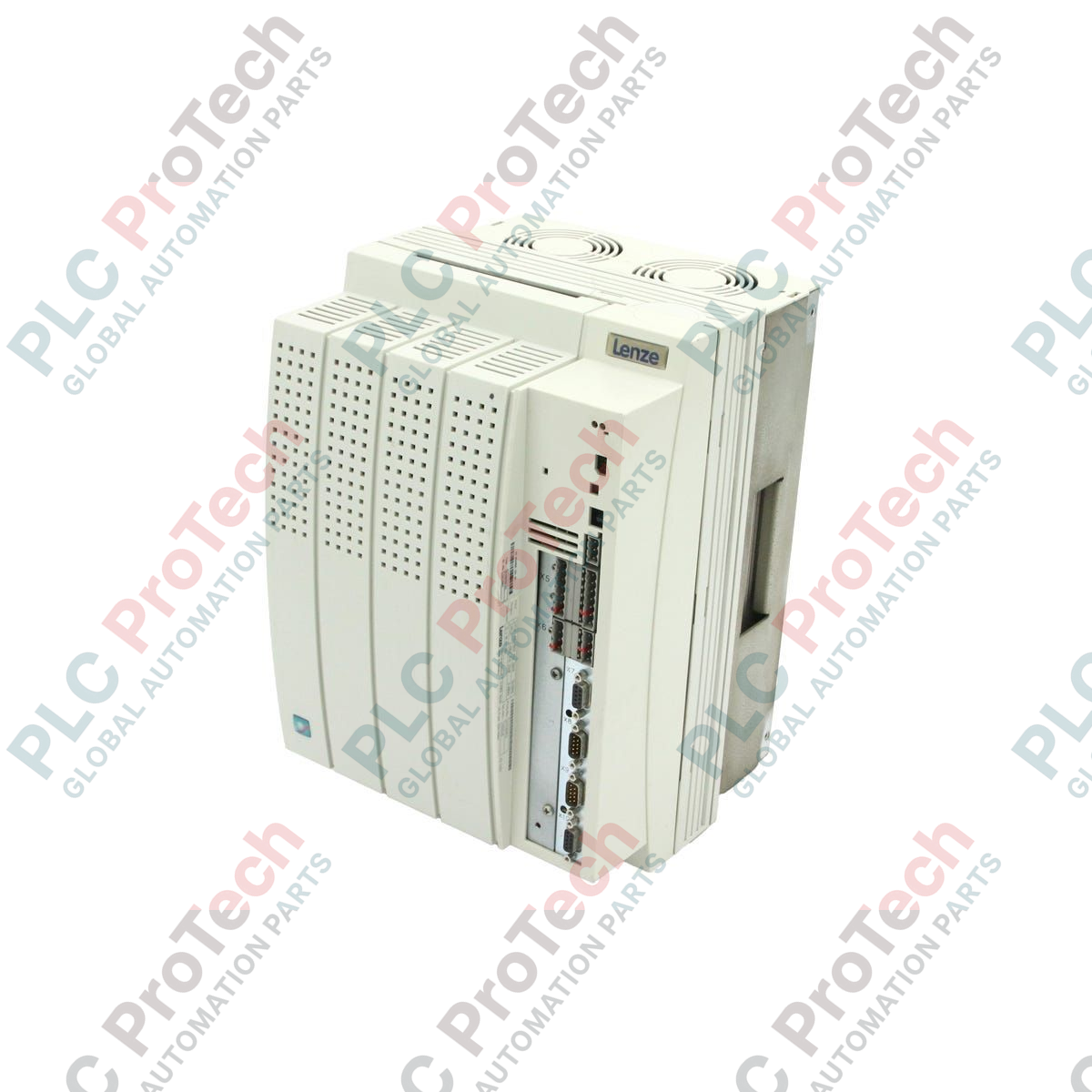
Product Overview
The Lenze EVS9329-EP (EVS9329-EP) is a high-performance servo position controller engineered for demanding motion control tasks within heavy-duty industrial automation. Designed to deliver a rated power of 30.0 kW, this unit provides the precise torque and speed regulation required for complex applications such as high-speed assembly lines, metal forming machinery, and large-scale material handling systems. By integrating advanced positioning algorithms directly into the drive logic, the EVS9329-EP reduces the computational load on the central PLC, effectively increasing throughput and minimizing mechanical stress to prevent unscheduled machine stoppages.
Technical Configuration
The EVS9329-EP utilizes a robust hardware architecture tailored for high-inertia motor control and dynamic response. As part of the 9300-Series, it is built to sustain long-term operation in challenging industrial environments.
-
Positioning Logic: Features integrated position control capabilities, allowing for multi-axis synchronization and complex point-to-point motion profiles without external controllers.
-
Thermal and Electrical Durability: The unit is rated at IP20, necessitating installation within a climate-controlled or dust-protected electrical cabinet. It features advanced internal monitoring to protect against overvoltage, undervoltage, and thermal overload.
-
Modularity: The drive supports various fieldbus communication options, enabling seamless integration into established decentralized automation architectures.
-
Power Handling: Designed specifically for 30.0 kW load requirements, the power stage utilizes high-efficiency switching transistors to maintain output stability under high-load transients.
Technical Specifications
| Feature |
Specification |
| Model |
EVS9329-EP |
| Brand |
Lenze |
| Range |
9300-Series |
| Type |
Servo Drives |
| Power Rating |
30.0 kW |
| Weight |
12.50 kg |
| Dimensions |
35.00 x 25.00 x 25.00 cm |
| Enclosure Rating |
IP20 |
| Origin |
Germany |
Frequently Asked Questions
Is the EVS9329-EP suitable for retrofitting into older 9300-Series systems?
Yes, this unit is a direct replacement for existing 30.0 kW EVS9329-EP installations. It maintains full parameter compatibility, allowing for "swap-in" maintenance without requiring a complete rewrite of your existing application software.
What precautions should be taken for a 30.0 kW drive installation?
Due to the power density of this servo drive, ensure adequate clearance (at least 100 mm) above and below the unit for air circulation. The cabinet should be equipped with forced ventilation to prevent the internal temperature from exceeding the rated limit, which could otherwise lead to premature power stage derating.
Does this drive require specialized software for initial configuration?
Yes, the 9300-Series controllers utilize Lenze’s proprietary configuration software. Ensure you have the correct version of the software and the appropriate communication adapter (often requiring an RS232 or fieldbus gateway) before attempting to upload or download parameters.
Engineering Integration and Safety Protocols
-
Thermal Management: Given the 30.0 kW rating, the drive generates significant heat during operation. It is highly recommended to mount the drive on a thermally conductive backplane and monitor the internal heatsink temperature via the device diagnostics.
-
Wiring and Shielding: For servo applications, use high-quality shielded motor cables. The motor cable shield must be connected to the drive's PE terminal or the designated EMC shield clamp to minimize electromagnetic interference (EMI) that could affect sensitive analog sensors or communication lines.
-
Pre-commissioning Checks: Before applying full DC bus voltage, verify all control and feedback wiring. Specifically, confirm the integrity of the encoder feedback cable, as a loose connection here can lead to immediate "Follow Error" trips or uncontrolled axis movement.
-
Safety Note: This drive operates with high-voltage DC bus potential. Always wait for the "Charge" LED to fully extinguish after removing power before touching internal components or disconnecting terminals to avoid electrical shock.