


Implementing 3-Switch XOR Ladder Logic with Internal Bit
Implement a 3-SPST switch XOR light circuit in LogixPro or RSLogix 500 using an internal relay bit. Includes truth tables, boolean equations, and verified.

Designed for high-performance multi-axis motion control, the Mitsubishi Electric MR-J4W2-1010B serves as a dual-axis AC servo amplifier operating within the MELSERVO-J4 product line. This unit integrates two independent 1.0 kW drive axes into a single physical housing, significantly reducing panel footprint and simplify cabling. Featuring high-speed SSCNET III/H fiber-optic communication, it provides high-speed synchronous control with real-time feedback. The amplifier is engineered to support rotary, linear, and direct-drive servo motors, adapting to complex motion profiles with integrated vibration suppression and advanced tuning functions.
| Parameter | Specification Value |
|---|---|
| Manufacturer | Mitsubishi Electric |
| Model Code | MR-J4W2-1010B |
| Series Name | MELSERVO-J4 (MR-J4 Series) |
| Number of Controlled Axes | 2 Axes (Axis A and Axis B) |
| Rated Output Power | 1.0 kW (Axis A) + 1.0 kW (Axis B) |
| Main Circuit Power Supply | 3-phase 200 VAC to 240 VAC, 50/60 Hz |
| Control Circuit Power Supply | 1-phase 200 VAC to 240 VAC, 50/60 Hz |
| Communication Interface | SSCNET III/H (Optical High-Speed Network) |
| Control Method | Sine-wave PWM control / Current control system |
| Cooling Method | Forced cooling fan |
| Ambient Operating Temperature | 0 to 55 degC (non-freezing) |
| Ambient Operating Humidity | 5% to 90% RH (non-condensing) |
| Unit Weight | 2.3 kg |
| Dimensions (W x H x D) | 85 mm x 168 mm x 195 mm |
| Terminal / Connection Port | Function / Circuit Assignment |
|---|---|
| CN1A | SSCNET III/H Front Connection (Optical Input from controller or previous drive) |
| CN1B | SSCNET III/H Rear Connection (Optical Output to next drive in network line) |
| CN2A | Axis A Encoder Input Connector |
| CN2B | Axis B Encoder Input Connector |
| L1, L2, L3 | Main Power Input Terminals (3-phase 200-240 VAC) |
| L11, L21 | Control Power Input Terminals (Single-phase 200-240 VAC) |
| U, V, W (Axis A) | Axis A Servo Motor Power Output Terminals |
| U, V, W (Axis B) | Axis B Servo Motor Power Output Terminals |
When migrating from two separate single-axis MR-J4-100B amplifiers to a single MR-J4W2-1010B unit, ensure you are utilizing MR Configurator2 (version 1.20W or higher). The software treats this dual-axis unit under a single physical station address with sub-axis parameter tabs. Check that your PLC network configuration map has assigned consecutive Axis A and Axis B addresses inside the Simple Motion Module or Motion Controller setup.
Since Axis A and Axis B share a single, built-in regenerative resistor, simultaneous deceleration of both high-inertia loads will quickly trigger regenerative overvoltage faults (Fault AL.30 or AL.33). If both axes operate under rapid cyclical start/stop sequences, we strongly advise installing an external regenerative option (such as the MR-RB12) to bypass the internal limits and prevent thermal overload of the integrated bus.
SSCNET III/H fiber-optic cables (CN1A and CN1B) are extremely sensitive to particulate contamination. Use dedicated cleaning fluid and lint-free wipes on the fiber ends before mating. A minute dust particle can degrade signal intensity, resulting in intermittent SSCNET command errors (AL.37 or AL.E4). Observe the minimum bending radius of 25 mm for standard fiber cables; tighter bends can attenuate the optical link signal permanently.
CRITICAL WARNING
Isolate and lock out all 3-phase mains (L1/L2/L3) and control power (L11/L21) circuits before handling wiring. High-voltage charge remains stored in the internal DC bus capacitors after power disconnection. Always wait a minimum of 15 minutes and verify that the voltage across terminals P+ and N- is under 50 VDC using an appropriately rated digital multimeter before initiating maintenance.
Global Express Shipping
Returns & Warranty


Manufacturer: Mitsubishi Electric
Product No.: MR-J4W2-1010B
Country of origin:United States
Product Type: AC Servo Amplifiers
Payment: T/T, Western Union
Weight: 2300g
Dimensions: 85 mm x 168 mm x 195 mm
Shipping port: Xiamen
Warranty: 12 months
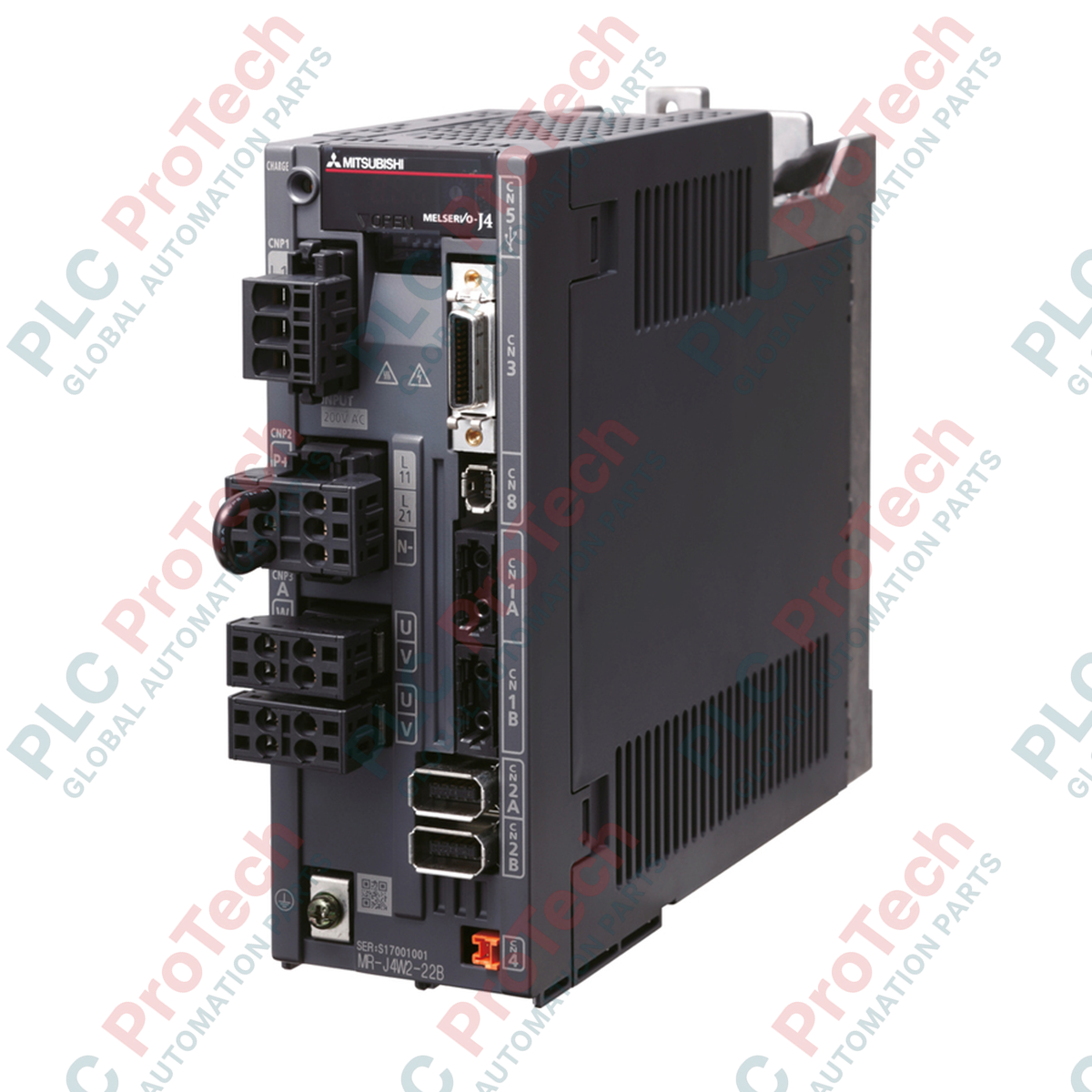
Designed for high-performance multi-axis motion control, the Mitsubishi Electric MR-J4W2-1010B serves as a dual-axis AC servo amplifier operating within the MELSERVO-J4 product line. This unit integrates two independent 1.0 kW drive axes into a single physical housing, significantly reducing panel footprint and simplify cabling. Featuring high-speed SSCNET III/H fiber-optic communication, it provides high-speed synchronous control with real-time feedback. The amplifier is engineered to support rotary, linear, and direct-drive servo motors, adapting to complex motion profiles with integrated vibration suppression and advanced tuning functions.
| Parameter | Specification Value |
|---|---|
| Manufacturer | Mitsubishi Electric |
| Model Code | MR-J4W2-1010B |
| Series Name | MELSERVO-J4 (MR-J4 Series) |
| Number of Controlled Axes | 2 Axes (Axis A and Axis B) |
| Rated Output Power | 1.0 kW (Axis A) + 1.0 kW (Axis B) |
| Main Circuit Power Supply | 3-phase 200 VAC to 240 VAC, 50/60 Hz |
| Control Circuit Power Supply | 1-phase 200 VAC to 240 VAC, 50/60 Hz |
| Communication Interface | SSCNET III/H (Optical High-Speed Network) |
| Control Method | Sine-wave PWM control / Current control system |
| Cooling Method | Forced cooling fan |
| Ambient Operating Temperature | 0 to 55 degC (non-freezing) |
| Ambient Operating Humidity | 5% to 90% RH (non-condensing) |
| Unit Weight | 2.3 kg |
| Dimensions (W x H x D) | 85 mm x 168 mm x 195 mm |
| Terminal / Connection Port | Function / Circuit Assignment |
|---|---|
| CN1A | SSCNET III/H Front Connection (Optical Input from controller or previous drive) |
| CN1B | SSCNET III/H Rear Connection (Optical Output to next drive in network line) |
| CN2A | Axis A Encoder Input Connector |
| CN2B | Axis B Encoder Input Connector |
| L1, L2, L3 | Main Power Input Terminals (3-phase 200-240 VAC) |
| L11, L21 | Control Power Input Terminals (Single-phase 200-240 VAC) |
| U, V, W (Axis A) | Axis A Servo Motor Power Output Terminals |
| U, V, W (Axis B) | Axis B Servo Motor Power Output Terminals |
When migrating from two separate single-axis MR-J4-100B amplifiers to a single MR-J4W2-1010B unit, ensure you are utilizing MR Configurator2 (version 1.20W or higher). The software treats this dual-axis unit under a single physical station address with sub-axis parameter tabs. Check that your PLC network configuration map has assigned consecutive Axis A and Axis B addresses inside the Simple Motion Module or Motion Controller setup.
Since Axis A and Axis B share a single, built-in regenerative resistor, simultaneous deceleration of both high-inertia loads will quickly trigger regenerative overvoltage faults (Fault AL.30 or AL.33). If both axes operate under rapid cyclical start/stop sequences, we strongly advise installing an external regenerative option (such as the MR-RB12) to bypass the internal limits and prevent thermal overload of the integrated bus.
SSCNET III/H fiber-optic cables (CN1A and CN1B) are extremely sensitive to particulate contamination. Use dedicated cleaning fluid and lint-free wipes on the fiber ends before mating. A minute dust particle can degrade signal intensity, resulting in intermittent SSCNET command errors (AL.37 or AL.E4). Observe the minimum bending radius of 25 mm for standard fiber cables; tighter bends can attenuate the optical link signal permanently.
CRITICAL WARNING
Isolate and lock out all 3-phase mains (L1/L2/L3) and control power (L11/L21) circuits before handling wiring. High-voltage charge remains stored in the internal DC bus capacitors after power disconnection. Always wait a minimum of 15 minutes and verify that the voltage across terminals P+ and N- is under 50 VDC using an appropriately rated digital multimeter before initiating maintenance.
Global Express Shipping
Returns & Warranty
Orders are processed and delivered Monday-Friday (excluding public holidays).
For full eligibility, restocking fees, and international return details, please view our official Refund & Return Policy .
| Country of origin |
United States
|

Implement a 3-SPST switch XOR light circuit in LogixPro or RSLogix 500 using an internal relay bit. Includes truth tables, boolean equations, and verified.

Integrate Allen-Bradley CompactLogix, Caterpillar ATS, and generators into DeltaV DCS over Modbus RTU. Covers ProSoft MVI69-MCM, Miille DIN266 gateways.

ONS instruction fires but the OTE coil never latches in Studio 5000 because the one-shot is only true for one scan. Use OTL/OTU or seal-in logic instead.

Configure Allen-Bradley Kinetix 5500 servo drives on EtherNet/IP. Covers CIP Sync, IEEE 1588 V2 timing, Stratix selection, DLR topology, and HMI.

A moving-average filter is the sliding-window smoother most instrument engineers drop into DCS and PLC analog paths. Here is how the window works, how N and sample time set lag, and when a...

On Frame 5–9 gas turbines, GE Mark VI and Mark VIe run control as function-block application software. This article maps process, protection, and sequencing functions—and what Toolbox ST access...