


First TwinCAT PLC Project on a Beckhoff IPC
Build and verify a first TwinCAT PLC project on a Beckhoff IPC. This checklist covers target selection, EtherCAT discovery, I/O mapping, safe activation, restart tests, and commissioning records.
Manufacturer: Mitsubishi Electric
Product No.: MR-J4W2-44B
Country of origin:United States
Product Type: Servo Amplifiers
Payment: T/T, Western Union
Weight: 1400g
Dimensions: 195 mm x 60 mm x 168 mm
Shipping port: Xiamen
Warranty: 12 months
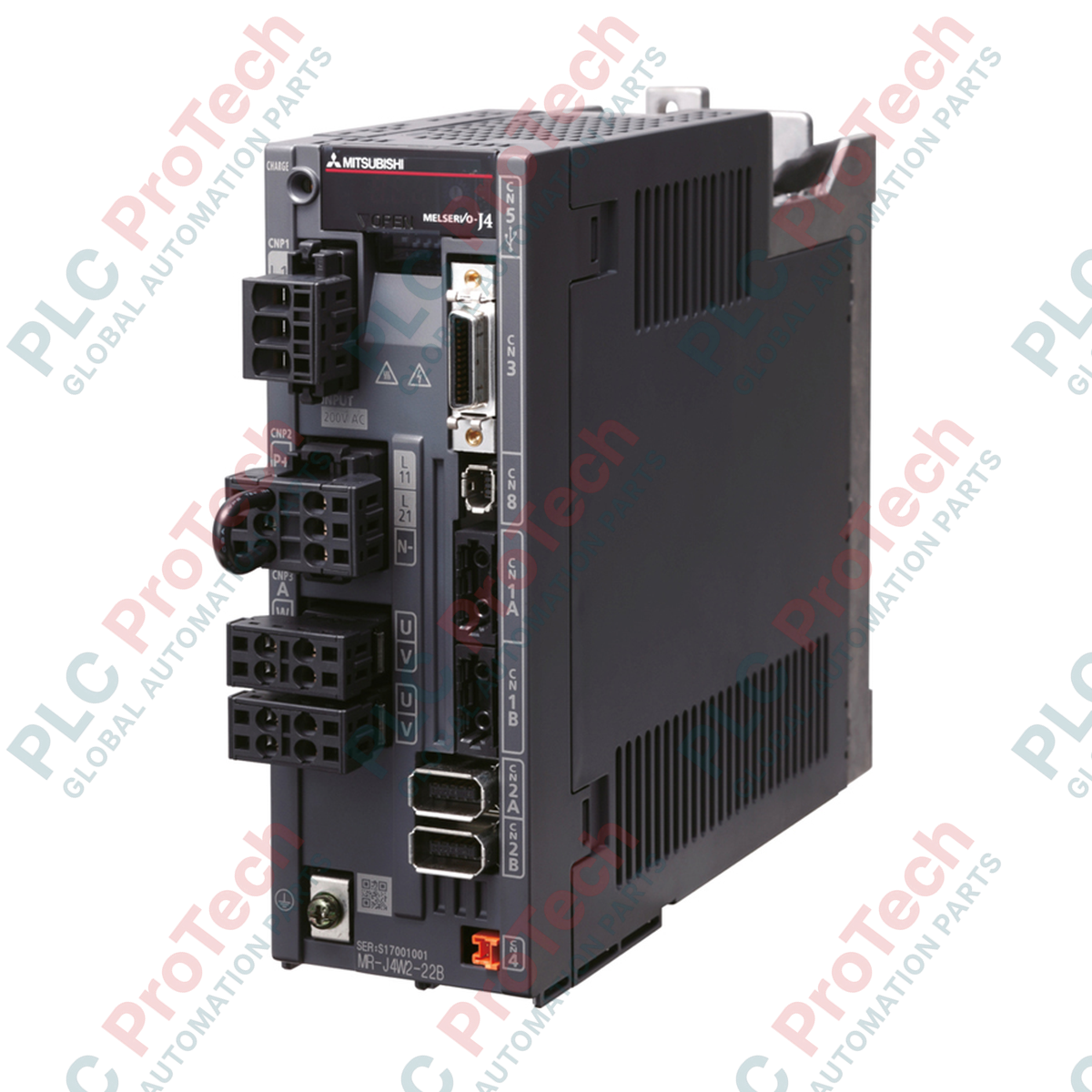
Designed to execute synchronized multi-axis control within a single space-saving envelope, the Mitsubishi Electric MR-J4W2-44B is a dual-axis digital AC servo amplifier operating on the MELSERVO-J4 platform. By consolidating control electronics for two independent 0.4 kW axes, this unit significantly reduces control panel footprints, optimizes power distribution, and streamlines network routing. The integration of high-speed SSCNET III/H optical fiber communications enables high-resolution motion synchronization with negligible electromagnetic interference, making it an ideal choice for high-speed, multi-axis automated assemblies.
| Manufacturer | Mitsubishi Electric |
| Model Number | MR-J4W2-44B |
| Series Name | MELSERVO-J4 (MR-J4) |
| Controlled Axes | 2 Axes (Axis A and Axis B) |
| Rated Output Power | 0.4 kW per axis (Total 0.8 kW) |
| Communication Interface | SSCNET III/H (Optical connection) |
| Main Circuit Power Supply | 3-phase 200 to 240 VAC, 50/60 Hz |
| Control Circuit Power Supply | 1-phase 200 to 240 VAC, 50/60 Hz |
| Encoder Compatibility | 22-bit absolute/incremental systems |
| Cooling Method | Natural cooling |
| Ambient Operating Temperature | 0 to 55 degC (non-freezing) |
| Dimensions (H x W x D) | 195 mm x 60 mm x 168 mm |
| Net Weight | 1.4 kg |
| Shipping Weight (Calculated) | 3.5 kg |
| Terminal / Connector Code | Functional Assignment |
|---|---|
| L1 / L2 / L3 | Main circuit power supply input (200-240 VAC) |
| L11 / L21 | Control circuit power supply input |
| U / V / W (Axis A) | Servo motor output terminals for Axis A |
| U / V / W (Axis B) | Servo motor output terminals for Axis B |
| CN1A / CN1B | SSCNET III/H optical fiber loop connectors (In/Out) |
| CN2A / CN2B | Encoder connection interfaces for Axis A / Axis B |
| CN8 | Functional safety signal connector (STO) |
The MR-J4W2 series is designed as the primary platform for multi-axis configurations within the MR-J4 ecosystem. Note that when migrating legacy MR-J3W units to the MR-J4W2 configuration, parameter translation within the programming suite (such as GX Works2 or GX Works3) is required. While physical mounting footprints differ slightly from single-axis units, the space gains from eliminating independent control power cabling easily justify the transition.
Because both Axis A and Axis B share a common internal DC bus, regenerative energy from decelerating one axis is naturally utilized by the second motoring axis. However, if both axes undergo simultaneous high-inertia deceleration, the regenerative capacity can quickly saturate the internal capacitor, triggering an Overvoltage (AL.33) fault. For operations with continuous regenerative cycles or high load inertia, always calculate total system regeneration requirements and connect an appropriately sized external regeneration resistor across the L+ and L- terminals.
When laying the SSCNET III/H optical fiber cables (MR-J3BUS_M), do not violate the minimum bend radius of 25 mm. Sharp bends or excessive zip-tie tension on the fiber optic routing will attenuate the light signal, leading to random line failures (AL.37) or communication errors (AL.E6). Always cap unused optical ports on the amplifier to prevent dust and humidity contamination of the optical transceiver lens.
CRITICAL WARNING:
Risk of electric shock and residual charge discharge. Always disconnect the main circuit and control circuit power supplies before beginning physical installation or wiring. Wait at least 15 minutes after power-down for the internal charge lamps on the front face of the amplifier to completely extinguish before handling cable connections.

Global Express Shipping
Returns & Warranty


Global Express Shipping
Returns & Warranty
Orders are processed and delivered Monday-Friday (excluding public holidays).
For full eligibility, restocking fees, and international return details, please view our official Refund & Return Policy .
| Country of origin |
United States
|

Build and verify a first TwinCAT PLC project on a Beckhoff IPC. This checklist covers target selection, EtherCAT discovery, I/O mapping, safe activation, restart tests, and commissioning records.

A practical commissioning sequence for KEPServerEX OPC UA connections: define data ownership, test tags locally, configure endpoint and certificate trust, limit access, then verify failure recovery...

Commissioning an Ethernet-connected PLC often starts with the laptop, not the controller. Learn how to record existing settings, choose a temporary address, test connectivity, and restore the plant...

Combustible dust controls require more than alarms. Learn how to map dust generation, select instrumentation, design interlocks, handle failed feedback, test safe states, and maintain the full...

Hairpin windings raise slot fill and support compact traction motors, but conductor geometry, AC losses, insulation damage, weld quality, and cooling determine whether the design meets its targets.

Use Ansible to standardize SCADA server changes without expanding OT risk. This guide covers inventories, idempotent playbooks, staged testing, credentials, logging, and practical rollback controls.