


Implementing 3-Switch XOR Ladder Logic with Internal Bit
Implement a 3-SPST switch XOR light circuit in LogixPro or RSLogix 500 using an internal relay bit. Includes truth tables, boolean equations, and verified.

Designed for high-performance positioning and multi-axis synchronization within the MELSEC-Q platform, the QD77MS16 Simple Motion Module delivers advanced motion control capabilities over the high-speed optical SSCNET III/H network. This module streamlines complex motion applications by integrating positioning control, synchronous control, and electronic cam functionality into a single slot design. By leveraging fiber-optic communication, the QD77MS16 ensures noise-immune, high-speed data transmission between the controller and servo amplifiers, making it highly reliable for demanding industrial automation setups.
The module supports synchronous operations such as electronic gears, clutches, and cams without requiring complex programming, relying instead on parameter-based configurations in GX Works2. It manages 2-, 3-, or 4-axis linear interpolation and 2-axis circular interpolation, enabling smooth trajectory execution for complex mechanical systems. It functions as an ideal interface for high-precision machinery requiring multi-axis coordination and centralized diagnostic monitoring.
| Parameter | Specification |
|---|---|
| Manufacturer | Mitsubishi Electric |
| Part Number/Model | QD77MS16 |
| Series | MELSEC-Q Series |
| Module Type | Simple Motion Module |
| Number of Control Axes | 16 axes |
| Servo Network Connection | SSCNET III/H (Optical communication) |
| Communication Cycle | 0.88 ms or 1.77 ms (depending on configured axis limit) |
| Interpolation Capabilities | 2-, 3-, or 4-axis linear interpolation, 2-axis circular interpolation |
| Control Method | PTP (Point-to-Point) control, CP (Continuous Path) control, Speed-Position switching, Position-Speed switching |
| Control Units | mm, inch, degree, pulse (PLS) |
| Positioning Data Capacity | 600 points per axis |
| Internal Current Consumption | 0.75 A (at 5V DC) |
| Backplane Slot Width | Single slot on MELSEC-Q base unit |
| Interface Port | Function Description |
|---|---|
| SSCNET III/H (CN1) | Optical connector for connection to downstream servo amplifiers (MR-J4/MR-J3 series). |
| External Input Connector | For manual pulse generator, external inputs (FLS, RLS, DOG, STOP, EMI), and high-speed touch probes. |
Global Express Shipping
Returns & Warranty


Manufacturer: Mitsubishi Electric
Product No.: QD77MS16
Country of origin:United States
Product Type: Simple Motion Modules
Payment: T/T, Western Union
Weight: 500g
Shipping port: Xiamen
Warranty: 12 months
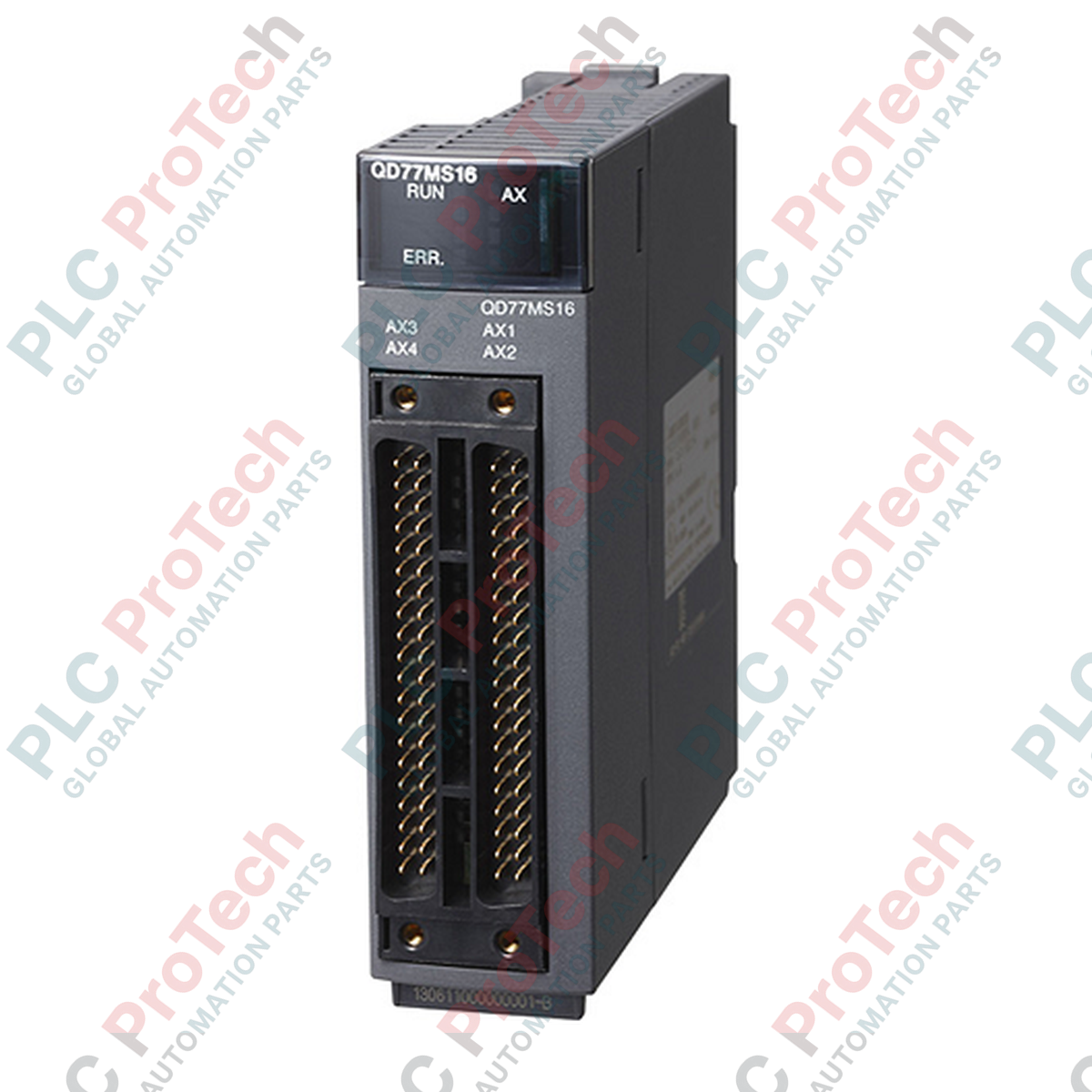
Designed for high-performance positioning and multi-axis synchronization within the MELSEC-Q platform, the QD77MS16 Simple Motion Module delivers advanced motion control capabilities over the high-speed optical SSCNET III/H network. This module streamlines complex motion applications by integrating positioning control, synchronous control, and electronic cam functionality into a single slot design. By leveraging fiber-optic communication, the QD77MS16 ensures noise-immune, high-speed data transmission between the controller and servo amplifiers, making it highly reliable for demanding industrial automation setups.
The module supports synchronous operations such as electronic gears, clutches, and cams without requiring complex programming, relying instead on parameter-based configurations in GX Works2. It manages 2-, 3-, or 4-axis linear interpolation and 2-axis circular interpolation, enabling smooth trajectory execution for complex mechanical systems. It functions as an ideal interface for high-precision machinery requiring multi-axis coordination and centralized diagnostic monitoring.
| Parameter | Specification |
|---|---|
| Manufacturer | Mitsubishi Electric |
| Part Number/Model | QD77MS16 |
| Series | MELSEC-Q Series |
| Module Type | Simple Motion Module |
| Number of Control Axes | 16 axes |
| Servo Network Connection | SSCNET III/H (Optical communication) |
| Communication Cycle | 0.88 ms or 1.77 ms (depending on configured axis limit) |
| Interpolation Capabilities | 2-, 3-, or 4-axis linear interpolation, 2-axis circular interpolation |
| Control Method | PTP (Point-to-Point) control, CP (Continuous Path) control, Speed-Position switching, Position-Speed switching |
| Control Units | mm, inch, degree, pulse (PLS) |
| Positioning Data Capacity | 600 points per axis |
| Internal Current Consumption | 0.75 A (at 5V DC) |
| Backplane Slot Width | Single slot on MELSEC-Q base unit |
| Interface Port | Function Description |
|---|---|
| SSCNET III/H (CN1) | Optical connector for connection to downstream servo amplifiers (MR-J4/MR-J3 series). |
| External Input Connector | For manual pulse generator, external inputs (FLS, RLS, DOG, STOP, EMI), and high-speed touch probes. |
Global Express Shipping
Returns & Warranty
Orders are processed and delivered Monday-Friday (excluding public holidays).
For full eligibility, restocking fees, and international return details, please view our official Refund & Return Policy .
| Country of origin |
United States
|

Implement a 3-SPST switch XOR light circuit in LogixPro or RSLogix 500 using an internal relay bit. Includes truth tables, boolean equations, and verified.

Integrate Allen-Bradley CompactLogix, Caterpillar ATS, and generators into DeltaV DCS over Modbus RTU. Covers ProSoft MVI69-MCM, Miille DIN266 gateways.

ONS instruction fires but the OTE coil never latches in Studio 5000 because the one-shot is only true for one scan. Use OTL/OTU or seal-in logic instead.

Configure Allen-Bradley Kinetix 5500 servo drives on EtherNet/IP. Covers CIP Sync, IEEE 1588 V2 timing, Stratix selection, DLR topology, and HMI.

A moving-average filter is the sliding-window smoother most instrument engineers drop into DCS and PLC analog paths. Here is how the window works, how N and sample time set lag, and when a...

On Frame 5–9 gas turbines, GE Mark VI and Mark VIe run control as function-block application software. This article maps process, protection, and sequencing functions—and what Toolbox ST access...