


Implementing 3-Switch XOR Ladder Logic with Internal Bit
Implement a 3-SPST switch XOR light circuit in LogixPro or RSLogix 500 using an internal relay bit. Includes truth tables, boolean equations, and verified.

Managing complex positioning profiles and multi-axis synchronization within the MELSEC Q Series architecture is the primary role of the Mitsubishi Electric QD77MS4 Simple Motion Module. This high-density module provides control over up to 4 independent or synchronized axes, utilizing the noise-immune, high-speed SSCNET III/H fiber-optic network. By implementing high-speed operation cycles, it guarantees fast response times and precise coordinate tracking in complex industrial machinery.
Engineers can easily configure advanced motion profiles including Point-to-Point (PTP) positioning, linear and circular interpolation, speed-torque control transitions, and electronic cam profiling directly via GX Works programming software. The physical integration consumes a minimal footprint on the base rack, occupying only 32 standard I/O points.
| Parameter | Specification |
|---|---|
| Manufacturer | Mitsubishi Electric |
| Model Number | QD77MS4 |
| Series | MELSEC Q Series |
| Module Type | Simple Motion Module |
| Number of Control Axes | 4 axes |
| Operation Cycle | 0.88 ms / 1.77 ms |
| Control Modes | PTP (Point To Point), linear interpolation (up to 4 axes), circular interpolation (2 axes), speed, speed-position, position-speed, speed-torque |
| Control Units | mm, inch, degree, PLS |
| Occupied I/O Points | 32 points (Intelligent function module assignment) |
| Internal Current Consumption (5 VDC) | 0.6 A |
| Flash ROM Write Capacity | Max. 100,000 writes |
| Module Weight | 0.16 kg |
| Shipping Weight (Calculated) | 1.50 kg |
| Port / Connection | Interface Specification / Function |
|---|---|
| SSCNET III/H Port | High-speed fiber optic connection (150 Mbps) for direct communication with MR-J4 servo amplifiers. |
| External Input Connection | Multi-pin front connector for external command signals (such as limit switches, proximity, and stop signals). |
The QD77MS4 acts as a functional transition path from older QD75 series modules. Note that because it utilizes the SSCNET III/H fiber optic network protocol, it cannot be directly wired via analog or traditional pulse trains to old-generation servo drives. It requires compatible SSCNET III/H compliant servo amplifiers (such as the MELSERVO MR-J4 series) to operate correctly.
When routing the fiber-optic cables (SSCNET III/H), ensure the minimum bending radius of the fiber lines does not drop below 25 mm. Exceeding this limit will cause signal attenuation, leading to intermittent communications failures and triggering motion faults (often manifesting as axis dropouts). Additionally, ensure unused ports are covered with dust caps to prevent optical performance degradation.
Always match the station numbers assigned via rotary switches on the physical MR-J4 servo amplifiers with the hardware axes configured in the GX Works Simple Motion Module Setting Tool. Misalignment will prevent synchronization during start-up, triggering card initialization errors.
Isolate and lock out all external power sources before installing or removing modules from the PLC chassis. Failure to do so can result in electrical shock, physical damage to the backplane connectors, or module failure due to transient voltage surges.
Power down the entire system rack and verify zero voltage using an appropriate industrial tester.
Align the lower hook of the QD77MS4 module with the mounting slot on the MELSEC Q base unit and press the module firmly onto the backplane connector until it clicks.
Secure the module lock-screw to ground the metal chassis to the backplane frame.
Connect the SSCNET III/H fiber optic cables until they click firmly into the optical terminal ports.
Global Express Shipping
Returns & Warranty


Manufacturer: Mitsubishi Electric
Product No.: QD77MS4
Country of origin:United States
Product Type: Simple Motion Modules
Payment: T/T, Western Union
Weight: 1500g
Shipping port: Xiamen
Warranty: 12 months
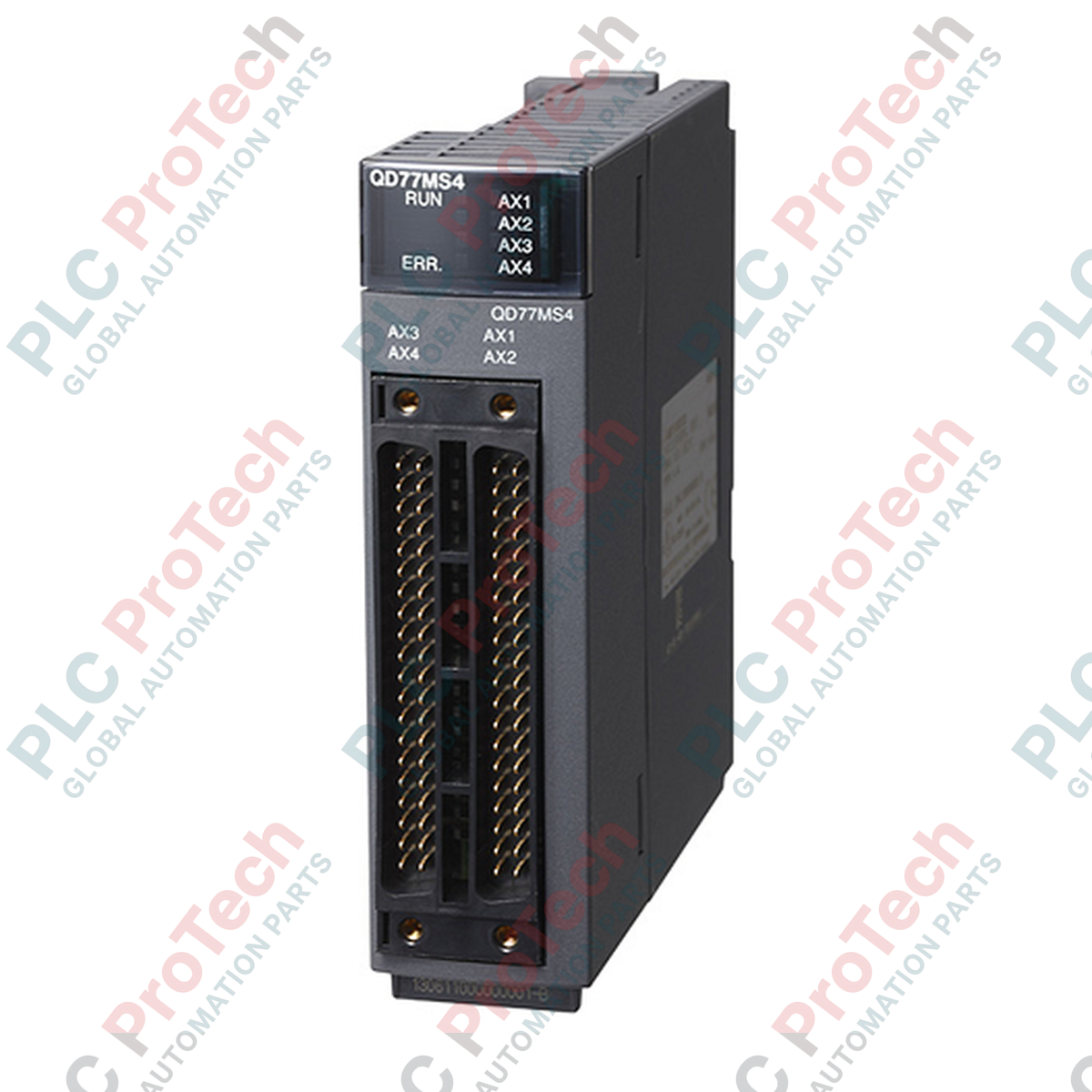
Managing complex positioning profiles and multi-axis synchronization within the MELSEC Q Series architecture is the primary role of the Mitsubishi Electric QD77MS4 Simple Motion Module. This high-density module provides control over up to 4 independent or synchronized axes, utilizing the noise-immune, high-speed SSCNET III/H fiber-optic network. By implementing high-speed operation cycles, it guarantees fast response times and precise coordinate tracking in complex industrial machinery.
Engineers can easily configure advanced motion profiles including Point-to-Point (PTP) positioning, linear and circular interpolation, speed-torque control transitions, and electronic cam profiling directly via GX Works programming software. The physical integration consumes a minimal footprint on the base rack, occupying only 32 standard I/O points.
| Parameter | Specification |
|---|---|
| Manufacturer | Mitsubishi Electric |
| Model Number | QD77MS4 |
| Series | MELSEC Q Series |
| Module Type | Simple Motion Module |
| Number of Control Axes | 4 axes |
| Operation Cycle | 0.88 ms / 1.77 ms |
| Control Modes | PTP (Point To Point), linear interpolation (up to 4 axes), circular interpolation (2 axes), speed, speed-position, position-speed, speed-torque |
| Control Units | mm, inch, degree, PLS |
| Occupied I/O Points | 32 points (Intelligent function module assignment) |
| Internal Current Consumption (5 VDC) | 0.6 A |
| Flash ROM Write Capacity | Max. 100,000 writes |
| Module Weight | 0.16 kg |
| Shipping Weight (Calculated) | 1.50 kg |
| Port / Connection | Interface Specification / Function |
|---|---|
| SSCNET III/H Port | High-speed fiber optic connection (150 Mbps) for direct communication with MR-J4 servo amplifiers. |
| External Input Connection | Multi-pin front connector for external command signals (such as limit switches, proximity, and stop signals). |
The QD77MS4 acts as a functional transition path from older QD75 series modules. Note that because it utilizes the SSCNET III/H fiber optic network protocol, it cannot be directly wired via analog or traditional pulse trains to old-generation servo drives. It requires compatible SSCNET III/H compliant servo amplifiers (such as the MELSERVO MR-J4 series) to operate correctly.
When routing the fiber-optic cables (SSCNET III/H), ensure the minimum bending radius of the fiber lines does not drop below 25 mm. Exceeding this limit will cause signal attenuation, leading to intermittent communications failures and triggering motion faults (often manifesting as axis dropouts). Additionally, ensure unused ports are covered with dust caps to prevent optical performance degradation.
Always match the station numbers assigned via rotary switches on the physical MR-J4 servo amplifiers with the hardware axes configured in the GX Works Simple Motion Module Setting Tool. Misalignment will prevent synchronization during start-up, triggering card initialization errors.
Isolate and lock out all external power sources before installing or removing modules from the PLC chassis. Failure to do so can result in electrical shock, physical damage to the backplane connectors, or module failure due to transient voltage surges.
Power down the entire system rack and verify zero voltage using an appropriate industrial tester.
Align the lower hook of the QD77MS4 module with the mounting slot on the MELSEC Q base unit and press the module firmly onto the backplane connector until it clicks.
Secure the module lock-screw to ground the metal chassis to the backplane frame.
Connect the SSCNET III/H fiber optic cables until they click firmly into the optical terminal ports.
Global Express Shipping
Returns & Warranty
Orders are processed and delivered Monday-Friday (excluding public holidays).
For full eligibility, restocking fees, and international return details, please view our official Refund & Return Policy .
| Country of origin |
United States
|

Implement a 3-SPST switch XOR light circuit in LogixPro or RSLogix 500 using an internal relay bit. Includes truth tables, boolean equations, and verified.

Integrate Allen-Bradley CompactLogix, Caterpillar ATS, and generators into DeltaV DCS over Modbus RTU. Covers ProSoft MVI69-MCM, Miille DIN266 gateways.

ONS instruction fires but the OTE coil never latches in Studio 5000 because the one-shot is only true for one scan. Use OTL/OTU or seal-in logic instead.

Configure Allen-Bradley Kinetix 5500 servo drives on EtherNet/IP. Covers CIP Sync, IEEE 1588 V2 timing, Stratix selection, DLR topology, and HMI.

A moving-average filter is the sliding-window smoother most instrument engineers drop into DCS and PLC analog paths. Here is how the window works, how N and sample time set lag, and when a...

On Frame 5–9 gas turbines, GE Mark VI and Mark VIe run control as function-block application software. This article maps process, protection, and sequencing functions—and what Toolbox ST access...