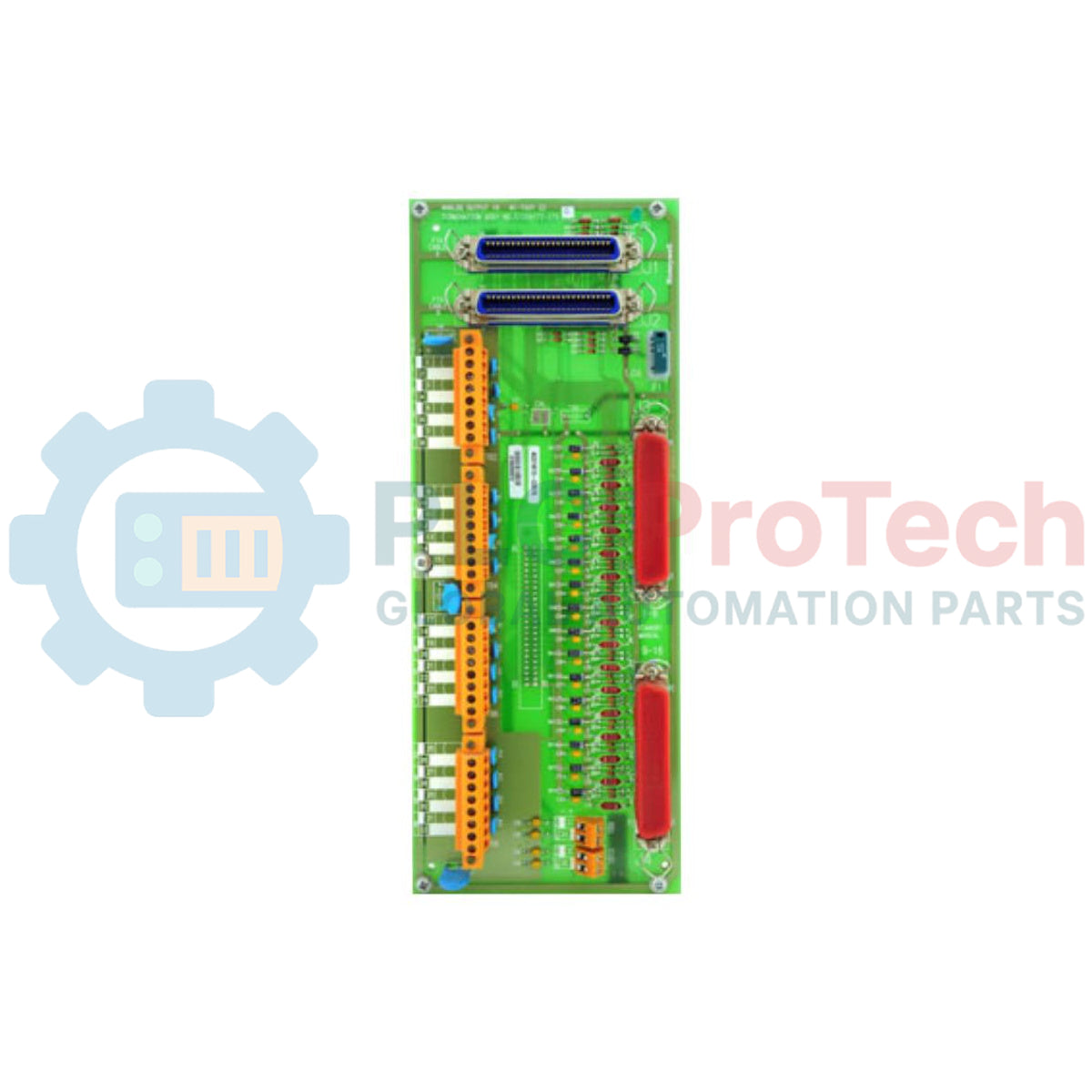
Product Overview
The MU-TAOY22 is a high-performance 16-Point Analog Output Field Termination Assembly (FTA) designed for the Honeywell TDC 3000 and TPS (TotalPlant Solution) systems. This module provides 16 channels of isolated 4-20 mA signals, serving as the critical interface between the process controller and field final control elements such as control valves, actuators, and variable speed drives. Engineered for mission-critical reliability, the MU-TAOY22 supports redundant configurations with standby manual capabilities, ensuring continuous process control even during hardware transitions or maintenance.
Functional Precision & Load Management
The MU-TAOY22 is built for extreme signal stability, featuring a resolution of ±0.05% and a calibrated accuracy of ±0.35%. It handles resistive loads up to 750 Ω at 20 mA, making it compatible with a wide array of long-distance field wiring and high-impedance devices. With a settling time of only 4 ms, the module ensures that control actions are executed almost instantaneously. Furthermore, its advanced surge withstand capability (per ANSI/IEEE C37.90.1) protects the control system from electrical transients often found in heavy industrial environments.
Technical Specifications
| Attribute |
Specification Details |
| Model |
MU-TAOY22 |
| Output Type |
4-20 mA (DC) |
| Output Channels |
16 |
| Directly Settable Range |
0 mA, 2.9 mA to 21.1 mA |
| Resolution |
± 0.05% |
| Settling Time |
4 ms (to 98% of final value) |
| Temperature Stability |
±0.02% Full Scale / °C |
| Max Resistive Load |
750 Ω @ 20 mA |
| FTA Size |
Size B |
| Termination Type |
Type C |
| Shipping Weight |
2.0 kg |
Technical FAQs
What is the significance of the "Redundant w/ Stby Man" feature?
The MU-TAOY22 is designed for high-availability loops. It supports redundant I/O modules where a secondary "Standby" module is ready to take over. The "Stby Man" capability allows for manual control or a safe transition during a failover, with a maximum gap to the field of only 20 ms, ensuring that sensitive control valves do not "glitch" or change position during a module swap.
How does the module handle output ripple?
The module is engineered with a peak-to-peak output ripple of less than 100 mV at power line frequency. This low-noise performance is vital for precision control applications where high-frequency oscillations could cause premature mechanical wear on control valve positioners or actuators.
What happens if the digital input code exceeds normal limits?
The MU-TAOY22 has an absolute maximum current output of 24 mA. This allows the system to drive signals into "over-range" for diagnostic purposes or to fully stroke a valve, while still protecting the internal circuitry from thermal damage due to excessive current draw.
Field Engineering & Installation Guide
-
FTA Mounting: Install the MU-TAOY22 on a standard Honeywell FTA mounting channel. Ensure the "Size B" footprint is accounted for in the cabinet layout to allow for proper cable routing and access to the Type C terminals.
-
Grounding & Shielding: To maintain the ±0.05% linearity, field cable shields should be terminated at the designated ground bar. This minimizes electromagnetic interference (EMI) that could affect the 4-20 mA signal integrity over long distances.
-
Diagnostic Check: The module performs an internal switching hardware diagnostic once per minute. During commissioning, verify that the AO readback accuracy (±4%) is monitored by the system software to ensure the field loop is healthy and the actual current matches the controller's demand.
Engineering Advantages
The MU-TAOY22 represents the industry standard for robust analog output management in legacy DCS environments. Its ability to provide stable, linear 4-20 mA signals under varying temperature and humidity conditions makes it a "fit and forget" component for critical infrastructure. For B2B procurement, choosing original Honeywell MU-TAOY22 FTAs ensures that your TDC 3000 system maintains its original engineering specifications and safety margins, protecting your process from the risks of unplanned downtime and signal drift.