


IC693CPU360 vs IC693CPU364: Ethernet and Power Budget
Compare the IC693CPU360 and IC693CPU364 by Ethernet interface, +5 VDC load, memory, rack limits, and replacement checks.
Manufacturer: Omron
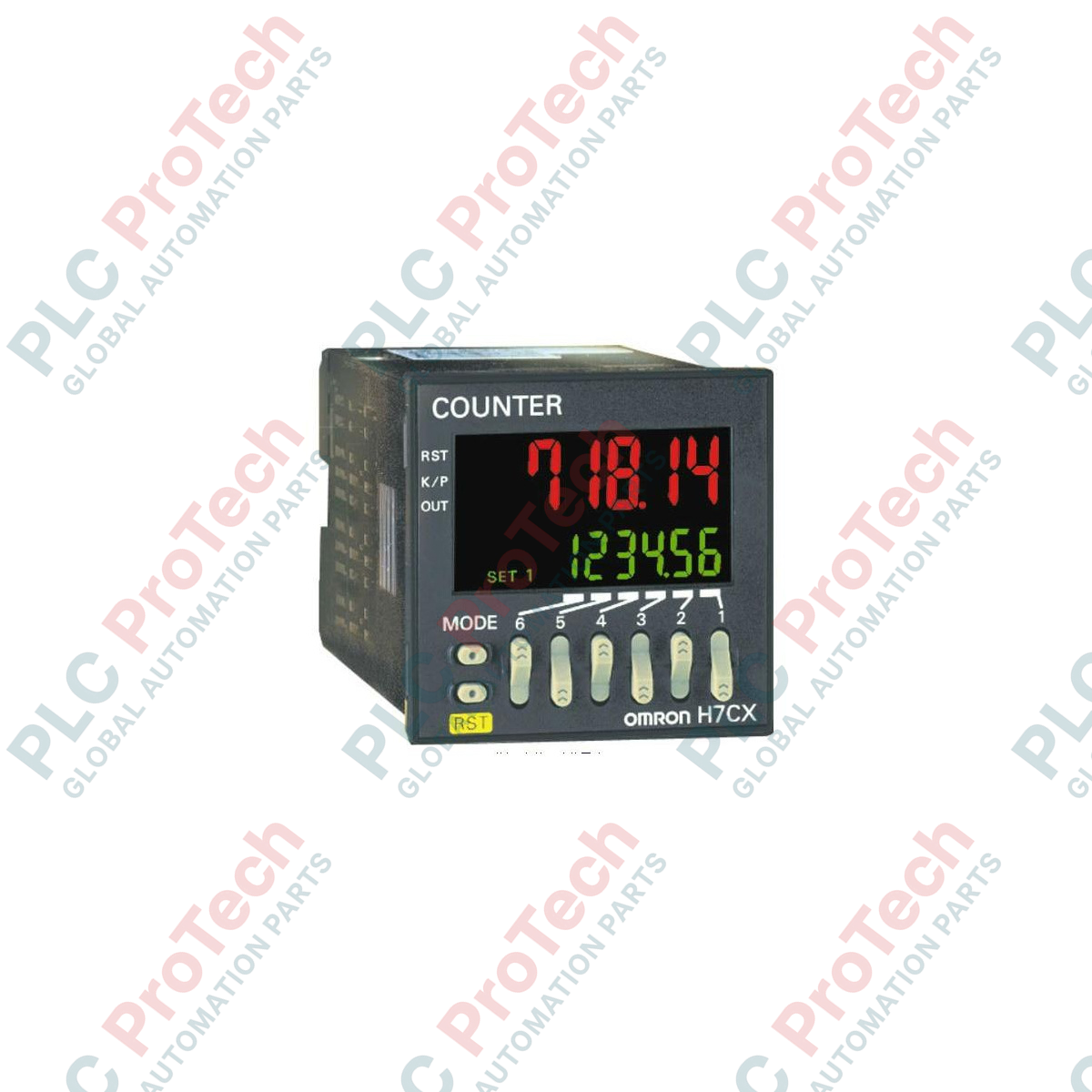
Product No.: H7CX-A11D1-N
Country of origin:Japan
Product Type: Multifunction Counters
Payment: T/T, Western Union
Weight: 2000g
Dimensions: 4.8 cm x 8.41 cm x 4.8 cm
Shipping port: Xiamen
Warranty: 12 months
Integrated seamlessly into modern processing lines, the Omron H7CX-A11D1-N functions as a high-precision 1/16 DIN digital counter and tachometer engineered for rapid pulse monitoring and output coordination. Equipped with a vivid, dual-color PV character display, this multi-mode controller enables operations personnel to track counts, batches, and velocity metrics on a single, compact panel footprint. The device supports a multi-voltage control bus and integrates flexible contact and solid-state output paths to drive secondary automation processes safely and reliably.
| Specification Parameter | Engineering Value |
|---|---|
| Manufacturer | Omron |
| Model Reference | H7CX-A11D1-N |
| Display Digits | 6 digits (-99999 to 999999) |
| Power Supply Voltage | 12 to 24 VDC / 24 VAC at 50/60 Hz |
| External Connections | 11-pin socket connection layout |
| Input Processing Speed | 30 Hz or 5 kHz (DIP-switch selectable) |
| Output Types | Contact (SPDT: 250 VAC, 3 A resistive) and Transistor (NPN/PNP open collector: 30 VDC, 100 mA) |
| Key Protection Range | Physical lockout via internal firmware levels |
| Operating Temperature Limit | -10 to 55 degC (with no icing or condensation) |
| Front Bezel Rating | IP66 / NEMA 4X (dust-proof and drip-proof) |
| Shipping Weight (Calculated) | 2.0 kg (including safe protective box layers) |
| Bezel Dimensions (Calculated) | 48.0 mm x 48.0 mm (1/16 DIN panel mount style) |
| Body Insertion Depth | 84.1 mm |
| 11-Pin Terminal | Function Assignment |
|---|---|
| Pin 1 | Input Common (GND) |
| Pin 2 | Power Supply Input (12-24 VDC / 24 VAC) |
| Pin 3 | Count Input 1 (CP1 Signal Input) |
| Pin 4 | Count Input 2 (CP2 Signal Input) |
| Pin 5 | Reset Input / Gateway Command Signal |
| Pin 6 | Transistor Output Emitter / Common |
| Pin 7 | Power Supply Input (12-24 VDC / 24 VAC) |
| Pin 8 | Transistor Output Collector (NPN/PNP Option) |
| Pin 9 | Contact Output Relay Common (COM) |
| Pin 10 | Contact Output Relay Normally Closed (NC) |
| Pin 11 | Contact Output Relay Normally Open (NO) |
The -N suffix variants directly replace legacy H7CX 11-pin models. While pin assignments remain strictly identical, note that default internal program parameters may vary between standard and newer revisions. Verify DIP switch configuration on the side housing to ensure that internal division ratios, counting modes, and response profiles align with the historical installation configuration.
When configuring for the maximum 5 kHz count speed, ensure input signals originate from solid-state, non-contact proximity sensors or rotary encoders. Mechanical contact inputs will suffer from physical contact bounce, resulting in erratic, false-high counts. If a mechanical switch interface must be used, lower the maximum input counting speed to 30 Hz via the physical DIP switches to activate the internal low-pass noise filter.
Ensure that all high-voltage cabling (specifically output contacts switching heavy inductive loads) is routed in physical separation from input sensor paths. Use twisted-pair shielded cabling for CP1, CP2, and Reset inputs, grounding the shield exclusively at the panel terminal block to mitigate electromagnetically induced signal noise from surrounding active drives and switchgear.
Prepare a standard 45.0 mm x 45.0 mm panel cutout matching standard DIN specifications.
Affix the waterproof gasket around the front housing shoulder to achieve NEMA 4X / IP66 front-face protection.
Slide the module from the front into the panel cutout, then slide the mounting adapter bracket onto the chassis from the rear, tightening physical panel screws until hand-tight.
Configure the physical DIP switch bank located on the rear or side panel according to the required function, input logic (NPN vs PNP), and sensor speed requirements.
Verify connection loops against the 11-pin socket pin configuration map, secure the socket onto the unit, and apply power lines to initiate commissioning.

Global Express Shipping
Returns & Warranty
Global Express Shipping
Returns & Warranty
Orders are processed and delivered Monday-Friday (excluding public holidays).
For full eligibility, restocking fees, and international return details, please view our official Refund & Return Policy .
| Country of origin |
Japan
|

Compare the IC693CPU360 and IC693CPU364 by Ethernet interface, +5 VDC load, memory, rack limits, and replacement checks.

A field-first diagnostic sequence for 1756-OF4 analog output problems: channel mode, removable terminal block, scaling, and controlled electrical checks.

A direct comparison of 1746-OA8 and 1746-OA16 output count, common grouping, backplane current and temperature-derated load limits.

A field checklist for recording the 1761-NET-DNI hardware series, firmware, EDS file, DF1 settings, DeviceNet address and messaging configuration before replacement.

The EL3062 is a 0–10 V EtherCAT terminal. The EL3062-0030 is a 0–30 V variant. This checklist covers identification, scaling and commissioning.

A field checklist for replacing Allen-Bradley 1769-OW8 relay output modules without losing load-group, wiring, and commissioning details.