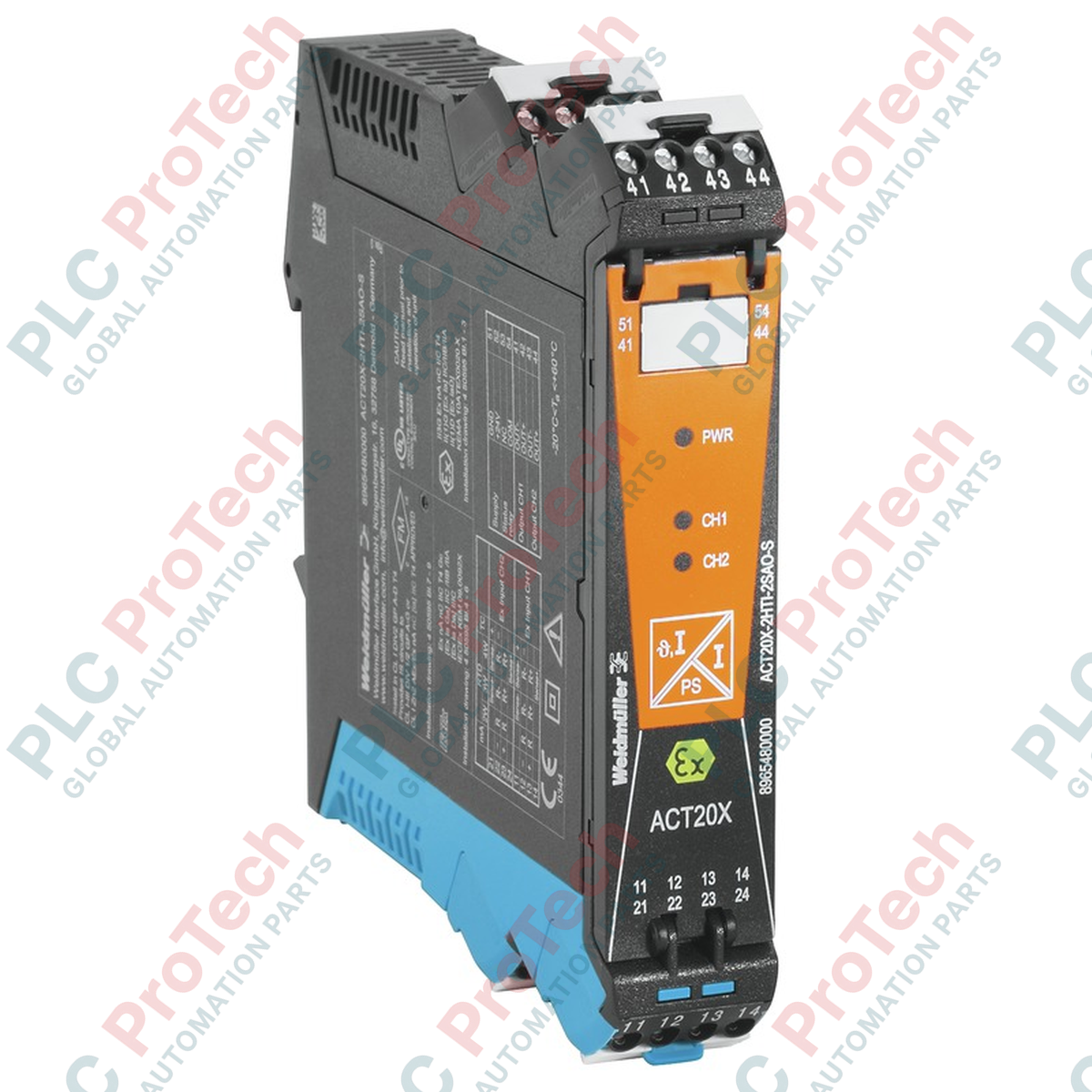
Processing temperature signals from hazardous areas requires high-integrity isolation, which is precisely what the Weidmuller ACT20X-HTI-SAO-S (Article Number 8965470000) delivers. This intrinsically safe temperature transducer converts RTD and thermocouple inputs into a standard isolated analog current signal, ensuring safe and accurate data transmission to the control system. Designed for DIN-rail mounting, it integrates seamlessly into modern process automation architectures.
Key Features
- Intrinsically safe input designed for Zone 0 / Division 1 hazardous area deployments.
- FDT/DTM software-based configuration for precise calibration and parameterization.
- Integrated alarm relay output for line interruption, short circuit, and device errors.
- High galvanic isolation between input, output, and power supply circuits.
- Compact 22.5 mm housing width to maximize control cabinet density.
Industrial Applications
- Chemical and petrochemical processing plants.
- Oil and gas extraction and refining facilities.
- Power generation thermal monitoring.
- Water and wastewater treatment systems.
Technical Specifications
| Parameter |
Value |
| Manufacturer |
Weidmuller |
| Article Number (SKU) |
8965470000 |
| Model Designation |
ACT20X-HTI-SAO-S |
| Supply Voltage |
19.2 to 31.2 V DC |
| Power Consumption |
<= 0.8 W |
| Input Type |
Temperature (RTD, Thermocouple) |
| Output Type |
Active current (analog) |
| Alarm Function |
Line interruption, short circuit, no supply voltage, device error |
| Nominal Switching Voltage |
<= 125 V AC / 110 V DC |
| Continuous Current |
<= 0.5 A AC / 0.3 A DC |
| Step Response Time |
<= 400 ms (with current), <= 1 s (with temperature) |
| Connection Technology |
Screw connection |
| Protection Degree |
IP20 |
| Operating Humidity |
0 to 95% (non-condensing) |
| Operating Temperature |
-20 to +60 degC |
| Dimensions (H x W x D) |
117.2 mm x 22.5 mm x 113.6 mm |
| Net Weight |
0.178 kg |
| Shipping Weight (Calculated) |
1.2 kg |
Connections and Interfaces
| Terminal / Pin |
Function / Circuit Assignment |
| 41 - 44 |
Sensor Input (RTD / Thermocouple / Resistance) |
| 11 - 12 |
Analog Output (Active Current) |
| 13 - 14 |
Device Power Supply (19.2...31.2 V DC) |
| 51 - 52 |
Alarm Relay Output |
Empirical Engineering Insights
Alternative Models & Compatibility
The ACT20X-HTI-SAO-S is part of Weidmuller's specialized intrinsically safe signal converter family. It requires the WI-Manager software (FDT frame) and the specific ACT20X DTM driver package for configuration. Ensure your USB interface cable (such as the Weidmuller CBX200) is compatible before attempting setup.
Application Pitfalls & Engineering Notes
When mounting multiple ACT20X modules side-by-side on a DIN rail, ensure adequate cabinet ventilation. Although the power consumption is low (<= 0.8 W), high ambient temperatures exceeding 60 degC can degrade the internal optocouplers over long-term operation. Always verify that the Ex-protection parameters (Uo, Io, Po) match the connected field sensor's entity parameters.
Commissioning & Wiring Tips
For thermocouple inputs, ensure the cold junction compensation (CJC) is correctly configured in the DTM software. If using RTDs, 3-wire or 4-wire configurations are highly recommended over 2-wire setups to eliminate lead resistance errors. Shielded cabling must be grounded only at the designated safe-area ground point to prevent ground loops.
Installation Guidelines
CRITICAL WARNING: De-energize all power sources before mounting, wiring, or configuring the device. Ensure the installation complies with all local and international intrinsic safety regulations (Ex-protection). Do not connect non-intrinsically safe signals to the blue Ex-input terminals.
1
Mount the device vertically on a standard TS 35 DIN rail.
2
Connect the temperature sensor to the blue Ex-input terminals (41-44) following the sensor-specific wiring diagram.
3
Wire the analog output (11-12), power supply (13-14), and alarm relay (51-52) to the safe-area terminals.
4
Apply power and connect via the front-panel interface to configure sensor type and scaling parameters using FDT/DTM software.