1 z 1

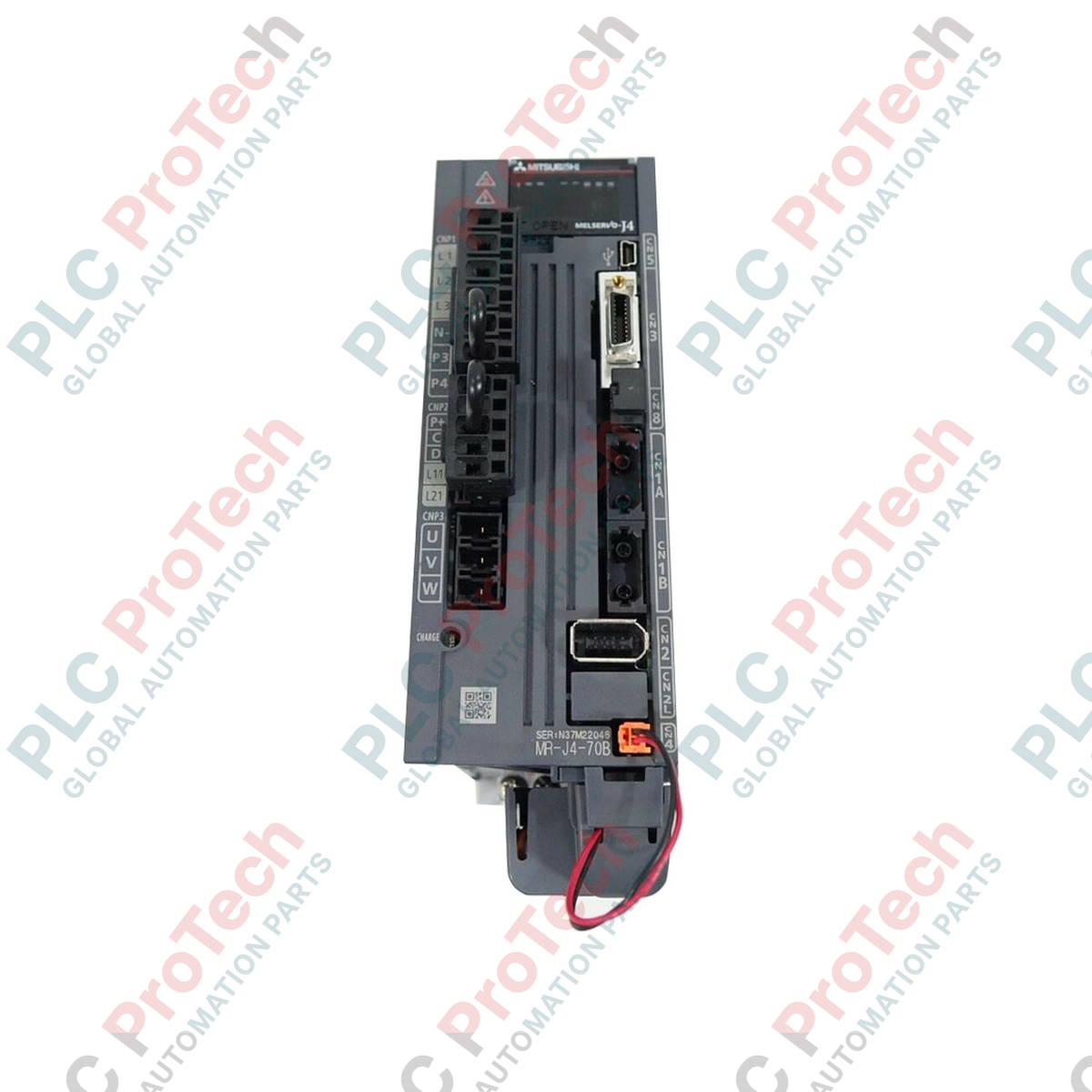
Mitsubishi Electric MR-J4-70B MELSERVO-J4 Series Servo Amplifier

Mitsubishi Electric MR-J4-70B MELSERVO-J4 Series Servo Amplifier

Only 10 item(s) left in stock
  • Manufacturer: Mitsubishi Electric

  • Product No.: MR-J4-70B

  • Country of origin:United States

  • Product Type: Servo Drives

  • Payment: T/T, Western Union

  • Weight: 1400g

  • Shipping port: Xiamen

  • Warranty: 12 months

Množství
Zobrazit veškeré podrobnosti

Description

Engineered for high-performance motion control, the Mitsubishi Electric MR-J4-70B servo amplifier delivers precise position, speed, and torque control within the MELSERVO-J4 ecosystem. Running on an output capacity of 0.75 kW, this 200V class amplifier interfaces natively with motion controllers using the ultra-fast SSCNET III/H synchronous optical network, optimizing cycle times down to 0.222 ms. Its integrated Safe Torque Off (STO) safety function and dynamic vibration suppression filters ensure machine protection and maximum mechanical throughput in demanding factory automation lines.

Key Features

  • SSCNET III/H Command Interface: Optical fiber networking allows high-speed, noise-immune communications with synchronization cycles of 0.222 ms, 0.444 ms, or 0.888 ms.
  • Built-In Safety Functions: Features STO (Safe Torque Off) certified to EN ISO 13849-1 Category 3 PL e and IEC 61508 SIL 3 for rapid motor power de-energization.
  • Dynamic Tuning and Filters: Real-time auto-tuning paired with adaptive vibration suppression, robust filters, and lost motion compensation minimizes settling times and machine resonance.
  • Versatile Power Configurations: Supports single-phase or three-phase input configurations from AC 200V to 240V.

Applications

  • Multi-axis positioning systems and high-speed pick-and-place packaging machinery.
  • Precision semiconductor handling platforms and rotary indexing tables.
  • Automated continuous-path assembly lines requiring synchronized multi-drive networks.

Technical Specifications

Parameter Specification
Manufacturer Mitsubishi Electric
Model Number MR-J4-70B
Product Series MELSERVO-J4 Series
Output Rated Power 0.75 kW
Output Rated Voltage Three-phase AC 170 V
Output Rated Current 5.8 A
Main Circuit Power Input Three-phase or Single-phase AC 200 V to 240 V, 50 Hz / 60 Hz
Main Circuit Rated Current 3.8 A
Control Circuit Power Input Single-phase AC 200 V to 240 V, 50 Hz / 60 Hz
Control Circuit Current & Power 0.2 A / 30 W
Command Interface SSCNET III/H Interface
Control Method Sine wave PWM control, current control system
Built-in Regenerative Resistor 20 W
Functional Safety STO (IEC/EN 61800-5-2), EN ISO 13849-1 Category 3 PL e, SIL 3
IP Protection Class IP20 (Natural cooling / open design)
Ambient Operating Temperature 0 degC to 55 degC (no freezing)
Weight 1.4 kg
Shipping Weight (Calculated) 4.0 kg

Connections and Interfaces

Connector / Terminal Block Signal / Circuit Assignment
L1, L2, L3 Main circuit AC power supply input (three-phase or single-phase)
L11, L21 Control circuit AC power supply input (single-phase)
U, V, W Servo motor power output (Phase U, Phase V, Phase W)
P+, C External regenerative resistor connections
CN1A / CN1B SSCNET III/H optical fiber bus connectors (In / Out)
CN2 Servo motor encoder feedback interface
CN5 USB port for PC communication (MR Configurator 2)
CN8 STO (Safe Torque Off) functional safety connector

Empirical Engineering Insights

Alternative Models & Compatibility

The MR-J4-70B supports a built-in J3 Compatibility Mode, permitting commissioning in older MR-J3-based SSCNET III system layouts. This enables drop-in physical and functional hardware replacements on mature machine configurations without requiring immediate software or master-controller rewrites. Keep in mind that when operating in J3 compatibility mode, the communication speed defaults to 50 Mbps instead of the native 150 Mbps SSCNET III/H capability.

Application Pitfalls & Engineering Notes

While the MR-J4-70B can operate on single-phase AC input, running the system with highly dynamic load cycles may stress the internal DC bus capacitor bank. Ensure your panel layout preserves a minimum of 10 mm spacing on both sides of the amplifier if multiple units are mounted adjacently, as natural convection cooling relies strictly on unobstructed vertical airflow. For heavy cyclic duty or large inertial mismatches, verify if the internal 20 W regenerative capacity is sufficient; if not, an external regenerative resistor must be added across terminal P+ and C with the internal resistor disconnected.

Commissioning & Wiring Tips

Never touch the polished faces of the SSCNET III/H optical fiber cables. Dust, moisture, or light surface oils will attenuate the optical signal, inducing communication timeouts or erratic cyclic packet dropouts. Ensure the fiber bending radius never goes below 25 mm. Additionally, keep the low-voltage control and feedback lines (CN2/CN8) isolated from power wiring (U/V/W and L1/L2/L3) by routing them through dedicated, grounded metallic conduits.

Installation Guidelines

CRITICAL WARNING:

HAZARDOUS VOLTAGE PRESENT. Disconnect and de-energize all main and control power feeds prior to physical installation or terminal wiring. Allow at least 15 minutes for the internal bus capacitors to discharge. Use a reliable digital voltmeter to confirm the DC bus voltage is zero across P+ and N- terminals before touching the terminals.

1

Mount the amplifier vertically onto a flat, non-flammable back panel using standard mounting hardware to facilitate correct convective airflow through the cooling channels.

2

Establish a solid protective ground connection via the dedicated earth terminals to mitigate electrical noise and prevent shock hazards.

3

Wire the control power (L11/L21) and main circuit input terminals (L1/L2/L3), ensuring appropriate branch-circuit protection fuses or circuit breakers are configured upstream.

4

Connect the encoder cable to CN2 and the SSCNET III/H optical fibers to CN1A/CN1B, verifying that the optical dust protectors are kept clean and stored safely.

Can the MR-J4-70B operate on a single-phase power supply?

Yes. The amplifier supports single-phase AC 200V to 240V supply on the main power circuit, connected across terminals L1 and L2.

What is the function of the J3 Compatibility Mode?

It allows the MR-J4-70B to emulate older J3 parameters and communications, permitting seamless drop-in replacements on existing SSCNET III lines.

What is the minimum bending radius for the SSCNET optical cables?

Maintain a minimum bending radius of 25 mm to prevent optical attenuation, signal distortion, or communication packet loss.

Does this amplifier feature a built-in regenerative resistor?

Yes, it has an integrated 20 W regenerative resistor. For high-inertia or fast deceleration applications, an external resistor can be wired.

Global Express Shipping

  • Standard Delivery: 4-6 Business Days via DHL, FedEx, and UPS.
  • Express Dispatch: Same-day dispatch for in-stock orders placed before 2:00 PM (GMT+8).
  • Worldwide Coverage: Serving over 150 countries, including rapid delivery to Saudi Arabia and UAE.

Returns & Warranty

  • 30-Day Guarantee: Returns accepted for in-stock products in original, factory-sealed packaging.
  • 12-Month Warranty: Every industrial component is backed by our professional technical warranty.

Orders are processed and delivered Monday-Friday (excluding public holidays).


For full eligibility, restocking fees, and international return details, please view our official Refund & Return Policy .

TECHNICAL SPECIFICATIONS

Country of origin
United States

Recently Viewed Products

Technical knowledge

Modernizing Bailey INFI 90 Symphony HMIs Running on OpenVMS Alpha

A practical guide to replacing aging Bailey Symphony operator stations running on OpenVMS Alpha. It compares Alpha emulation, OpenVMS x86 migration, OPC re-platforming, and phased ABB modernization.

Why Maintenance Data Is Essential for Industrial Reliability

Maintenance data connects work orders, sensor signals, asset history, costs, and technician knowledge. Used well, it improves planning, reliability, predictive maintenance, spare-parts control, and...

Elektrické pohony navržené jako náhrada hydraulických systémů: Praktická příručka průmyslové automatizace

Tento článek vysvětluje, jak integrované elektrické pohony, jako je řada e-Actuator od SMC, mění průmyslové řízení pohybu nahrazením tradičních pneumatických a hydraulických systémů. Zdůrazňuje...

Matematické operace pomocí OpenPLC pro průmyslové automatizační aplikace

Tento článek vysvětluje, jak PLC systémy provádějí základní matematické operace, jako jsou sčítání, odčítání, násobení, dělení, modulo a umocňování v rámci průmyslové automatizace. Ukazuje, jak tyto...

Pokročilá Booleovská logika s programováním FBD PLC: Praktické průmyslové aplikace nad rámec základní logiky

Článek vysvětluje několik pokročilých funkcí Booleovy logiky používaných v programování PLC nad rámec základních operací AND, OR a NOT. Popisuje, jak se v diagramu funkčních bloků (FBD) využívají...

Booleovská logika v programování PLC: Pochopení logických bran FBD

Booleovská logika je základem každého programu PLC. Od jednoduchých ovládání strojů až po složité průmyslové automatizační systémy určují logické hradla, jak řadiče reagují na měnící se vstupy a...