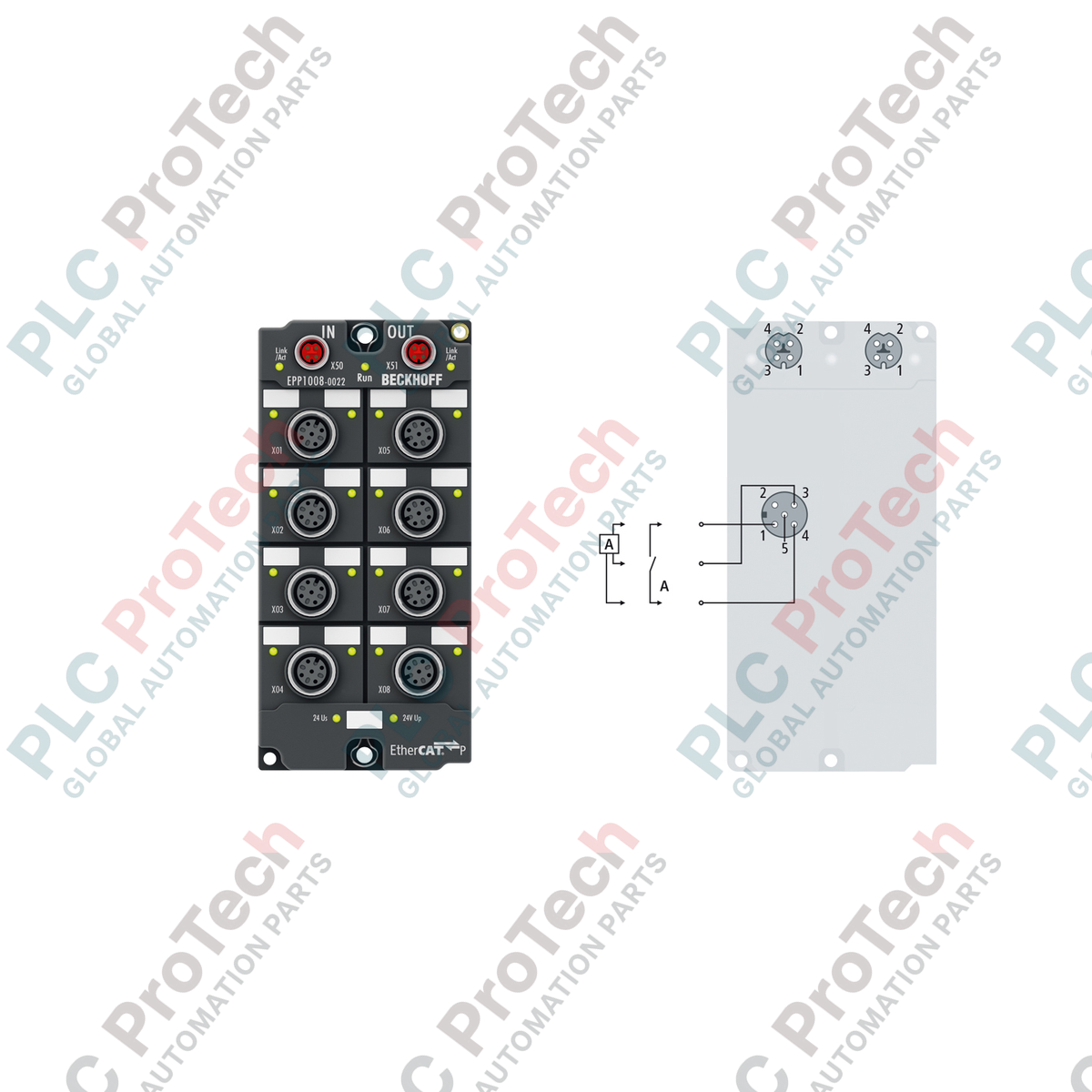
Beschreibung
Für platzbeschränkte industrielle Umgebungen direkt am Maschinenrahmen konzipiert, ist das Beckhoff EPP1008-0022 ein digitaler EtherCAT-P-Eingangsbaustein, der lokale Feldgehäuse überflüssig macht. Er erfasst schnelle digitale Steuersignale von der Feldebene und überträgt sie über eine einheitliche Hochgeschwindigkeitsverbindung an die Steuerungsarchitektur. Durch die Integration von Daten- und Stromversorgung (Us und Up) in ein einziges 4-adriges, P-codiertes M8-Kabel optimiert dieses Modul die Verkabelungskomplexität und gewährleistet gleichzeitig eine deterministische Kommunikation. Das robuste Polyamidgehäuse bietet eine ausgezeichnete Beständigkeit gegen Umwelteinflüsse, Vibrationen und das Eindringen von Feuchtigkeit.
Wichtige Merkmale
-
Einheitliche EtherCAT-P-Schnittstelle: Kombiniert die EtherCAT-Ethernet-Kommunikation und die Stromversorgung (24 V DC Steuerspannung Us und Peripheriespannung Up) über eine einzige M8-Buchse.
-
Zuverlässige Signalerfassung: 8 digitale Eingänge gemäß EN 61131-2 Typ 1/3 für eine äußerst zuverlässige Erfassung industrieller Signale.
-
M12-Buchsen mit jeweils einem Eingang: Direkte 1:1-Zuordnung der Sensoren über 8 dedizierte, 5-polige, A-codierte M12-Steckverbinder, wodurch Verdrahtungsfehler vor Ort minimiert werden.
-
Kurzschlussschutz: Integrierte Sensorversorgung mit 0,5 A, abgeleitet von der Steuerspannung Us und vollständig gegen Überstrom und Kurzschlüsse geschützt.
-
Industriegerechtes Gehäuse: Gehäuse aus PA6 (Polyamid) mit Schutzarten IP65, IP66 und IP67, ausgelegt für die direkte Montage in rauen, reinigungsintensiven oder öligen Umgebungen.
Anwendungen
-
Dezentralisierte Werkzeugmaschinen: Direkte Installation an CNC-Rahmen, Stanzaggregaten und Roboterarmen ohne Schutzgehäuse.
-
Förder- und Logistiklinien: Optimierte Sensordatenerfassung über große Entfernungen durch Reihenschaltung mit einem einzigen Kabel.
-
Automatisierte Montagesysteme: Direkte Anbindung von Näherungsschaltern, Lichtschranken und mechanischen Endschaltern in der Bearbeitungszone.
-
Feuchte und Nassreinigungsbereiche: Lebensmittel- und Getränkeverpackungslinien, die eine Beständigkeit gegen Hochdruckreinigung gemäß IP67 erfordern.
Technische Spezifikationen
| Parameter |
Spezifikationswert |
| Hersteller |
Beckhoff Automation |
| Modellnummer |
EPP1008-0022 |
| Protokoll |
EtherCAT P |
| Busschnittstelle |
2 x M8-Buchse, geschirmt, Schraubausführung, P-codiert |
| Anzahl der Eingänge |
8 Digitaleingänge (1 Eingang pro physischem M12-Stecker) |
| Eingangsspezifikation |
EN 61131-2, Typ 1/3 |
| Eingangsanschlüsse |
M12 x 1, 5-polig, A-codiert |
| Nenneingangsspannung |
24 V DC (−15 % / +20 %) |
| Eingangsfilterzeit |
3,0 ms |
| "0"-Signalspannungsbereich |
-3 bis +5 V DC |
| "1"-Signalspannungsbereich |
11 bis 30 V DC |
| Typischer Eingangsstrom |
3 mA (EN 61131-2, Typ 3) |
| Sensorversorgung |
Abgeleitet von der Steuerspannung Us, max. 0,5 A, kurzschlussfest (gesamt) |
| Stromaufnahme (von Us) |
Typischerweise 100 mA |
| Elektrische Isolierung |
500 V RMS |
| Schutzart |
IP65 / IP66 / IP67 (gemäß EN 60529) |
| Gehäusematerial |
PA6 (Polyamid) |
| Betriebstemperatur |
-25 bis +60 °C |
| Lagertemperatur |
-40 bis +85 °C |
| Abmessungen |
60 mm x 126 mm x 26,5 mm (B x H x T) |
| Gewicht |
Etwa 250 g |
| Versandgewicht (berechnet) |
2,0 kg (mit schützender Großhandels-Exportverpackung) |
Anschlüsse und Schnittstellen
| Porttyp |
Pin-Nummer |
Funktionale Signalbezeichnung |
| M8 (EtherCAT P) |
Pin 1 |
Übertragungsdaten + (Tx+) / Steuerspannung + (Us +24 V DC) |
| Pin 2 |
Empfangsdaten + (Rx+) / Peripheriespannung + (Up +24 V DC) |
| Pin 3 |
Empfangsdaten − (Rx−) / Peripherie-GND (GNDp) |
| Pin 4 |
Übertragungsdaten − (Tx−) / Steuerungs-GND (GNDs) |
| M12 (Digitaleingänge) |
Pin 1 |
+24-V-DC-Sensorversorgung Us |
| Pin 2 |
Nicht angeschlossen (NC) |
| Pin 3 |
0-V-GND-Sensorversorgung |
| Pin 4 |
Digitals Eingangssignal (Kanäle 1 bis 8) |
| Pin 5 |
Funktionserde (FE) / Schirmung |
Empirische Erkenntnisse aus der Entwicklung
Alternative Modelle und Kompatibilität
Der EPP1008-0022 verwendet EtherCAT P und erfordert P-codierte M8-Anschlüsse. Er ist nicht pinkompatibel mit standardmäßigen EP1008-0002-Modulen, die standardmäßiges A-codiertes EtherCAT und externe Hilfsstromleitungen verwenden. Wenn Sie von standardmäßigen EtherCAT-EP-Boxen auf EPP-Boxen umsteigen, überprüfen Sie, ob die Masterstation einen EP9224-Stromeinspeiser oder einen EK1310-Verteilerkoppler integriert, um die kombinierte Us-/Up-Versorgung über die Leitung bereitzustellen.
Anwendungsfehler und technische Hinweise
Ein häufiger Fehler bei der Systemintegration besteht darin, die maximal zulässige Stromstärke von 3,0 A für Us (Steuerspannung) oder Up (Peripheriespannung) innerhalb eines in Reihe geschalteten EtherCAT-P-Segments zu überschreiten. Verwenden Sie bei der Implementierung langer Ketten aus EPP1008-0022-Modulen die TwinCAT System Manager-Software, um die kumulativen Spannungsabfälle entlang der Leitung zu berechnen. Wenn die Us-Spannung am letzten Knoten unter 20,4 V DC fällt, kommt es zu einer intermittierenden Feldkommunikation oder zu Ausfällen der Sensoren.
Tipps zur Inbetriebnahme und Verdrahtung
Im Gegensatz zu einigen M12-Multieingangsblöcken, bei denen sich zwei Signale einen physischen Stecker teilen, verfügt der EPP1008-0022 über genau einen Eingang pro M12-Schnittstelle, der ausschließlich Pin 4 zugeordnet ist. Standardmäßige 3-adrige Sensoren mit einem Kanal (PNP-Typ) können ohne kundenspezifische Y-Splitter direkt verdrahtet werden. Stellen Sie sicher, dass alle nicht verwendeten M12- und M8-Anschlüsse mit industriellen Schraubkappen verschlossen sind, um die Umgebungsabdichtung nach IP67 des Geräts zu gewährleisten.
Installationsrichtlinien
KRITISCHER WARNHINWEIS: Trennen Sie vor der physischen Montage oder Verdrahtung des Geräts alle Stromquellen, die die EtherCAT-P-Leitung versorgen, vollständig. Das An- oder Abstecken von P-codierten M8-Modulen unter Last kann elektrische Lichtbögen verursachen, die zu dauerhaften Schäden an den internen EtherCAT-P-Transceiver-Komponenten und den angeschlossenen Sensoren führen.
1
Positionieren Sie das Modul auf einem flachen, vibrationsbeständigen Maschinenrahmen. Befestigen Sie es mithilfe der oberen und unteren Befestigungsbohrungen. Verwenden Sie 2 × M3-Schrauben (für 3,5-mm-Bohrungen) oder 2 × M4-Schrauben (für 4,5-mm-Bohrungen) und ziehen Sie sie mit dem vorgeschriebenen Drehmoment an, um ein mechanisches Lockern bei Hochfrequenzbetrieb zu verhindern.
2
Verbinden Sie das eingehende EtherCAT-P-Kabel mit der oberen, P-codierten M8-Buchse und führen Sie das abgehende Daisy-Chain-Segment von der unteren M8-Buchse weiter. Ziehen Sie die Metallschraubkappen der M8-Steckverbinder handfest an, um eine gasdichte Verbindung und die Integrität der Schirmung sicherzustellen.
3
Stecken Sie die digitalen M12-Sensorkabel in die entsprechenden 5-poligen Buchsen. Ziehen Sie die gerändelten Metallmuttern fest, um das Eindringen von Feuchtigkeit zu verhindern. Verschließen Sie nicht verwendete Anschlüsse mit Schutzstopfen, um die Schutzart IP67 zu gewährleisten.
4
Schalten Sie den EtherCAT-P-Zweig ein und prüfen Sie den LED-Status. Vergewissern Sie sich, dass die Anzeigen für das System „Us“ und die Kommunikationsverbindung dauerhaft grün leuchten. Dies bestätigt eine bestehende Feldkommunikation und eine ordnungsgemäße Knotenversorgung.