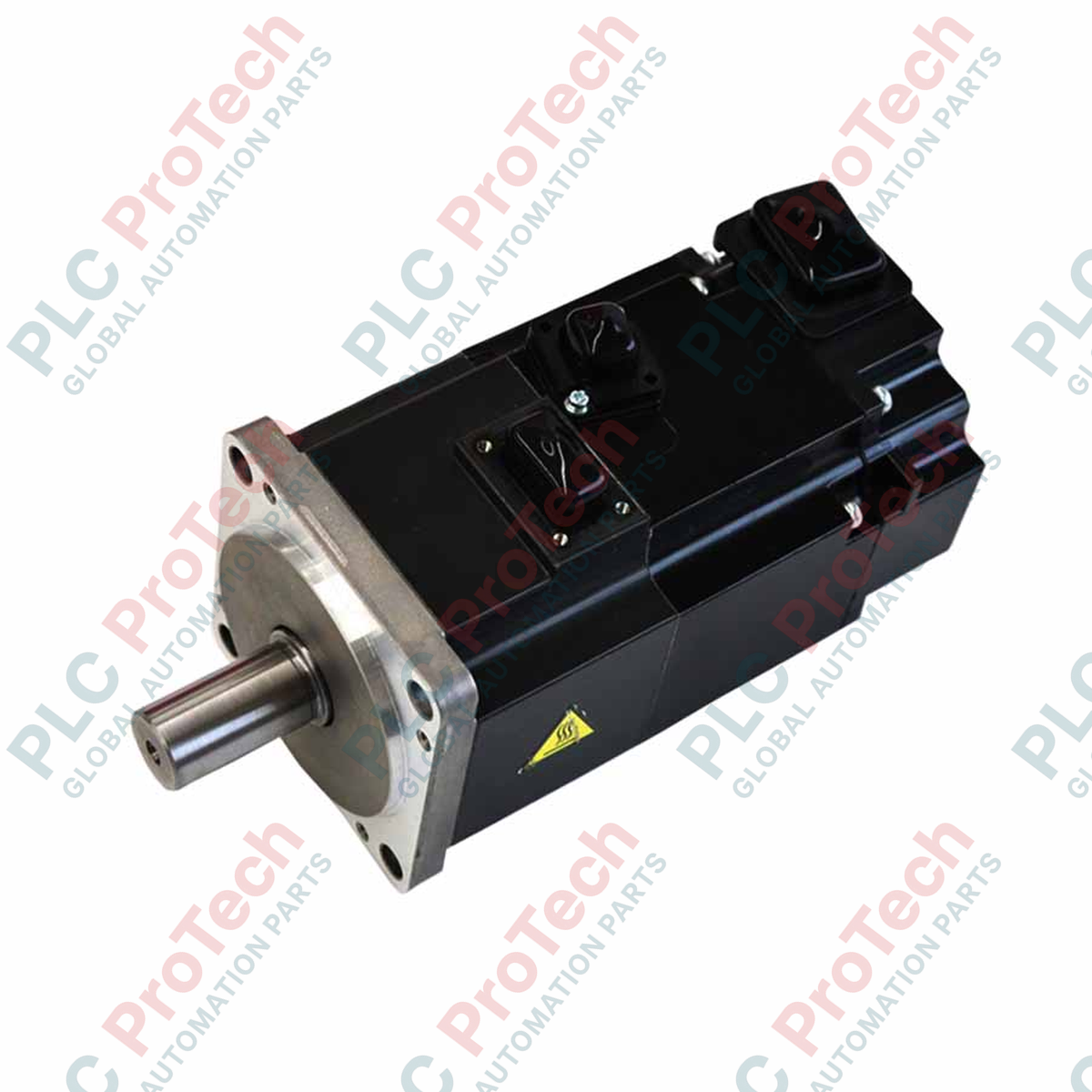
Dieser 750-W-Rotationsservomotor kombiniert präzise Bewegungssteuerung mit einem Design mit geringer Trägheit und wurde für dynamische Positionieranwendungen mit hoher Belastung entwickelt. Der Mitsubishi Electric HG-KR73B verfügt über eine integrierte elektromagnetische Bremse und einen hochauflösenden Absolutgeber, um auch unter anspruchsvollen industriellen Lasten eine stabile Leistung und Sicherheit zu gewährleisten. Er lässt sich nahtlos in Servoverstärker der MR-J4-Serie integrieren und ermöglicht eine zuverlässige Regelung von Geschwindigkeits- und Positionskreisen.
Wichtigste Merkmale
-
Design mit geringer Trägheit: Optimiert für hochfrequente Positionierzyklen sowie schnelles Beschleunigen und Abbremsen.
-
Elektromagnetische Haltebremse: Integrierte Sicherheitsbremse für die Steuerung vertikaler Achsen und die Positionshaltung bei ausgeschaltetem Gerät.
-
Feedback mit hoher Auflösung: Ausgestattet mit einem 22-Bit-Absolut-/Inkrementalgeber, der 4.194.304 Impulse pro Umdrehung für außergewöhnliche Positioniergenauigkeit liefert.
-
Robuster Schutz: Schutzart IP65, vollständig geschlossen und eigengekühlt, geeignet für anspruchsvolle Industrieumgebungen.
-
Flexible Integration: Vollständig kompatibel mit CC-Link IE Field, SSCNET III/H und allgemeinen Impuls-/Analog-Schnittstellen über kompatible MR-J4-Verstärker.
Anwendungen
- Hochgeschwindigkeits-Verpackungsmaschinen und Etikettiersysteme.
- Materialhandhabungssysteme und Roboterportale für Pick-and-Place-Anwendungen.
- Mehrachsige CNC-Vorschubsysteme und Textilmaschinen.
- Vertikale Hubachsen, die Feststellbremsen mit positiver Verriegelung erfordern.
Technische Daten
| Parameter |
Wert |
| Hersteller |
Mitsubishi Electric |
| Modellnummer |
HG-KR73B |
| Baureihe |
HG-KR (geringe Trägheit, kleine Leistung) |
| Nennleistung |
0.75 kW (750 W) |
| Nenndrehzahl |
3000 U/min |
| Maximaldrehzahl |
6000 U/min |
| Nenndrehmoment |
2.4 N.m |
| Maximales Drehmoment |
8.4 N.m |
| Nennstrom |
4.8 A |
| Maximalstrom |
17 A |
| Spannungsklasse |
200 V AC |
| Leistungsversorgungskapazität |
1.3 kVA |
| Trägheitsmoment (J) |
1.37 x 10^-4 kg.m2 |
| Encodertyp |
22-Bit absolut/inkremental (4.194.304 Impulse/Umdrehung) |
| Elektromagnetische Bremse |
Integriert (Haltebremse) |
| Wärmeklasse |
130 (B) |
| Schutzart |
IP65 (ausgenommen Wellendurchführung) |
| Vibrationsfestigkeit |
49 m/s2 (X- und Y-Richtung) |
| Betriebstemperatur |
0 bis 40 °C (frostfrei) |
| Nettogewicht |
3.8 kg |
| Versandgewicht (berechnet) |
5.0 kg |
Kompatible Servoverstärker
| Schnittstellentyp |
Kompatible Modelle |
| CC-Link IE Field Network |
MR-J4-70GF, MR-J4-70GF-RJ, MR-J4-70B-RJ010 |
| SSCNET III/H-Schnittstelle |
MR-J4-70B, MR-J4-70B-RJ |
| Mehrachs-SSCNET III/H |
MR-J4W2-77B, MR-J4W2-1010B |
| Allzweck (Impuls/Analog) |
MR-J4-70A, MR-J4-70A-RJ |
Empirische Erkenntnisse aus der Entwicklung
Alternative Modelle & Kompatibilität
Der HG-KR73B ist ein direkter Ersatz für Motoren der älteren HF-KP73B-Serie. Achten Sie beim Wechsel von HF-KP zu HG-KR darauf, dass die Firmware des Servoverstärkers aktualisiert wurde, um die 22-Bit-Encoderauflösung zu unterstützen. Die mechanischen Einbaumaße (Flanschgröße und Wellendurchmesser) bleiben identisch und ermöglichen eine unkomplizierte mechanische Nachrüstung.
Anwendungsfallen und technische Hinweise
Die integrierte elektromagnetische Bremse des HG-KR73B ist ausschließlich eine Haltebremse und darf niemals zum dynamischen Abbremsen oder für einen Not-Halt verwendet werden. Das Betätigen der Bremse, während der Motor mit hoher Drehzahl läuft, führt zu schnellem Verschleiß der Reibbeläge und damit zu einem vorzeitigen mechanischen Ausfall. Stellen Sie bei vertikalen Achsen mit hoher Belastung sicher, dass die Verzögerungszeit des Bremsausgangs des Verstärkers (MBR-Signal) korrekt kalibriert ist, um ein Absinken der Achse während der Einschaltsequenzen zu verhindern.
Tipps zur Inbetriebnahme und Verdrahtung
Verwenden Sie für die Verbindung des HG-KR73B mit dem MR-J4-Verstärker stets dedizierte, doppelt geschirmte Encoderkabel. Hochfrequente Störungen der Motorstromleitungen können die seriellen 22-Bit-Encoderdaten verfälschen, wenn sie ohne geeignete Abschirmung im selben Kabelkanal geführt werden. Stellen Sie sicher, dass das Motorgehäuse direkt mit der Erdungsklemme des Verstärkers verbunden ist, und überprüfen Sie, dass die 24-V-DC-Stromversorgung der elektromagnetischen Bremse geregelt und von der Stromversorgung der Steuerlogik galvanisch getrennt ist.
Installationsrichtlinien
WICHTIGER WARNHINWEIS:
Stellen Sie sicher, dass alle primären AC-Stromquellen vollständig spannungsfrei geschaltet und gegen Wiedereinschalten verriegelt sind, bevor Sie mit der Installation oder Wartung beginnen. Warten Sie mindestens 15 Minuten, damit sich die internen Zwischenkreiskondensatoren des Servoverstärkers vollständig entladen. Überprüfen Sie vor dem Umgang mit den Motorstromanschlüssen, dass zwischen den Zwischenkreisanschlüssen keine Spannung anliegt.
1
Befestigen Sie den Motor sicher auf einer starren, ebenen Metallfläche, um die Wärmeableitung zu verbessern. Stellen Sie sicher, dass die Ausrichtung der Motorwelle zur Lastkupplung innerhalb der angegebenen radialen (392 N) und axialen (147 N) Grenzwerte liegt, um Lagerverschleiß zu verhindern.
2
Schließen Sie das Encoderkabel und das Stromkabel an die jeweils vorgesehenen Buchsen an. Stellen Sie sicher, dass die Steckverbinder vollständig eingesteckt und verriegelt sind, damit die IP65-Umgebungsabdichtung erhalten bleibt.
3
Verbinden Sie die Klemmen der elektromagnetischen Bremse mit einer dedizierten 24-V-DC-Stromquelle, die über das Bremsverriegelungsrelais (MBR) des Verstärkers gesteuert wird. Teilen Sie diese 24-V-Leitung nicht mit induktiven Sensoren oder Geräten mit hohem Störpegel.
4
Führen Sie einen Probelauf bei niedriger Drehzahl ohne mechanische Last durch, um vor der vollständigen Inbetriebnahme des Systems die korrekte Drehrichtung, das Encoder-Feedback und die Funktion zur Freigabe der Haltebremse zu überprüfen.