B&R

B&R 7EX470.50-1 B&R 2003 CAN Bus Controller

SKU 7EX470.50-1

Disponibile
  • 12-month warranty
  • Free returns within 30 days
  • Manufacturer: B&R
  • Product No.: 7EX470.50-1
  • Origin United States
  • Product Type: 2003 CAN Bus Controller
  • Payment: T/T, Western Union
  • Weight: 1.5 kg
  • Shipping port: Xiamen
  • Warranty: 12 months

Tags

Quantità

Product Description

Product Overview

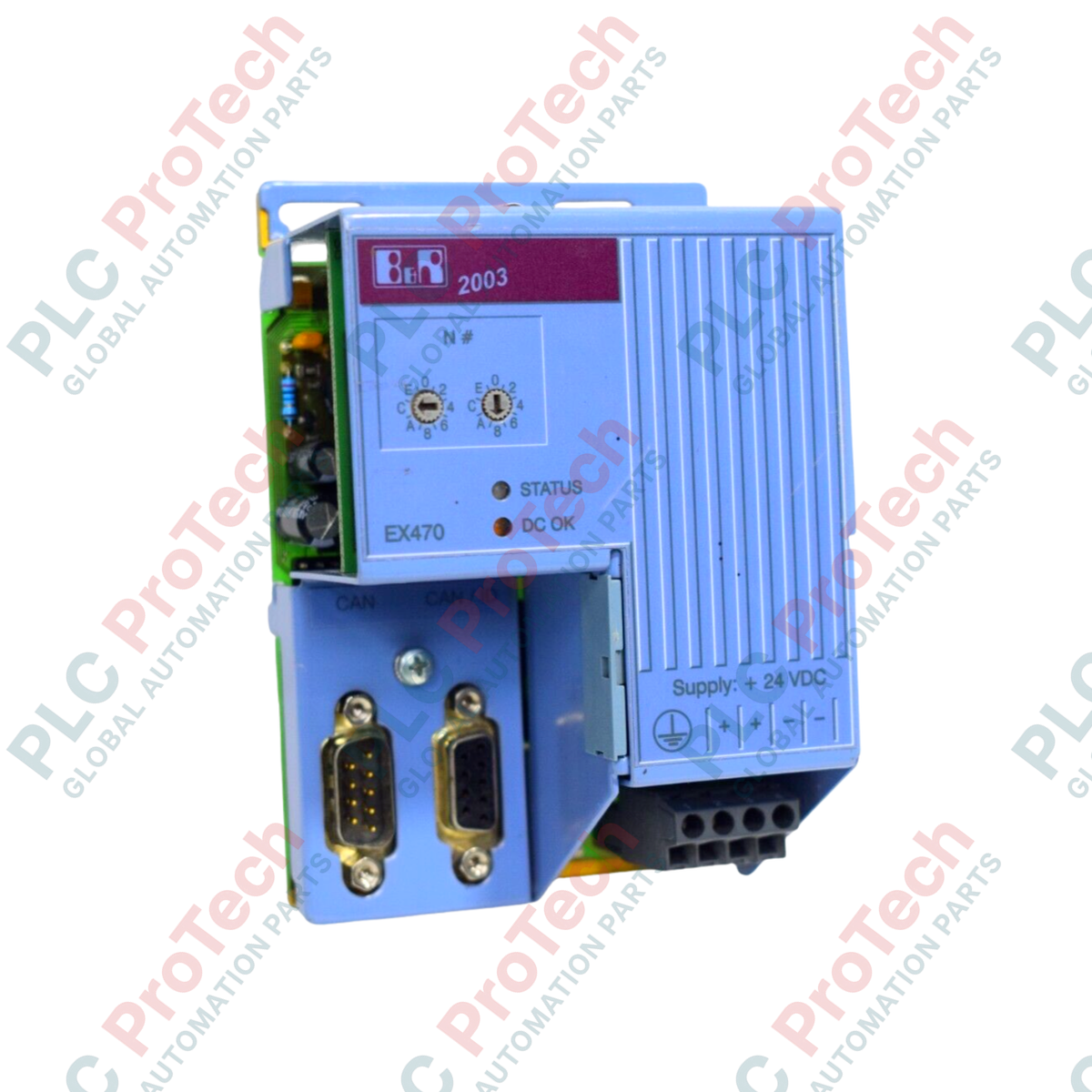
The 7EX470.50-1 (7EX470.50-1) is a network-capable CAN bus controller module engineered for the B&R 2003 series industrial control architecture. This module serves as a critical communication bridge, facilitating reliable data exchange between distributed I/O systems and the main controller via two electrically isolated CAN interfaces. Its design prioritizes operational continuity in high-noise environments, such as large-scale material handling systems, automated logistics, and multi-axis motion control applications, where robust network communication is vital to preventing system-wide downtime.

Technical Configuration

The 7EX470.50-1 is built for high-performance network integration, featuring dual CAN interfaces that are electrically isolated to prevent ground-loop interference. The module allows for precise configuration of network parameters, including node identification and baud rate, via an integrated number switch located on the front panel.

In terms of power management, the module operates on a standard 24 VDC supply (with an operational range of 18 VDC to 30 VDC). Beyond its own power consumption (max. 20 W), it acts as a power distribution node, providing 14.5 W of output power to support connected I/O and screw-in modules. This integrated power delivery simplifies cabinet wiring and ensures that peripheral modules remain powered consistently within the 2003 rack system.

Technical Specifications

Feature Specification
Model 7EX470.50-1
Brand B&R
Series B&R 2003
Module Type CAN Bus Controller
CAN Interfaces 2 (Electrically isolated)
Input Voltage 18 to 30 VDC (Nominal 24 VDC)
Power Consumption Max. 20 W
I/O Power Output 14.5 W
Interface 9-pin D-type socket
Configuration Integrated Number Switch
Weight 1.5 kg

FAQs

What is the purpose of the number switch on the module?

The number switch is a physical interface used to manually set the CAN node address and the network baud rate, ensuring the controller is correctly recognized by the master system during commissioning.

How does electrical isolation benefit the CAN bus network?

Electrical isolation protects the module's communication transceivers from voltage spikes and ground potential differences between different nodes on the network, which significantly increases network reliability and prevents port damage.

Can I daisy-chain power through this module?

The 7EX470.50-1 provides 14.5 W of output power to adjacent I/O modules within the same rack. Ensure that the total power demand of your connected modules does not exceed this rating.

What happens if the input voltage drops below 18 VDC?

The module is specified to operate between 18 and 30 VDC. Operating below this threshold may lead to unstable communication, loss of network synchronization, or potential module reset.

Installation and Network Best Practices

  • CAN Termination: Ensure that both physical ends of the CAN bus network are terminated with a 120-ohm resistor. Failing to terminate the bus correctly often leads to signal reflections, which manifest as intermittent communication errors or "bus off" states.
  • Cable Selection: Use high-quality, shielded twisted-pair cables specifically designed for CAN bus applications. Avoid running communication cables in parallel with high-voltage lines or motor drive power cables to mitigate electromagnetic interference.
  • Grounding Protocol: Maintain a consistent grounding scheme across the entire network. While the module's interfaces are isolated, the cable shield should be tied to a clean functional earth at one central point to ensure effective noise dissipation.
  • Baud Rate Matching: All nodes on the CAN network must be configured to the same baud rate. Use the integrated number switches carefully; a baud rate mismatch will prevent the module from entering the network and may cause error frames on the bus.
Shipping & Returns

Global Express Shipping

  • Standard Delivery: 4–6 business days via DHL, FedEx, and UPS.
  • Express Dispatch: Same-day dispatch for in-stock orders placed before 2:00 PM (GMT+8).
  • Worldwide Coverage: Serving over 150 countries.

Returns & Warranty

  • 30-Day Guarantee: Returns accepted for in-stock products in original, factory-sealed packaging.
  • 12-Month Warranty: Every industrial component is backed by our technical warranty.
Reviews

7EX470.50-1

Stock & lead time on request

Call
1 su 1

B&R 7EX470.50-1 B&R 2003 CAN Bus Controller

Only 10 item(s) left in stock
  • Manufacturer: B&R

  • Product No.: 7EX470.50-1

  • Country of origin:United States

  • Product Type: 2003 CAN Bus Controller

  • Payment: T/T, Western Union

  • Weight: 1500g

  • Shipping port: Xiamen

  • Warranty: 12 months

Quantità
Visualizza dettagli completi

Product Description

Product Overview

The 7EX470.50-1 (7EX470.50-1) is a network-capable CAN bus controller module engineered for the B&R 2003 series industrial control architecture. This module serves as a critical communication bridge, facilitating reliable data exchange between distributed I/O systems and the main controller via two electrically isolated CAN interfaces. Its design prioritizes operational continuity in high-noise environments, such as large-scale material handling systems, automated logistics, and multi-axis motion control applications, where robust network communication is vital to preventing system-wide downtime.

Technical Configuration

The 7EX470.50-1 is built for high-performance network integration, featuring dual CAN interfaces that are electrically isolated to prevent ground-loop interference. The module allows for precise configuration of network parameters, including node identification and baud rate, via an integrated number switch located on the front panel.

In terms of power management, the module operates on a standard 24 VDC supply (with an operational range of 18 VDC to 30 VDC). Beyond its own power consumption (max. 20 W), it acts as a power distribution node, providing 14.5 W of output power to support connected I/O and screw-in modules. This integrated power delivery simplifies cabinet wiring and ensures that peripheral modules remain powered consistently within the 2003 rack system.

Technical Specifications

Feature Specification
Model 7EX470.50-1
Brand B&R
Series B&R 2003
Module Type CAN Bus Controller
CAN Interfaces 2 (Electrically isolated)
Input Voltage 18 to 30 VDC (Nominal 24 VDC)
Power Consumption Max. 20 W
I/O Power Output 14.5 W
Interface 9-pin D-type socket
Configuration Integrated Number Switch
Weight 1.5 kg

FAQs

What is the purpose of the number switch on the module?

The number switch is a physical interface used to manually set the CAN node address and the network baud rate, ensuring the controller is correctly recognized by the master system during commissioning.

How does electrical isolation benefit the CAN bus network?

Electrical isolation protects the module's communication transceivers from voltage spikes and ground potential differences between different nodes on the network, which significantly increases network reliability and prevents port damage.

Can I daisy-chain power through this module?

The 7EX470.50-1 provides 14.5 W of output power to adjacent I/O modules within the same rack. Ensure that the total power demand of your connected modules does not exceed this rating.

What happens if the input voltage drops below 18 VDC?

The module is specified to operate between 18 and 30 VDC. Operating below this threshold may lead to unstable communication, loss of network synchronization, or potential module reset.

Installation and Network Best Practices

  • CAN Termination: Ensure that both physical ends of the CAN bus network are terminated with a 120-ohm resistor. Failing to terminate the bus correctly often leads to signal reflections, which manifest as intermittent communication errors or "bus off" states.
  • Cable Selection: Use high-quality, shielded twisted-pair cables specifically designed for CAN bus applications. Avoid running communication cables in parallel with high-voltage lines or motor drive power cables to mitigate electromagnetic interference.
  • Grounding Protocol: Maintain a consistent grounding scheme across the entire network. While the module's interfaces are isolated, the cable shield should be tied to a clean functional earth at one central point to ensure effective noise dissipation.
  • Baud Rate Matching: All nodes on the CAN network must be configured to the same baud rate. Use the integrated number switches carefully; a baud rate mismatch will prevent the module from entering the network and may cause error frames on the bus.

Global Express Shipping

  • Standard Delivery: 4-6 Business Days via DHL, FedEx, and UPS.
  • Express Dispatch: Same-day dispatch for in-stock orders placed before 2:00 PM (GMT+8).
  • Worldwide Coverage: Serving over 150 countries, including rapid delivery to Saudi Arabia and UAE.

Returns & Warranty

  • 30-Day Guarantee: Returns accepted for in-stock products in original, factory-sealed packaging.
  • 12-Month Warranty: Every industrial component is backed by our professional technical warranty.

Orders are processed and delivered Monday-Friday (excluding public holidays).


For full eligibility, restocking fees, and international return details, please view our official Refund & Return Policy .

TECHNICAL SPECIFICATIONS

Color pattern
Blue
Country of origin
United States
Power source
DC Power

Technical knowledge

1756-L73 Firmware Upgrade Guide: v19 vs v21/v31 Decision

Replacing a 1756-L73 does not automatically mean upgrading its firmware. This guide compares v19.013, v21.011 and v31.011, focusing on project compatibility, HMI communications, legacy networks and...

Implementing 3-Switch XOR Ladder Logic with Internal Bit

Implement a 3-SPST switch XOR light circuit in LogixPro or RSLogix 500 using an internal relay bit. Includes truth tables, boolean equations, and verified.

Building a Modbus RTU Network with CompactLogix and DeltaV

Integrate Allen-Bradley CompactLogix, Caterpillar ATS, and generators into DeltaV DCS over Modbus RTU. Covers ProSoft MVI69-MCM, Miille DIN266 gateways.

ONS Instruction Not Energizing OTE in Studio 5000 Ladder Logic

ONS instruction fires but the OTE coil never latches in Studio 5000 because the one-shot is only true for one scan. Use OTL/OTU or seal-in logic instead.

Kinetix 5500 EtherNet/IP Network Switch Requirements and Topology

Configure Allen-Bradley Kinetix 5500 servo drives on EtherNet/IP. Covers CIP Sync, IEEE 1588 V2 timing, Stratix selection, DLR topology, and HMI.

Moving Average Filtering in DCS and PLC Analog Control

A moving-average filter is the sliding-window smoother most instrument engineers drop into DCS and PLC analog paths. Here is how the window works, how N and sample time set lag, and when a...