Description
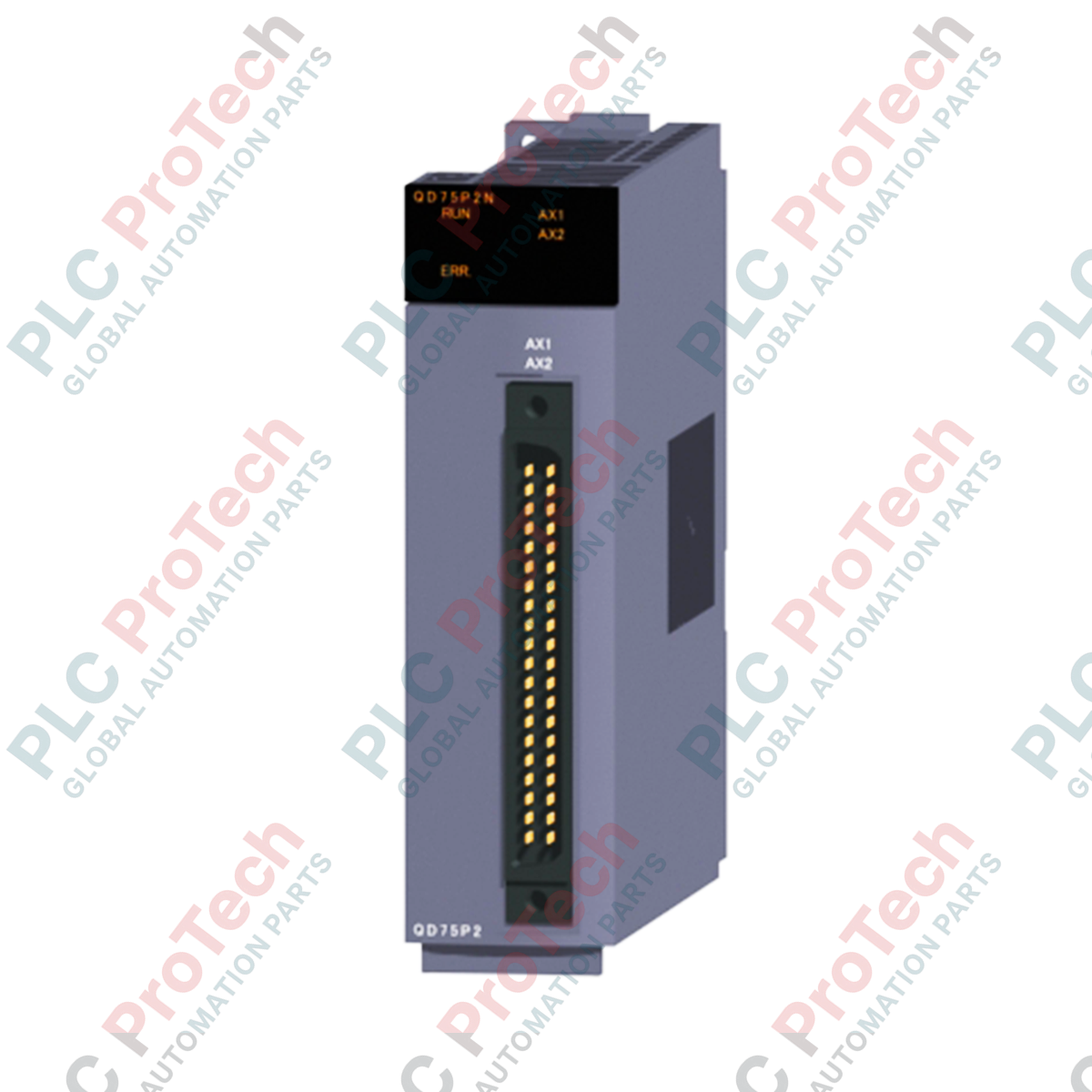
Executing high-accuracy motion profiles within the MELSEC Q Series platform is direct and efficient with the Mitsubishi Electric QD75P2N. This dual-axis positioning module specializes in open collector pulse train outputs, providing seamless command control for stepper drives and servo systems. Designed for flexible architecture, it coordinates independent point-to-point (PTP) operations, continuous path trajectories, and multi-axis interpolation directly from the PLC backplane.
By housing dedicated processing hardware on-board, the QD75P2N offloads complex path calculations from the main CPU, ensuring consistent 1.5 ms startup response times. It supports multiple engineering unit systems, including millimeters, inches, degrees, and raw pulses, allowing engineers to program movement parameters directly in native machine units. The module stores up to 600 positioning data points per axis in non-volatile flash ROM, eliminating the requirement for external backup batteries.
Features
- Dual-axis independent or coordinated motion control.
- Supports 2-axis linear interpolation and 2-axis circular interpolation.
- Open collector pulse output structure reaching speeds up to 200 kpulse/s.
- Comprehensive motion profiles including PTP, speed control, speed/position switching, and position/speed switching.
- Trapezoidal and S-curve acceleration/deceleration filtering profiles to minimize mechanical resonance.
- Batteryless storage of parameter sets and positioning profiles directly in internal Flash ROM.
Applications
- X-Y gantry Cartesian coordinate positioning systems.
- Packaging machine indexing and material feed axes.
- Rotary table angular positioning using degree-based unit scaling.
- Material handling transfer shuttles and automated storage lifters.
Technical Specifications
| Specification Parameter |
Value / Rating |
| Manufacturer |
Mitsubishi Electric |
| Model Reference |
QD75P2N |
| Series |
MELSEC Q Series |
| Control Axes |
2 Axes |
| Output Interface Type |
Open Collector Output |
| Maximum Pulse Frequency |
200 kpulse/s |
| Interpolation Modes |
2-axis linear, 2-axis circular |
| Internal Current Consumption (5V DC) |
0.30 A |
| Max. Drive Connection Distance |
2 meters |
| External Connection Port |
40-pin connector (compatible with A6CON1, A6CON2, A6CON4) |
| Occupied I/O Points |
32 Points (Intelligent function module) |
| Net Module Mass |
0.14 kg |
| Shipping Weight (Calculated) |
1.2 kg |
| Module Dimensions (H x W x D) |
98 mm x 27.4 mm x 90 mm |
Empirical Engineering Insights
Alternative Models & Compatibility
The "N" suffix in the QD75P2N designates an updated hardware revision of the legacy QD75P2. Parameter structures remain highly backward-compatible; however, project validation within GX Works2 or GX Works3 is required to confirm configuration mapping. If your application demands longer transmission distances or higher pulse rates, consider the differential driver output version (QD75D2N), which extends pulse frequencies up to 4 Mpulse/s and connection runs up to 10 meters.
Application Pitfalls & Engineering Notes
Because this module utilizes open collector outputs, the pulse signal quality degrades exponentially with cable length due to parasitic line capacitance. Standard installations must enforce the 2-meter physical limits between the module and the motor driver inputs. Exceeding this distance risks signal distortion, missed pulses, and erratic positioning errors. Additionally, ensure high-voltage motor cabling is separated by a minimum of 100 mm from the 40-pin command signal lines to prevent EMI-induced tracking errors.
Commissioning & Wiring Tips
The open collector output circuits within the module require an external DC power source to energize the optocouplers inside your servo/stepper drives. Verify that external 5V DC or 24V DC is supplied to the appropriate pin headers on the 40-pin connection layout. If the PLC diagnostics indicate active pulses are generating but the drive receives no commands, verify the presence of this external circuit voltage. We highly recommend using shielded, twisted-pair cables with the screen grounded exclusively on the PLC panel side.
Installation Guidelines
CRITICAL SYSTEM SAFETY WARNING
Isolate all primary and auxiliary power supplies feeding the PLC rack, servo drives, and field machinery before mounting, removing, or wiring this module. Hazardous electrical arcs can damage internal CMOS components and lead to uncontrolled movement commands upon initial startup.
1
Align the module hook at the bottom of the QD75P2N onto the module mounting hole of the Q Series base unit, then press firmly into the slot until the top latch engages.
2
Secure the module to the base plate using the top-mounted retaining screw (M3 x 12). Tighten to a torque specification of 0.36 to 0.48 N-m.
3
Connect the pre-wired 40-pin connector (such as A6CON1 or A6CON2) to the front face of the module. Tighten the connector side-screws securely to prevent pin vibration during operation.