Product Overview
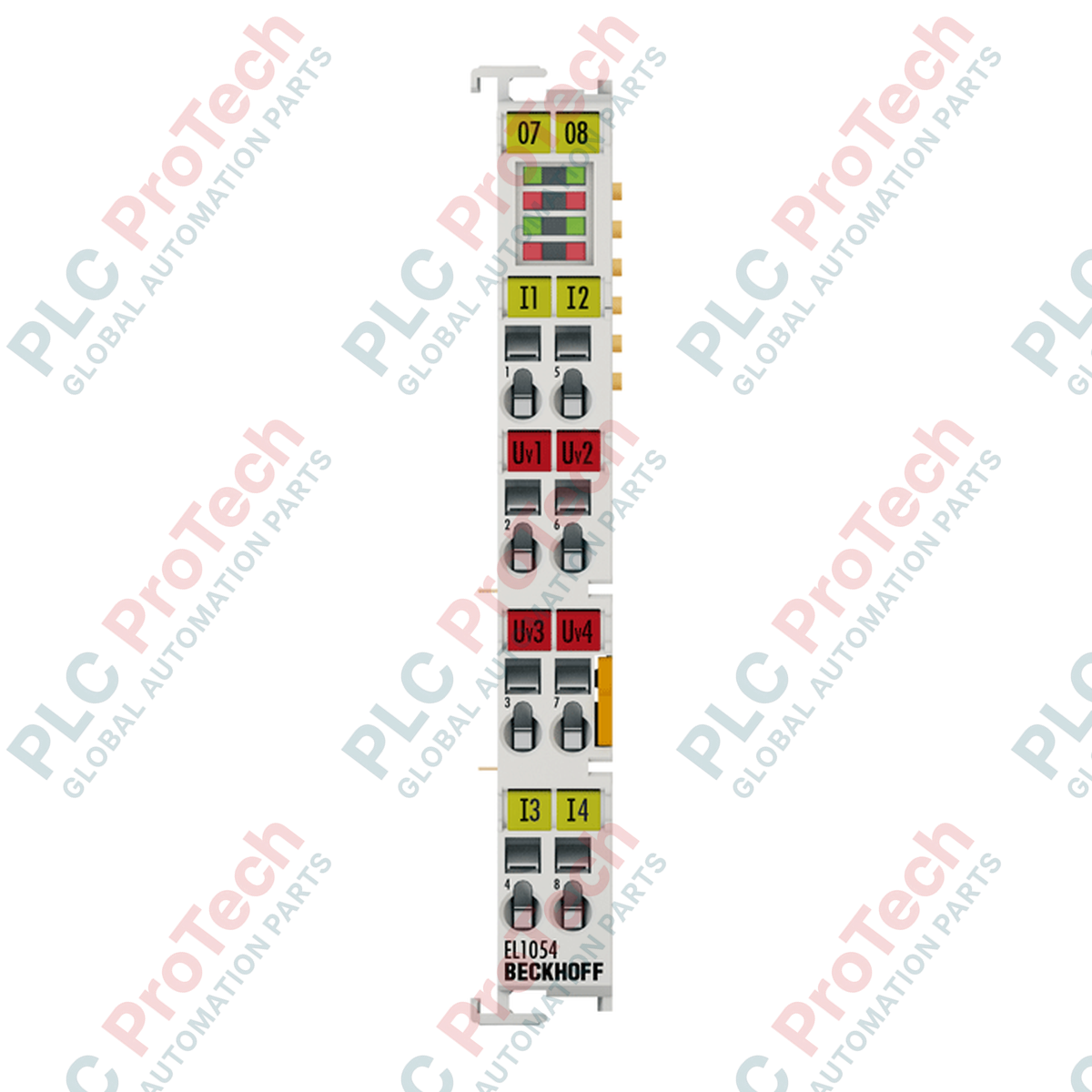
The EL1054 (EL1054) is a specialized 4-channel digital input terminal designed to interface with NAMUR sensors in accordance with IEC 60947-5-6. This terminal is a critical component for process automation and hazardous area applications, providing high-reliability signal acquisition from proximity switches and encoders. Unlike standard digital inputs, the EL1054 functions as a switching amplifier, monitoring current levels to distinguish between signal states while simultaneously performing continuous line diagnostics. It is widely utilized in oil and gas refineries, chemical processing plants, and grain silos where the detection of cable breaks or short circuits is essential for functional safety and preventing unplanned downtime in explosive atmospheres.
Technical Configuration
The hardware architecture of the EL1054 is optimized for 2-wire NAMUR technology, providing an open-circuit voltage of approximately 8.2 VDC. The terminal interprets a current of ≤ 1.2 mA as a "0" signal and ≥ 2.1 mA as a "1" signal, with a built-in 350 microampere hysteresis to prevent signal chatter. A major technical advantage of this module is its integrated fault detection: it can trigger a diagnostic alarm if the current drops below 200 microamperes (indicating a cable break) or exceeds 7.0 mA (indicating a short circuit). With a maximum switching frequency of 5 kHz, the EL1054 is capable of high-speed pulse counting and rotation monitoring. The unit is fully certified for ATEX, IECEx, and cFMus Zone 2/Division 2 environments, featuring 500 V electrical isolation to protect the EtherCAT E-bus from field-side transients.
Technical Specifications
| Feature |
Specification |
| Model |
EL1054 |
| Brand |
BECKHOFF |
| Origin |
Germany |
| Number of Inputs |
4 |
| Technology |
NAMUR (IEC 60947-5-6) |
| Signal Type |
Binary current input |
| Max. Switching Frequency |
5 kHz |
| Cable Break Detection |
I <= 200 microamperes |
| Short Circuit Detection |
I >= 7.0 mA |
| Current Consumption (E-bus) |
typ. 50 mA |
| Electrical Isolation |
500 V (E-bus / field potential) |
| Approvals |
CE, UL, ATEX, IECEx, cFMus |
| Dimensions (W x H x D) |
12 mm x 100 mm x 68 mm |
| Operating Temperature |
0 to +55 Celsius |
Technical FAQs
What is the primary advantage of using NAMUR sensors with the EL1054?
NAMUR technology allows for "live-zero" monitoring. Because the sensor always draws a small amount of current even in the "OFF" state, the EL1054 can instantly distinguish between a valid "0" signal and a disconnected or broken wire, significantly increasing system safety.
Does this terminal provide intrinsic safety (Ex i)?
No. The EL1054 is an "Ex nA" or "Ex ec" (non-sparking/increased safety) device intended for installation in Zone 2. While it interfaces with NAMUR sensors, it does not contain the galvanic isolation barriers required for "Ex i" intrinsic safety. If sensors are located in Zone 0 or 1, an additional safety barrier may be required depending on your local regulations.
Can the EL1054 be used for standard dry contact switches?
While possible, it is not recommended without a specific resistor network. NAMUR inputs expect specific impedance levels. Connecting a simple dry contact would result in a "Short Circuit" error when closed and a "Cable Break" error when open.
Engineering & Installation Guide
-
Diagnostic Mapping: In the TwinCAT System Manager, ensure you map the "Error" and "Diagnosis" bits for each channel. These bits provide real-time feedback on the health of your field wiring, allowing the PLC to execute a safe state routine immediately upon detecting a short circuit or line break.
-
Hazardous Area Compliance: When installing in ATEX/IECEx Zone 2, the EL1054 must be mounted in an enclosure that provides a minimum protection rating of IP54. Ensure all wiring adheres to the requirements for "Ex n" or "Ex ec" installation, including proper cable glandular and strain relief.
-
High-Speed Signal Integrity: Since the terminal supports up to 5 kHz, signal cable length and capacitance become factors. For high-frequency pulse acquisition, use shielded twisted-pair (STP) cabling and ensure the shield is grounded at the entry point of the control cabinet to prevent EMI from causing false switching or diagnostic errors.
-
Wiring Precision: Use the 2-wire connection technology with ferrules for stranded wires to ensure a gas-tight, vibration-proof connection. The stripping length must be exactly 8–9 mm to ensure proper engagement with the spring-actuated terminal without exposing live copper.