Product Overview
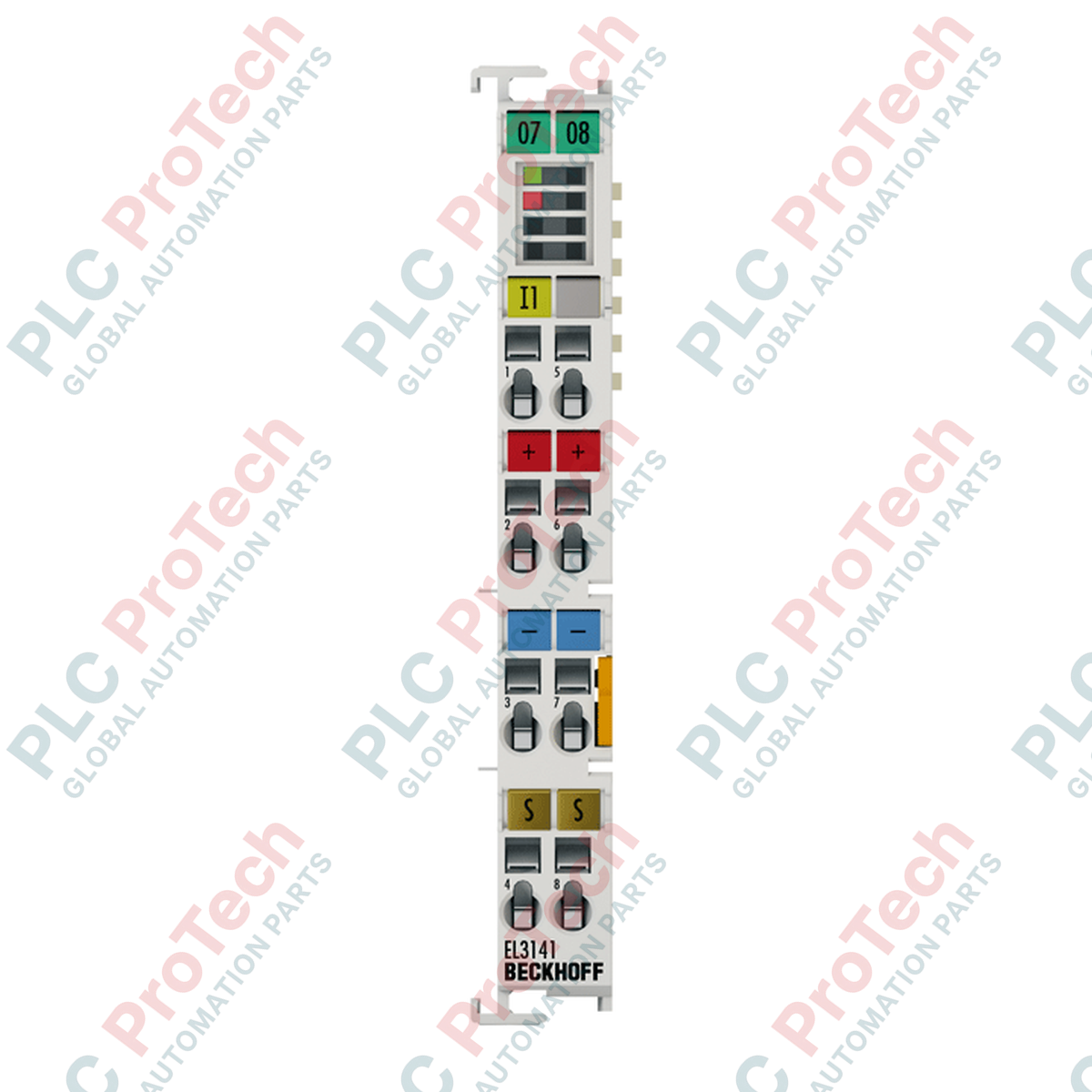
The EL3141 (EL3141) is a high-precision 1-channel analog input terminal designed for the EtherCAT I/O system, specializing in 0 to 20 mA current signal acquisition. Engineered for high-speed industrial processes such as pressure monitoring, flow rate measurement, and real-time sensor feedback, this module delivers an impressive 16-bit resolution. By leveraging EtherCAT Distributed Clocks (DC) technology, the EL3141 ensures sub-microsecond synchronization accuracy, allowing the analog value to be sampled with a precision of << 1 µs relative to other DC-capable terminals. Its robust hardware design, featuring integrated FIR/IIR filters and limit value monitoring, makes it a reliable choice for sensitive control loops in chemical processing and precision manufacturing.
Technical Configuration
The hardware architecture of the EL3141 is optimized for high-speed signal processing, boasting a fast conversion time of approximately 40 µs. It utilizes a single-ended connection technology where the current signal is measured against the terminal's internal ground. The process image is 4 bytes wide, supporting both standard and compact data representations. A significant technical advantage is the inclusion of activatable digital filters (Finite Impulse Response - FIR or Infinite Impulse Response - IIR), which allow engineers to suppress high-frequency noise and stabilize readings in electrically noisy environments. The terminal is powered entirely via the E-bus and provides 500 V electrical isolation between the signal voltage and the internal EtherCAT communication logic.
Technical Specifications
| Feature |
Specification |
| Model |
EL3141 |
| Brand |
BECKHOFF |
| Origin |
Germany |
| Number of Inputs |
1 (Single-ended) |
| Signal Current |
0 to 20 mA |
| Resolution |
16 bit (including sign) |
| Conversion Time |
approx. 40 microseconds |
| Distributed Clocks |
Yes, precision << 1 microsecond |
| Input Filter Frequency |
5 kHz |
| Measurement Error |
< +/- 0.3 percent (relative to full scale) |
| Internal Resistance |
typ. 85 Ohms + diode voltage |
| Electrical Isolation |
500 V (E-bus / signal voltage) |
| Current Consumption (E-bus) |
typ. 130 mA |
| Dimensions (W x H x D) |
12 mm x 100 mm x 68 mm |
| Operating Temperature |
-25 to +60 Celsius |
Technical FAQs
Can the EL3141 be used for 4-20 mA sensors?
Yes. While the hardware range is 0-20 mA, you can easily scale the 4-20 mA signal in the TwinCAT software or via the terminal’s CoE (CanOpen over EtherCAT) settings. This also allows for "low-range" error detection if the signal drops below 4 mA (indicating a possible cable break).
What is the benefit of the Distributed Clocks (DC) feature?
DC allows the terminal to sample the analog value at the exact same moment as other terminals in the network, regardless of the EtherCAT cycle time or cable lengths. This is critical for applications where the relationship between multiple high-speed signals must be precisely analyzed.
Is external power required for the sensor?
The EL3141 is powered via the E-bus for its internal logic, but it does not provide a separate 24V loop power for the sensor. The sensor usually requires its own 24 VDC supply, with the signal returned to the EL3141 input.
Engineering & Installation Guide
-
Signal Integrity and Noise: Analog signals at 0-20 mA are susceptible to electromagnetic interference. Always use shielded twisted-pair (STP) cabling. Ground the shield at the control cabinet entry bar to prevent ground loops while ensuring the 5 kHz input filter is appropriately configured for your process speed.
-
Filter Selection: Use the FIR (Finite Impulse Response) filter for maximum noise suppression in steady-state processes. For faster processes where lag must be minimized, the IIR (Infinite Impulse Response) filter or disabling the filter entirely is preferable to match the 40 µs conversion capability.
-
Wiring Precision: Use the spring-actuated terminals for a vibration-proof connection. For stranded wires, ferrules (0.14 to 1.5 mm²) are highly recommended to ensure all strands are captured. A stripping length of 8 to 9 mm is vital for maintaining high-quality electrical contact.
-
Hazardous Area Mounting: For ATEX/IECEx Zone 2 compliance, the module must be installed in an enclosure with a minimum rating of IP54. Ensure all connections are secured to prevent accidental disconnection while the system is under load.