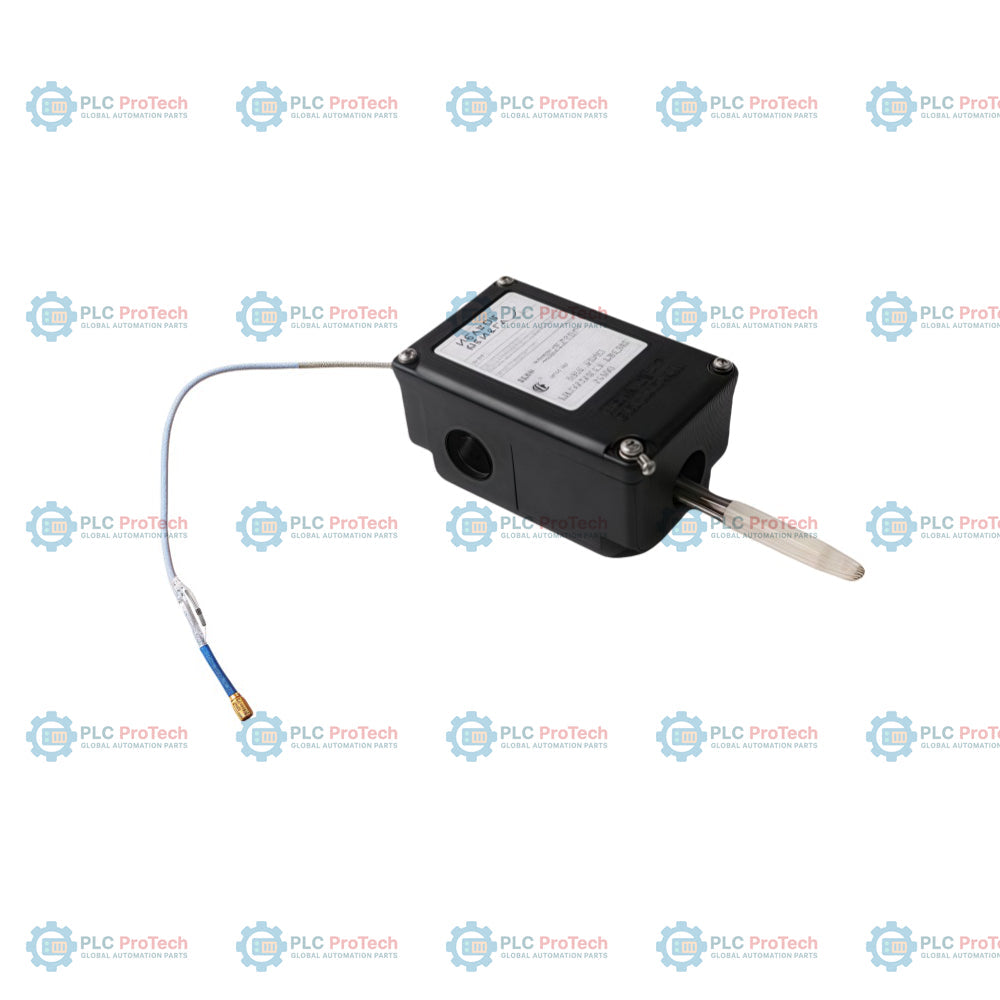
Product Overview
Bently Nevada 31000-28-05-15-042-06-02 is a 31000 series proximity probe housing assembly designed for 3300 XL 8 mm probe integration in hazardous and heavy-duty industrial environments. It is widely used in turbines, compressors, pumps, and refinery rotating equipment where stable probe positioning and environmental sealing directly impact machine protection reliability.
This housing supports high-integrity vibration and shaft displacement measurement under extreme mechanical stress, chemical exposure, and wide temperature variations. It is engineered for long-term deployment in critical asset monitoring systems where downtime reduction is a primary operational target.
The reinforced PPS thermoplastic body with conductive fibers provides electrostatic dissipation, while stainless steel structural elements ensure mechanical stability in high-vibration installations.
Configuration Breakdown
| Segment |
Meaning |
| 31000 |
31000 series proximity probe housing |
| 28 |
3300 XL 8 mm probe compatibility with approvals |
| 05 |
0.5 m probe cable length |
| 15 |
1.5 in standoff adapter |
| 042 |
4.2 in probe penetration |
| 06 |
Multi-fitting configuration with reducer and plugs |
| 02 |
3/4-14 NPT mounting thread |
Each segment defines probe compatibility, mechanical depth, mounting geometry, and installation flexibility for hazardous area applications.
Technical Specifications
| Parameter |
Specification |
| Model |
31000-28-05-15-042-06-02 |
| Brand |
Bently Nevada |
| Origin |
United States |
| Weight |
2.5 kg |
| Product Type |
Proximity probe housing assembly |
| Compatible Probe |
3300 XL 8 mm probe |
| Cable Length |
0.5 m |
| Standoff Adapter |
1.5 in (38 mm) |
| Probe Penetration |
4.2 in |
| Mounting Thread |
3/4-14 NPT |
| Housing Material |
Glass-reinforced PPS with conductive fibers |
| Metal Components |
AISI 303 / 304 stainless steel |
| Seal Material |
Neoprene |
| Temperature Range |
-51 deg C to 105 deg C |
| Protection Rating |
IP66, Type 4X certified |
| Impact Resistance |
Up to 7 Joule certified |
| Application |
Hazardous area machinery monitoring |
Engineering Interpretation Notes
This housing is designed for hazardous industrial zones where electrostatic control and mechanical durability are critical. The conductive PPS material dissipates static charge, reducing ignition risk in explosive atmospheres.
Stainless steel reinforcement ensures structural integrity under continuous vibration and thermal cycling conditions common in refinery and offshore installations.
The impact-tested design ensures survivability in harsh industrial environments where accidental mechanical shocks may occur during maintenance or operation.
Field Application Notes
Where is this housing used?
It is used in refineries, petrochemical plants, offshore platforms, and heavy industrial rotating equipment.
Why is PPS material important?
It provides electrostatic dissipation and chemical resistance in hazardous environments.
Is it suitable for explosion risk areas?
Yes. It is certified for hazardous area operation with appropriate protection ratings.
What is the benefit of stainless steel structure?
It improves mechanical strength and corrosion resistance in harsh environments.
Installation & Commissioning Notes
Ensure correct NPT torque tightening to maintain sealing integrity in hazardous environments.
Verify proper alignment of probe penetration depth before commissioning to maintain measurement accuracy.
Use approved sealing methods for threaded connections to prevent fluid or gas ingress.
Avoid mechanical stress on housing during installation to preserve internal alignment stability.
Engineering & Operational Guidance
Maintain proper grounding strategy to ensure electrostatic discharge performance of conductive housing material.
Inspect sealing integrity periodically in corrosive environments such as offshore or chemical plants.
Avoid over-tightening fittings to prevent stress fractures in thermoplastic housing structure.
Ensure cable routing avoids high-voltage conductors to reduce EMI influence on measurement signals.