Product Overview
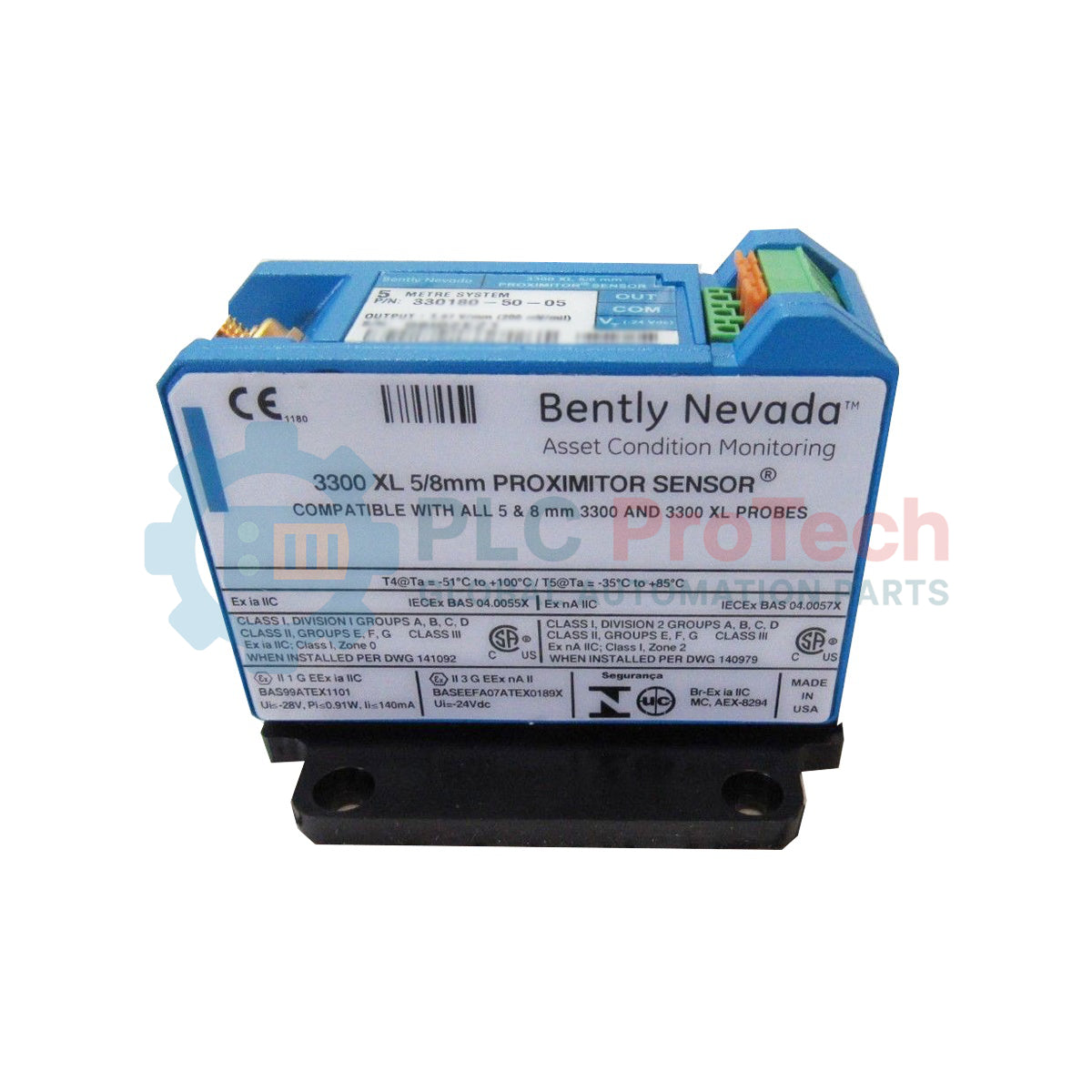
The 330180-X1-CN (MOD: 143416-34) is a high-performance signal conditioning unit and a core component of the Bently Nevada 3300 XL series. This 330180-X1-CN Proximitor Sensor provides specialized non-contacting measurements of shaft vibration, radial position, and axial displacement. Specifically modified under the 143416-34 designation for tailored industrial requirements, it is widely deployed in gas turbines, high-speed centrifugal compressors, and power generation units. In heavy industries like oil refining and mining, where machinery downtime can cost millions per hour, this sensor serves as a critical early-warning system. By converting eddy current probe signals into precise voltage outputs, it enables DCS and TSI systems to detect bearing wear and rotor instability before catastrophic failure occurs, ensuring maximum asset availability and personnel safety.
Suffix Breakdown
The alphanumeric configuration of the 330180-X1-CN MOD: 143416-34 indicates the following technical specifications:
-
330180: Base model for the 3300 XL Proximitor Sensor series.
-
X1 (Mounting/Length): Standardized DIN-rail mounting option for rapid and secure installation within industrial control cabinets.
-
CN (Agency Approval): Triple-certified for hazardous environments, carrying ATEX, IECEx, and the mandatory Chinese NEPSI markings, ensuring compliance for international and Mainland China projects.
-
MOD: 143416-34: A specific factory modification. Modification 143416-34 typically refers to customized electrical scaling or specific housing adaptations required for unique machinery interfaces or legacy system compatibility.
Technical Specifications
| Attribute |
Specification Details |
| Model |
330180-X1-CN (MOD: 143416-34) |
| Brand |
Bently Nevada (Baker Hughes) |
| Origin |
U.S.A. |
| Transducer Type |
Eddy Current / Proximity |
| Output Type |
Analog Voltage (proportional to gap) |
| Mounting |
35 mm DIN-rail |
| Operating Temp |
-51 to +100 deg C |
| Hazardous Ratings |
ATEX, IECEx, NEPSI |
| Input Supply |
-17.5 to -26 VDC |
| Shipping Weight |
2.0 kg |
Technical FAQs
What does the 143416-34 modification represent?
Factory "MOD" codes like 143416-34 indicate that the internal circuitry or physical housing has been adjusted from the standard 330180 configuration. These modifications are usually requested for specific OEM turbine requirements or to match a non-standard probe impedance.
Is the NEPSI marking mandatory for my installation?
If your project is located within the People's Republic of China and is situated in a hazardous area, the -CN (NEPSI) approval is a legal requirement for electrical safety and insurance compliance, alongside global ATEX/IECEx standards.
Does this module include the proximity probe?
No. The 330180-X1-CN is the signal conditioning Proximitor only. To form a complete measurement loop, you must also utilize a 3300 XL probe and an extension cable gapped and calibrated to the same system length.
Engineering & Installation Guide
Gap Voltage Calibration
During commissioning, the proximity probe must be gapped while the shaft is at rest. Connect a digital multimeter to the "Prox" and "Com" terminals on the 330180-X1-CN. For a standard 3300 XL 8 mm system, a typical gap voltage is -10.0 VDC. Adjust the probe distance until this voltage is achieved, placing the sensor in the center of its linear range for optimal vibration tracking.
Cabling and EMI Shielding
Since this unit is DIN-rail mounted (X1 option), ensure the rail itself is properly bonded to the instrument ground. Field cables from the probe must be shielded twisted-pair. The shield should be grounded only at the Proximitor end (or the monitor rack) to prevent ground loops. In high-vibration environments, use connector protectors on the coaxial junctions to prevent the cable from loosening over time.
Hazardous Area Integrity
Because this unit carries -CN (NEPSI) and ATEX approvals, any installation in a Class 1 Division 1 or Zone 0/1 area must utilize appropriate Zener barriers or galvanic isolators between the Proximitor and the monitoring system. Ensure all cable glands and seals meet the local explosion-proof requirements specified in the project’s safety certification.