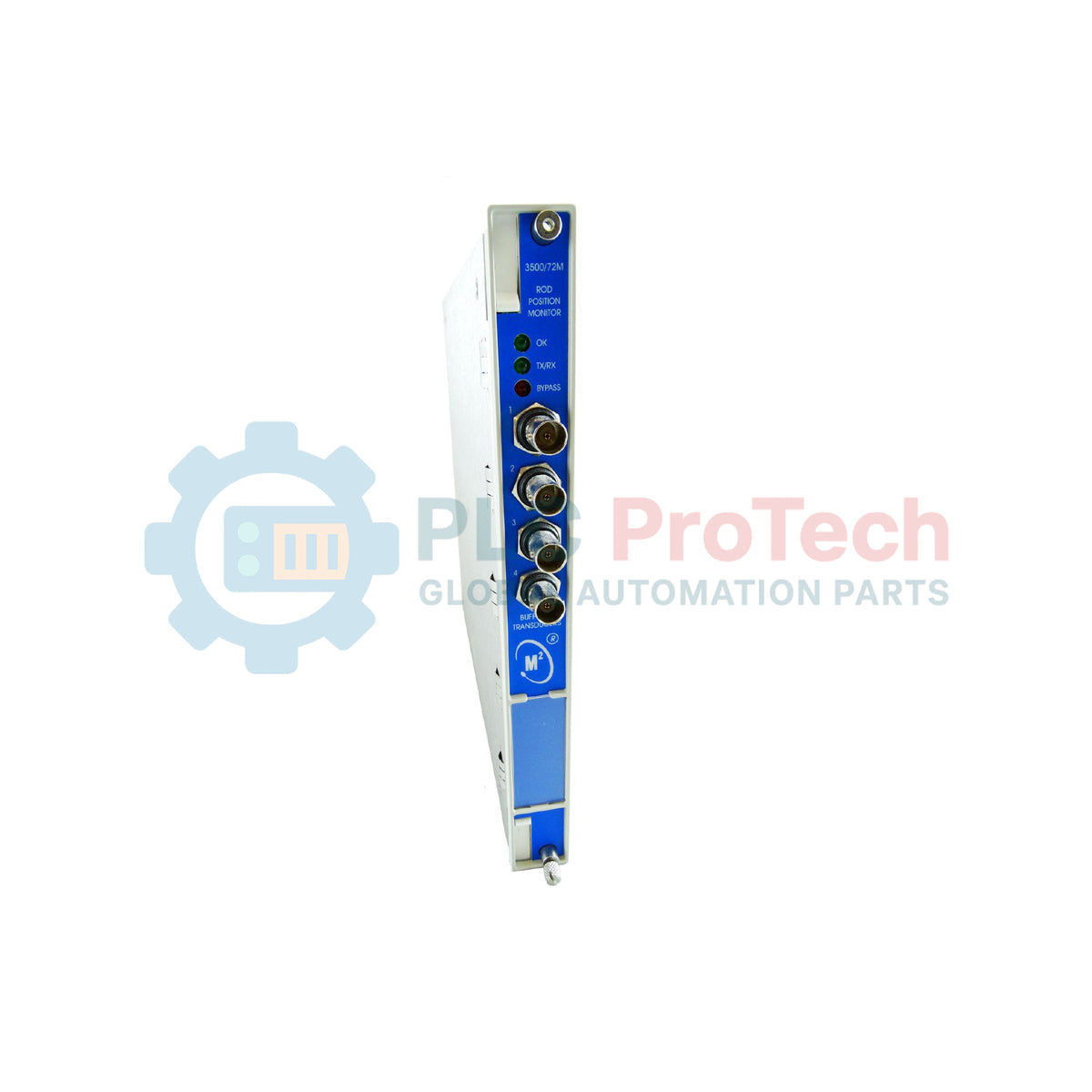
Product Overview
The 3500/72-03-CN (3500/72M) is a high-performance, 4-channel monitor specifically designed for the continuous protection of reciprocating compressors. This 3500/72-03-CN module provides advanced signal conditioning for rod position, rod drop, and hyper-compressor crosshead monitoring. In demanding industrial environments such as natural gas midstream processing, oil refining, and chemical manufacturing, the integrity of the piston rod and rider bands is paramount. By delivering real-time wear data and precise displacement tracking, the 3500/72M allows operators to transition from reactive maintenance to predictive strategies. Identifying excessive rod movement before internal mechanical contact occurs is critical for preventing catastrophic cylinder failure, thereby ensuring maximum machinery uptime and personnel safety in high-pressure environments.
Suffix Breakdown
The alphanumeric configuration of the 33500/72-03-CN defines the following hardware and certification profile:
-
3500/72: Base model for the Reciprocating Rod Position Monitor.
-
-03 (I/O Module Type): Configured with an I/O module featuring Internal Barriers and Internal Terminations. This eliminates the need for external Zener barriers when interfacing with transducers in hazardous areas, streamlining cabinet space and reducing wiring complexity.
-
-CN (Agency Approval): Specifically certified for compliance with Chinese regional standards, including NEPSI (National Supervision and Inspection Center for Explosion Protection and Safety of Instrumentation) and CCC requirements for hazardous area installations.
Technical Specifications
| Attribute |
Specification Details |
| Model |
3500/72-03-CN |
| Brand |
Bently Nevada (Baker Hughes) |
| Origin |
Made in U.S.A. |
| Monitor Type |
4-Channel Reciprocating Monitor |
| I/O Type |
Internal Barriers with Internal Terminations |
| Main Board Weight |
0.91 kg |
| Module Dimensions |
24.18 cm x 2.44 cm x 24.13 cm |
| Operating Temp |
-30 to +65 deg C |
| Input Signal |
Proximity Transducers and Keyphasor |
| Shipping Weight |
3.0 kg |
Technical Maintenance FAQs
What is the difference between Rod Drop and Rod Position monitoring?
Rod Drop specifically tracks the vertical wear of the rider bands by measuring the rod's position relative to the cylinder. Rod Position is a more general measurement used to monitor the rod's travel and alignment within the packing case. Both are vital for assessing the health of reciprocating components.
Why does this module require a Keyphasor input?
For accurate Rod Drop measurements, the monitor must "sample" the rod's position at a consistent point in the stroke (usually the point of maximum rod load). The Keyphasor provides the timing trigger necessary to filter out natural rod runout and flex that occurs at other points in the cycle.
Can the 3500/72-03-CN be used in explosive gas environments?
Yes. The -03 option indicates that the I/O module contains internal intrinsic safety barriers. When installed according to the -CN (NEPSI) guidelines, it can safely interface with probes located in Zone 0, 1, or 2 hazardous areas.
Engineering & Installation Guide
Intrinsic Safety and Internal Barriers
The 3500/72-03-CN is equipped with internal barriers to limit electrical energy delivered to the field. When wiring the proximity probes, ensure that the field cables are kept physically separate from all non-intrinsically safe wiring (power cables, relay lines) to prevent induction and maintain the integrity of the safety circuit. Use blue-jacketed cables where required by local regulations to clearly identify IS loops.
Transducer Gapping and Signal Stability
Successful Rod Drop monitoring depends on the initial gap setting of the proximity probes. The probes must be gapped while the compressor is at a known mechanical state (e.g., Bottom Dead Center). Use the 3500 Rack Configuration software to establish a "Zero Wear" baseline when the machine is commissioned with new rider bands. This baseline is the reference for all future wear calculations.
Thermal Considerations and Rack Placement
While the module is rated for operation up to 65 deg C, reciprocating compressor monitors often process high-speed data that generates localized heat. Ensure the 3500 rack has adequate ventilation. If installing in a high-temperature plant environment, utilize a cooling fan assembly at the bottom of the rack to maintain a stable internal temperature, which prevents thermal drift in the analog signal conditioning circuitry.