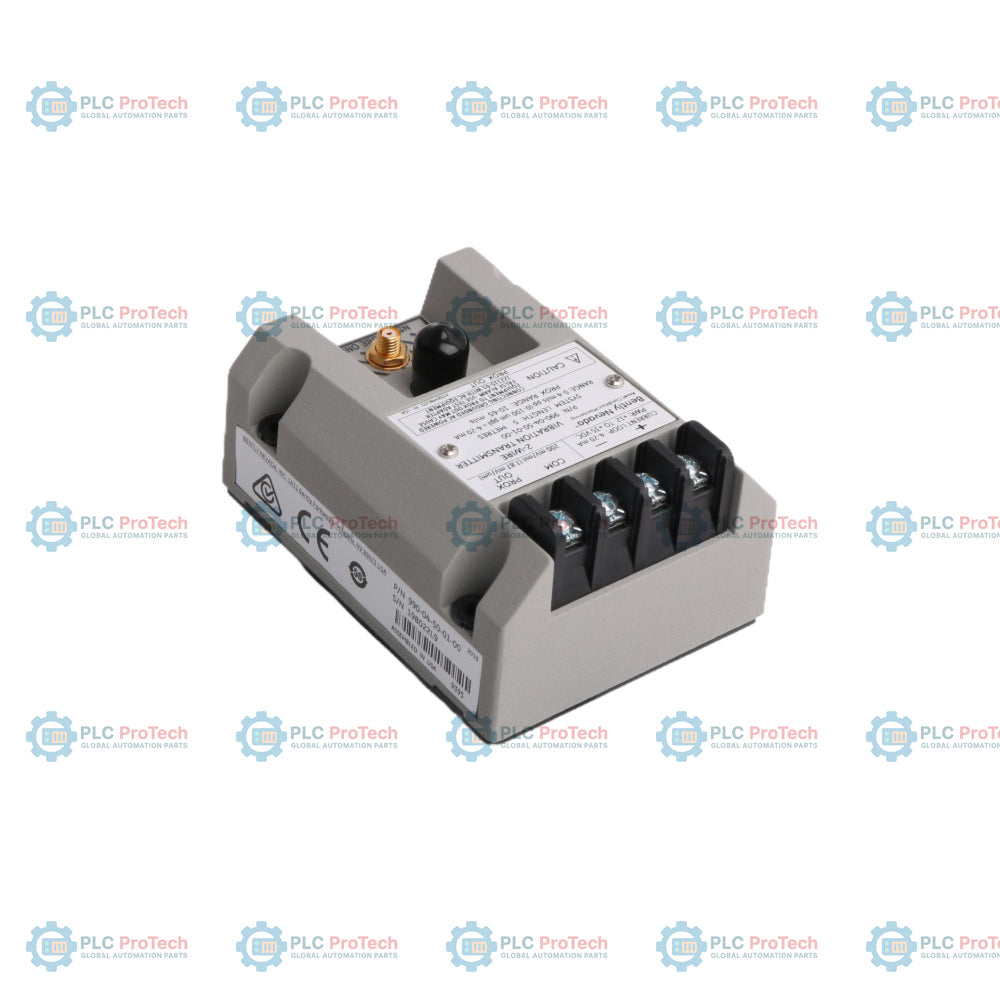
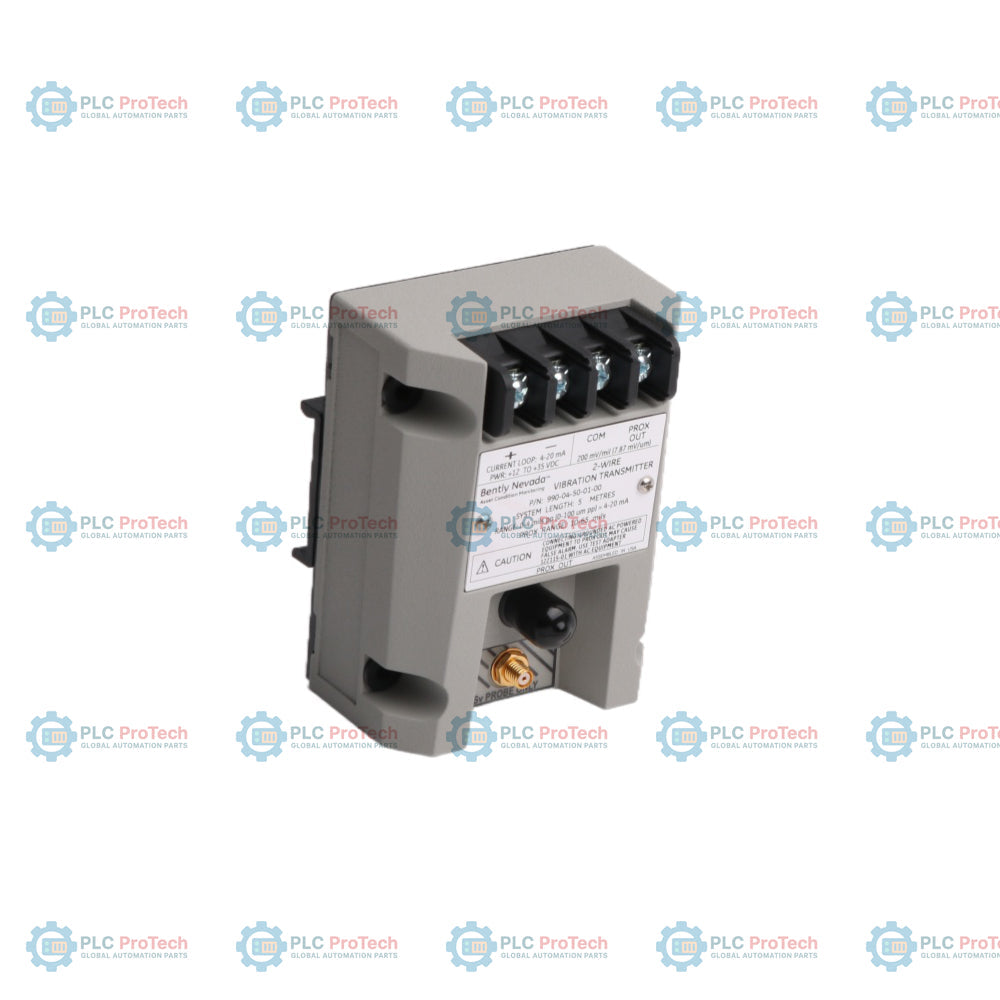
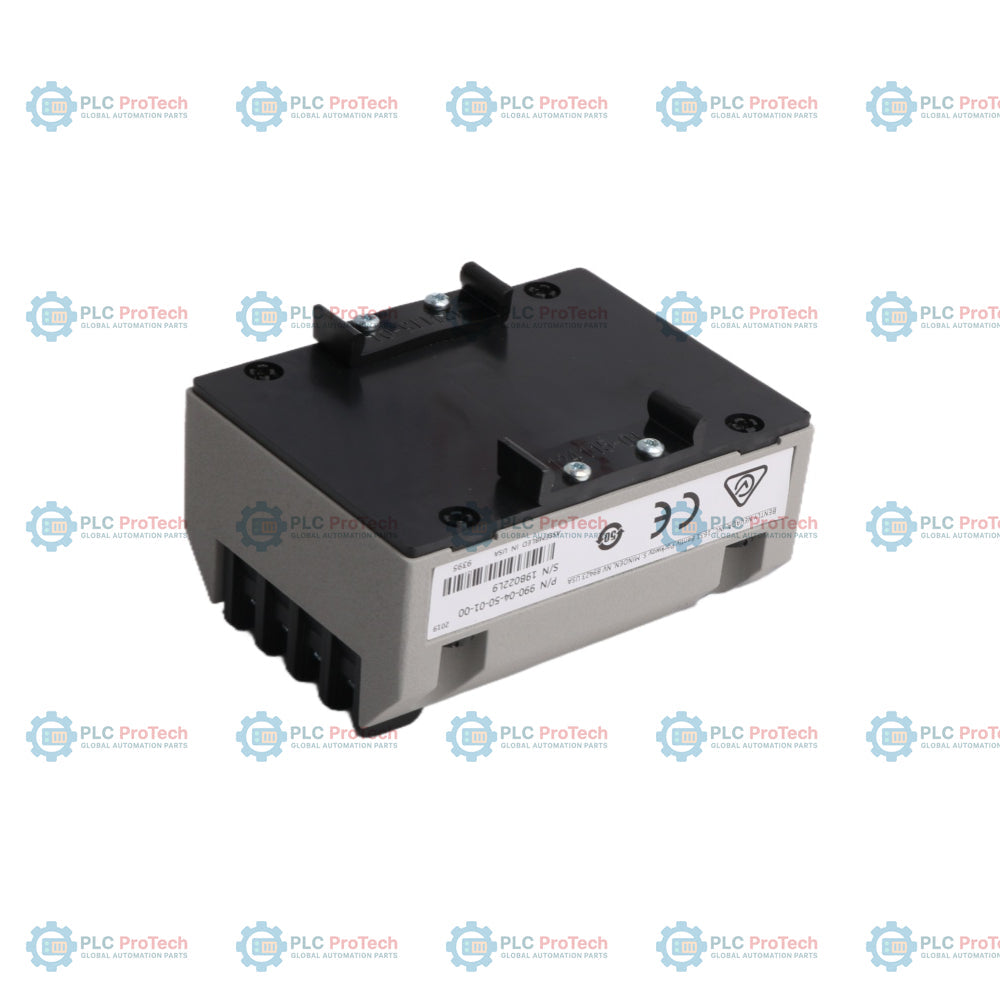
The 990-04-50-01-01 is a compact 2-wire vibration transmitter designed for direct integration of shaft vibration signals into industrial control systems. It converts proximity probe displacement into a linear 4 to 20 mA output, allowing PLC and DCS systems to perform continuous vibration trending and basic protection logic.
This version is typically selected when CSA Division 2 compliance is required alongside a standard DIN rail installation format. In practical engineering use, it is deployed on rotating equipment where vibration monitoring needs to be reliable but not dependent on a full rack-based monitoring system.
The transmitter works with a 3300 NSv proximity probe system and supports a 5.0 metre system length configuration. From a field perspective, this makes it suitable for medium-distance probe routing inside compressor skids, pump bases, and packaged machinery panels.
Once installed, the device is usually left to operate continuously with minimal intervention, provided probe alignment and loop power stability are correctly configured during commissioning.
Functional Overview
Converts shaft vibration signal into 4–20 mA analog output
Designed for 3300 NSv proximity probe systems
CSA Division 2 approved configuration
2-wire loop-powered architecture
DIN rail mounting using 35 mm clips
Integrated signal conditioning electronics
External zero and span adjustment capability
PROX OUT diagnostic access point
Fault detection with output current drop behavior
Compact sealed industrial housing design
Typical Application Context
Equipment Type
Practical Use Case
Centrifugal compressors
Continuous vibration trending
Industrial pumps
Bearing condition monitoring
Fans and blowers
Unbalance detection
OEM skid packages
Embedded protection loop
Utility auxiliaries
Alarm input to PLC systems
Process machinery
Basic condition monitoring point
Ordering Structure
Parameter
Code Description
Model
990 Vibration Transmitter
Full-scale Option
-04 = 0-4 mils pp (0-100 µm pp)
System Length Option
-50 = 5.0 metres (16.4 feet)
Mounting Option
-01 = 35 mm DIN rail clips
Agency Approval Option
-01 = CSA Division 2
Mechanical Data
Item
Specification
Part Number
990-04-50-01-01
Manufacturer
Bently Nevada
Product Type
Vibration Transmitter
Condition
New & Original in Factory Packing
Factory Warranty
12 Months
Minimum Target Size
9.5 mm (0.375 in)
Dimensions (H x W x D)
53.3 mm x 73.9 mm x 100.1 mm
Body Height (without DIN clip)
42.6 mm
Mounting Hole Distance
63.5 mm x 69.9 mm
Mounting Hole Diameter
5.8 mm
Transmitter Weight
0.43 kg
Total System Weight
0.82 kg
Interface Overview
Interface
Function
Probe Input
3300 NSv proximity probe connection
4–20 mA Output
Vibration signal to control system
Power Input
Loop-powered DC supply
PROX OUT
Raw vibration diagnostic signal
COM
Signal reference
Installation Notes (Engineering Practice)
In typical installations, this transmitter is mounted on a DIN rail inside a control cabinet close to the PLC I/O system. The key engineering focus is not the transmitter itself, but stable probe wiring and correct grounding practice.
Cable routing should avoid parallel runs with inverter output cables or motor feeders, especially in compressor skid environments where electromagnetic noise is common. Proper shielding termination is critical for signal stability.
During commissioning, loop current should be verified before enabling any alarm logic. Engineers usually confirm stable vibration readings under steady-state machine conditions before integrating the signal into shutdown or warning systems.
CSA Division 2 certification makes this configuration suitable for specific hazardous locations, depending on final system design and enclosure compliance.
FAQ
What is the main function of this transmitter? It converts vibration from a proximity probe into a 4–20 mA signal for control systems.
Which probe system is required? It is designed for Bently Nevada 3300 NSv proximity probe systems.
What makes this version different? It includes CSA Division 2 certification for hazardous area applications.
Can it be used directly with PLCs? Yes, it outputs a standard analog signal compatible with PLC input modules.
Is this a diagnostic system? No, it is intended for basic vibration trending and protection logic.
What is PROX OUT used for? It provides access to raw vibration signals for maintenance diagnostics.
Is DIN rail mounting mandatory? No, but it is the standard and recommended installation method.
What is the operating principle? It converts displacement measurement into proportional current output.
Where is it typically installed? Inside control cabinets for compressors, pumps, and rotating machinery.
Does it require external signal conditioning? No, signal conditioning is fully integrated into the unit.
Maintenance data connects work orders, sensor signals, asset history, costs, and technician knowledge. Used well, it improves planning, reliability, predictive maintenance, spare-parts control, and...
This article explains how integrated electric actuators, such as SMC’s e-Actuator series, are transforming industrial motion control by replacing traditional pneumatic and hydraulic systems. It...
This article explains how PLC systems perform core mathematical operations such as addition, subtraction, multiplication, division, modulo, and exponentiation within industrial automation. It shows...
The article explains several advanced Boolean logic functions used in PLC programming beyond basic AND, OR, and NOT operations. It covers how tools like truth tables, multiplexers, pulse generators,...
Boolean logic is the foundation of every PLC program. From simple machine controls to complex industrial automation systems, logic gates determine how controllers respond to changing inputs and...
Industrial firewalls play a critical role in OT cybersecurity, protecting PLC, DCS, and SCADA networks through segmentation, ingress/egress control, and IDS/IPS integration aligned with IEC 62443...
Choosing a selection results in a full page refresh.