


Troubleshooting Beckhoff KL1512 Counter Inputs and Mapping
A field checklist for KL1512 signal thresholds, counter direction, process data and the KL1512-to-KS1512 wiring difference.
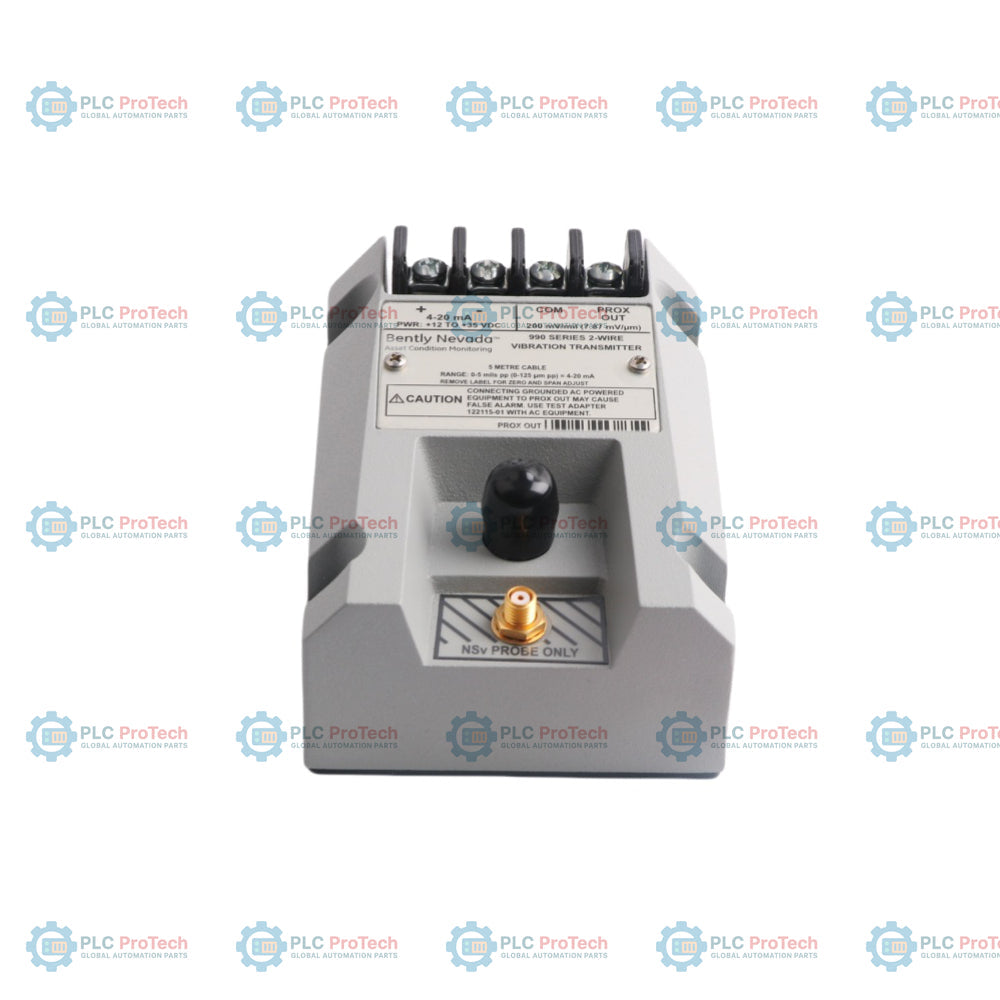
Manufacturer: Bently Nevada
Product No.: 990-05-50-02-01
Country of origin:United States
Product Type: Vibration Transmitter
Barcode: 8537101190
Payment: T/T, Western Union
Weight: 820g
Dimensions: 7.3cm x 5cm x 10cm
Shipping port: Xiamen
Warranty: 12 months
The 990-05-50-02-01 provides continuous, proportional linear scaling of proximity probe signals into a simplified two-wire loop architecture. Engineered to serve industrial plant operators looking to streamline monitoring on high-speed assets, this compact component interfaces directly with standard machinery control infrastructure where basic alarm limits and process monitoring calculations are performed. By translating physical shaft movement into a standard analog format, it bridges the gap between field-level eddy current measurements and plant-wide control loops.
Constructed using a ruggedized, fully encapsulated potting compound, the unit functions safely when exposed to severe moisture, shifting temperatures, and airborne industrial contaminants. The system operates out of a single combined module housing, removing traditional multi-component panel steps and lowering the total hardware footings required inside remote field enclosures.
| Part Number Element | Selected Option Code | Hardware Selection Breakdown |
|---|---|---|
| Model Number | 990 | Base Vibration Transmitter System |
| A: Full-Scale Measurement | 05 | 0 to 5 mils peak-to-peak (0 to 125 micrometers pp) range |
| B: Calibrated System Length | 50 | 5.0 meters (16.4 feet) total transducer tracking |
| C: Hardware Mounting Style | 02 | Bulkhead installation screws configuration |
| D: Safety Agency Approvals | 01 | CSA Division 2 certified hazardous location option |
| Core Category | Verified Engineering Parameter Details |
|---|---|
| Primary Input Path | Accepts 1 single channel non-contacting 3300 NSv eddy current probe and matching cable |
| Supply Voltage Window | +12 Vdc to +35 Vdc input measured directly at the transmitter wire blocks |
| Current Loop Signal | 2-wire configuration supplying 4 to 20 mAdc proportional to peak-to-peak displacement |
| Loop Error Allocation | Within ±1.5% of full-scale across a standard 250 ohm monitoring loop resistance |
| Target Proximity Gap | Mechanical installation gap between 0.5 and 1.75 mm (20 and 55 mils) |
| Impedance Constraints | 1,000 ohms maximum loop resistance threshold at full 35 Vdc input power |
| Overcurrent Threshold | Limited internally to a maximum of 23 mA typical |
| Loop Fail-Safe Action | Output drops below 3.6 mA within 100 microseconds of a probe or connection fault |
| Fault Recovery Window | Restores normal analog tracking within 2 to 3 seconds after fault clearance |
| Power-On Stabilization | Drops output below 3.6 mA for 2 to 3 seconds during initial system power ramp-up |
| Dynamic Port Impedance | 10 kohm calibrated source impedance configured specifically for a 10 Mohm testing load |
| Sensor Linear Field | 1.4 mm (55 mils) total span beginning 0.25 mm (10 mils) away from target surface |
| Scale Factor Performance | 7.87 mV/micrometer (200 mV/mil) ±6.5% typical based on an AISI 4140 steel target |
| Inherent Noise Floor | 50 mV peak-to-peak typical noise level |
| Thermal Drift Deviation | Scale factor remains within ±10% of nominal from 0 degC to +70 degC (+32 degF to +158 degF) |
| Frequency Bandwidth | 5 Hz to 6,000 Hz flat response with +0, -3 dB attenuation curves |
| Minimum Target Profiling | 9.5 mm (0.375 in) minimum target surface diameter |
| Diagnostic Cable Limit | 3 meters (10 feet) maximum physical cable distance for the coaxial BNC connection |
| Transmitter Ambient Limits | Operating: -35 degC to +85 degC; Storage: -52 degC to +100 degC |
| Transducer Temperature | Operating and Storage limits rated from -52 degC to +177 degC |
| Hardware Mass Metrics | Transmitter Unit: 0.43 kg (0.9 lbm); Total System: 0.82 kg (1.8 lbm) typical |
| Enclosure Composition | Sensor tip: Polyphenylene sulfide (PPS); Case body: AISI 303 or 304 Stainless Steel |
| Product Manufacturer | Bently Nevada (A Baker Hughes Company) |
| Production Origin | United States of America |
| Wiring Pin Location | System Terminal Designation |
|---|---|
| Terminal E1 | Loop Power Supply Positive Input (+) / 4 to 20 mA Connection |
| Terminal E2 | Loop Power Supply Negative Input (-) / 4 to 20 mA Connection |
| Terminal E3 | Non-Isolated Proximitor Dynamic Output (PROX OUT) |
| Terminal E4 | Non-Isolated Proximitor Dynamic Common Reference (COM) |
| Coaxial J2 Plug | Front-Facing BNC Dynamic Signal Connection |
| Coaxial J3 Plug | Heavy Duty Integrated Proximity Probe Input Terminal |
What is the practical consequence of exceeding the maximum calculated loop resistance?
When the circuit resistance exceeds the limit defined by the supply voltage formula, the system runs out of electrical headroom. As a result, the loop current becomes clamped and fails to reach the 20 mA full-scale limit during high vibration events.
Why does the analog loop current read under 3.6 mA immediately after applying power?
This is an automated power-up inhibit cycle that runs for 2 to 3 seconds. It holds the transmitter in a Not OK state to let internal circuits stabilize, preventing initial electrical switch-on spikes from being misread as vibration trips.
How does the integrated signal defeat logic handle a broken extension cable?
The transmitter recognizes the open circuit as a Not OK condition and immediately drops the analog loop current below 3.6 mA within 100 microseconds. This rapid drop alerts the attached PLC or DCS that the measurement channel has failed rather than reporting an actual machine over-vibration event.
Can standard diagnostic instruments be hooked directly up to the BNC terminal?
Only battery-powered or fully floating diagnostic instruments should be attached to the non-isolated PROX OUT port. Grounded, AC-powered instruments require the 122115-01 signal isolation adapter to prevent ground loops that could trigger false alarms on the loop network.


Global Express Shipping
Returns & Warranty


Global Express Shipping
Returns & Warranty
Orders are processed and delivered Monday-Friday (excluding public holidays).
For full eligibility, restocking fees, and international return details, please view our official Refund & Return Policy .
| Color pattern |
Greyish White
|
| Country of origin |
United States
|

A field checklist for KL1512 signal thresholds, counter direction, process data and the KL1512-to-KS1512 wiring difference.

A field checklist for EPP2008-0001 current limits, supply voltage, channel LEDs, connector coding and load-related output faults.

Before moving a TwinCAT 3 license with a Beckhoff C9900-L100, verify the TwinCAT build, XML device description, exact order code and cabinet limits.

A field checklist for replacing a Beckhoff EL4032, covering the ±10 V load, terminal map, power contacts, EtherCAT state, and watchdog behavior.

Before replacing a Yokogawa AAI835, verify the 4-in/4-out channel map, power-loss loop behavior, barrier type, output load, cable, and redundancy.

ABB PM891K01 article 3BSE053241R1 is the non-redundant AC 800M processor kit. Use this field checklist before replacement.