


Troubleshooting Beckhoff EPP2008-0001 Output Faults
A field checklist for EPP2008-0001 current limits, supply voltage, channel LEDs, connector coding and load-related output faults.
Manufacturer: Bently Nevada
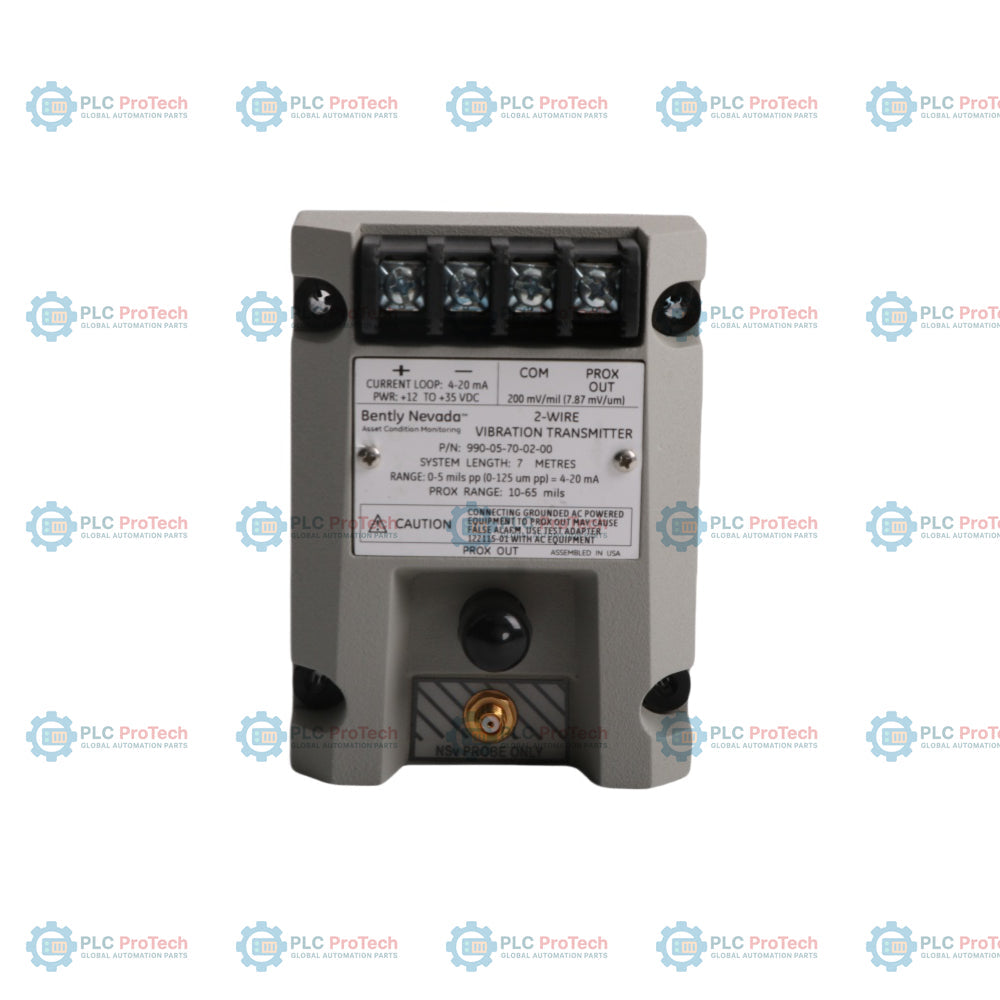
Product No.: 990-05-70-02-00
Country of origin:United States
Product Type: Vibration Transmitter
Barcode: 8537101190
Payment: T/T, Western Union
Weight: 820g
Dimensions: 7.4cm x 4.6cm x 10cm
Shipping port: Xiamen
Warranty: 12 months
The Bently Nevada 990-05-70-02-00 is a two-wire, loop-powered 990 Vibration Transmitter designed to process signals from proximity probes into a proportional 4 to 20 mA industry-standard current loop. The device directly interfaces with a 3300 NSv proximity probe and its matching extension cable to monitor peak-to-peak vibration amplitude. This transmitter provides an engineered solution for machinery control systems where local control-level protection alarming and logic are required. It operates as an integrated Proximitor Sensor unit, optimizing signal processing for compact industrial equipment.
| Suffix Code | Option Type | Field Description |
|---|---|---|
| 990 | Base Model | 990 Vibration Transmitter |
| -05 | A: Full-scale Option | 0-5 mils pp (0-125 um pp) |
| -70 | B: System Length Option | 7.0 meters (23.0 feet) |
| -02 | C: Mounting Option | Bulkhead screws |
| -00 | D: Agency Approval Option | Not required |
| Category | Parameter | Specification |
|---|---|---|
| Identity | Manufacturer | Bently Nevada |
| Model | 990-05-70-02-00 | |
| Electrical | Input | 1 non-contacting 3300 NSv Proximity Probe and extension cable |
| Power Requirements | +12 to +35 Vdc input at the transmitter terminal | |
| Signal Output | 4 to 20 mAdc over specified full-scale range (2-wire configuration) | |
| 4 to 20 mA Loop Accuracy | Within +/-1.5% over specified full-scale range across 250 Ohm resistance | |
| Maximum Loop Resistance | 1,000 Ohm including cable at 35 Vdc | |
| Current Limiting | 23 mA typical | |
| Zero and Span | Non-interacting external adjustments | |
| NOT OK/Signal Defeat | Signal output < 3.6 mA within 100 us of fault; restores in 2-3 seconds | |
| Power-up Inhibit | Signal output < 3.6 mA for 2 to 3 seconds after power application | |
| Dynamic Performance | Prox Out Linear Range | 1.4 mm (55 mils), begins approx. 0.25 mm (10 mils) from target |
| Prox Out Scale Factor | 7.87 mV/um (200 mV/mil) +/-6.5% typical | |
| Temperature Stability | Scale factor remains within +/-10% of 7.87 mV/um from 0 Celsius to +70 Celsius | |
| Frequency Response | 5 Hz to 6,000 Hz +0, -3 dB | |
| Minimum Target Size | 9.5 mm (0.375 in) diameter | |
| Environmental | Transmitter Operating Temp | -35 Celsius to +85 Celsius (-31 Fahrenheit to +185 Fahrenheit) |
| Transmitter Storage Temp | -52 Celsius to +100 Celsius (-62 Fahrenheit to +212 Fahrenheit) | |
| Probe Operating/Storage Temp | -52 Celsius to +177 Celsius (-62 Fahrenheit to +351 Fahrenheit) | |
| Relative Humidity | 100% condensing, non-submerged (with coaxial connector protection) | |
| Mechanical | Transducer Tip Material | Polyphenylene sulfide (PPS) |
| Transducer Case Material | AISI 303 or 304 Stainless Steel (SST) | |
| Probe Cable Type | 75 Ohm coaxial, fluoroethylene propylene (FEP) insulated | |
| Transmitter Weight | 0.43 kg (0.9 lbm) | |
| Total System Weight | 0.82 kg (1.8 lbm) typical |
| Interface / Terminal | Function |
|---|---|
| Transmitter Terminals | +12 to +35 Vdc Loop Power Input and 4-20 mA Signal Output |
| PROX OUT Terminal | Non-isolated dynamic transducer signal for local diagnostic connections |
| COM Terminal | Common reference point for signal verification |
| Coaxial Connector | BNC connection for dynamic vibration and gap voltage monitoring (Max 3m distance) |
| Test Input Pin | Signal injection point for verifying loop response via a function generator |
The proximity probe must be physically gapped between 0.5 and 1.75 mm (20 and 55 mils) from the target surface. This ensures the target remains inside the transmitter's linear measurement range during machine operation.
Do not exceed the maximum thread engagement lengths during installation to avoid component binding. For 1/4-28 threads, the limit is 0.375 inches; for M8x1 threads, the limit is 12 mm. Bently Nevada does not cover warranty replacements for probes damaged by excessive thread engagement.
The unit utilizes potted construction suitable for up to 100% condensing humidity. To maintain loop integrity, all coaxial connectors must be protected against direct moisture ingress using appropriate sealing boots or enclosures.
The PROX OUT coaxial connector is non-isolated from the 4 to 20 mA loop circuit. While compatible with ungrounded, portable test equipment, you must use a 122115-01 or 990/991 Test Adapter when connecting to grounded, ac-powered test equipment like oscilloscopes to isolate the loops and maintain safety integrity.
What limitations do vibration transmitters have compared to standard machinery protection monitors?
Transmitters provide peak-to-peak trending data only and cannot capture dynamic waveforms during an alarm event. They do not support phase tracking, gap alarms, Timed OK channel defeat, Danger Bypass, or Trip Multiply, and they cannot interface with plant-wide diagnostic platforms like System 1.
How does the Not OK circuit manage loose sensor connections?
If a probe connection loosens or fails, the transmitter drops the loop output below 3.6 mA within 100 microseconds. Once the connection is secure, the transmitter waits 2 to 3 seconds before restoring the standard output signal.
What size target is required for the transmitter to meet its accuracy specification?
The target must have a minimum diameter of 9.5 mm (0.375 inches) and be composed of AISI 4140 steel to maintain the calibrated scale factor.


Global Express Shipping
Returns & Warranty




Global Express Shipping
Returns & Warranty
Orders are processed and delivered Monday-Friday (excluding public holidays).
For full eligibility, restocking fees, and international return details, please view our official Refund & Return Policy .
| Color pattern |
Greyish White
|
| Country of origin |
United States
|

A field checklist for EPP2008-0001 current limits, supply voltage, channel LEDs, connector coding and load-related output faults.

Before moving a TwinCAT 3 license with a Beckhoff C9900-L100, verify the TwinCAT build, XML device description, exact order code and cabinet limits.

A field checklist for replacing a Beckhoff EL4032, covering the ±10 V load, terminal map, power contacts, EtherCAT state, and watchdog behavior.

Before replacing a Yokogawa AAI835, verify the 4-in/4-out channel map, power-loss loop behavior, barrier type, output load, cable, and redundancy.

ABB PM891K01 article 3BSE053241R1 is the non-redundant AC 800M processor kit. Use this field checklist before replacement.

Replacement checks for ABB TP853 3BSE018126R1: identify the installed CI853, CI855, CI857, or CI861 interface, record wiring, and verify communication after installation.