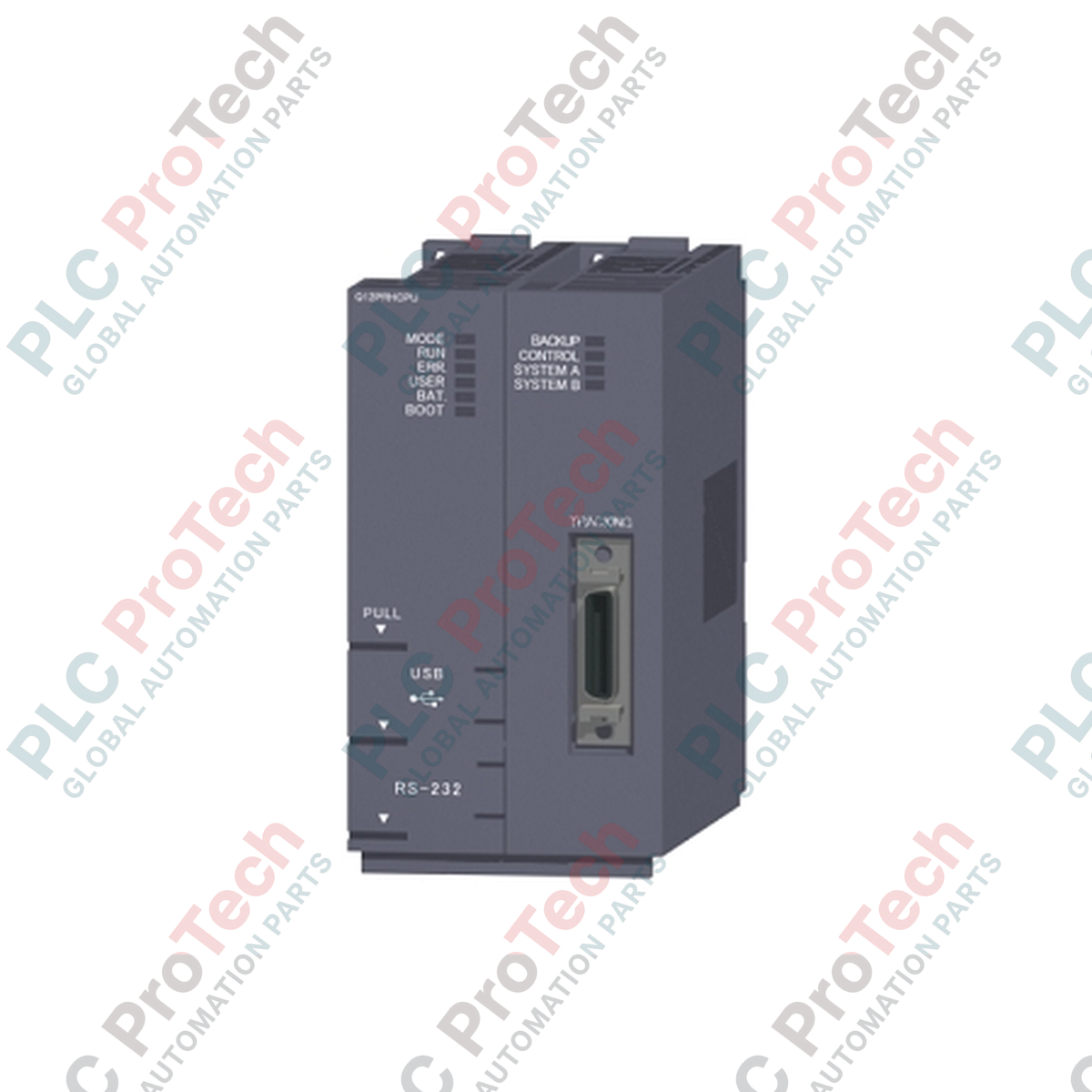
Designed to ensure high-availability control in critical automation environments, the Mitsubishi Electric Q12PRHCPU operates as a high-performance redundant CPU module within the MELSEC Q Series platform. This module is engineered to prevent system downtime by utilizing a dual-redundant architecture where a backup CPU instantly assumes control in the event of a primary CPU failure. It features a program capacity of 120k steps and supports up to 4096 physical I/O points, making it suitable for large-scale, fault-tolerant industrial operations.
Key Features
-
Redundant System Architecture: Supports hot-standby redundancy with automatic, bumpless switchover to prevent process interruption.
-
High-Speed Processing: Delivers an LD instruction execution speed of 34 nanoseconds (0.034 microseconds) for rapid task execution.
-
Hot-Swappable Capability: Allows online module replacement of the standby CPU, power supply, and network modules without stopping the active control process.
-
Dual Programming Interfaces: Equipped with both USB (Mini-B) and RS-232 (Mini-DIN) ports for flexible programming, diagnostics, and monitoring.
-
Extensive Memory Capacity: Provides 120k steps of program memory alongside dedicated tracking memory for seamless data synchronization between active and standby units.
Applications
- Water treatment and municipal wastewater processing plants.
- Continuous chemical, petrochemical, and pharmaceutical processing lines.
- Power generation, substation automation, and utility distribution networks.
- Tunnel ventilation, public transit power systems, and critical infrastructure.
Technical Specifications
| Parameter |
Specification Value |
| Manufacturer |
Mitsubishi Electric |
| Model Number |
Q12PRHCPU |
| Series |
MELSEC Q Series |
| Module Type |
Redundant PLC CPU Module |
| Program Capacity |
120k steps (480 KB) |
| I/O Points (Physical) |
4096 points |
| I/O Points (Device) |
8192 points |
| LD Instruction Speed |
0.034 microseconds (34 ns) |
| Current Consumption (5 VDC) |
0.89 A |
| Operating Temperature |
0 to 55 degC |
| Storage Temperature |
-25 to 75 degC |
| Relative Humidity |
5 to 95% RH (non-condensing) |
| Net Weight |
0.30 kg |
| Shipping Weight (Calculated) |
2.00 kg |
| Dimensions (W x H x D) |
27.4 mm x 98 mm x 115 mm |
| Country of Origin |
Japan |
Connections and Interfaces
| Interface Port |
Connector Type |
Functional Assignment |
| RS-232 Port |
Mini-DIN 6-Pin |
Serial programming, peripheral connection, and system diagnostics. |
| USB Port |
Mini-B |
High-speed programming, monitoring, and parameter configuration via GX Works2. |
| Tracking Port |
Dedicated Redundant Connector |
High-speed tracking cable connection to synchronize memory with the standby CPU. |
Empirical Engineering Insights
Alternative Models & Compatibility
The Q12PRHCPU must be used in conjunction with redundant base units (such as the Q38RB or Q68RB) and redundant power supply modules (Q61P-D). It cannot be mixed with standard Q-series CPUs on a standard base unit for redundant operations. When replacing older Q12HCPU modules, note that standard non-redundant base units are incompatible with the physical tracking interface and dual-bus routing of the redundant series.
Application Pitfalls & Engineering Notes
Tracking cable length is a critical constraint. Standard tracking cables (QC10TR or QC30TR) are limited to 3 meters. Exceeding this distance or using non-shielded custom cables can introduce electromagnetic interference, leading to tracking synchronization failures (such as "SP.UNIT LAY. ERR" or "CONTROL CPU ERROR"). Additionally, optimize the tracking data size settings in GX Works2 to prevent excessive scan time extensions during synchronization cycles.
Commissioning & Wiring Tips
Before powering up the redundant system, verify that both the primary (System A) and standby (System B) CPU modules have identical firmware versions. Discrepancies in firmware can prevent the standby CPU from entering the "BACKUP" state, leaving the system in a non-redundant, single-CPU run mode. Always download identical parameter files and program blocks to both units before executing the initial system synchronization.
Installation Guidelines
CRITICAL WARNING:
Ensure all external power sources feeding the base unit and associated I/O racks are completely de-energized before mounting or removing the CPU modules. Failure to isolate power can result in electrical arcing, damage to the internal backplane bus, or unexpected control system state changes.
1
Mount the CPU module securely onto the redundant base unit (Q38RB or Q68RB), ensuring the bottom locking tab clicks firmly into place.
2
Connect the dedicated tracking cable between the tracking ports of the two Q12PRHCPU modules to establish the synchronization link.
3
Secure the tracking cable connectors using the integrated retention screws to prevent accidental disconnection due to panel vibration.
4
Establish a solid functional ground connection from the base unit's LG and FG terminals to the main control cabinet ground bus.