


Implementing 3-Switch XOR Ladder Logic with Internal Bit
Implement a 3-SPST switch XOR light circuit in LogixPro or RSLogix 500 using an internal relay bit. Includes truth tables, boolean equations, and verified.

Engineered for high-performance multi-axis synchronization, the Mitsubishi Electric Q173CPUN serves as a dedicated motion CPU within the MELSEC Q Series platform. This controller seamlessly integrates on the same base unit alongside standard Q Series PLC CPUs, distributing processing loads to achieve precise synchronization of complex machinery. It supports advanced motion control tasks such as virtual axis configuration, electronic camming, and synchronized gear operations while relying on highly immune fiber-optic communication interfaces to interface with external servo amplifiers.
| Manufacturer | Mitsubishi Electric |
| Model | Q173CPUN |
| Series | MELSEC Q Series |
| Module Type | Motion Controller CPU Module |
| Number of Control Axes | Up to 32 axes |
| I/O Points | 8192 points |
| Program Capacity | 14k steps |
| Motion Network | SSCNET III (Fiber-Optic) |
| Operating Temperature | 0 to 55 degC |
| Storage Temperature | -25 to 75 degC |
| Shipping Weight (Calculated) | 3.0 kg |
| Package Dimensions (Calculated) | 150 mm x 120 mm x 100 mm |
| Interface Type | Physical Description & Function |
|---|---|
| SSCNET III Ports | Optical fiber connector sockets for high-speed synchronization communication to MR-J3/MR-J4 series servo amplifiers. |
| Multi-CPU Interface | High-speed backplane connector matching the MELSEC Q Series main base unit slot allocation. |
| USB Connection | Peripheral communication port for commissioning, configuration downloading, and real-time trace diagnostics. |
When migrating from older non-N models like the Q173CPU, verify the physical network layout. The standard Q173CPU uses copper-based SSCNET, while the Q173CPUN utilizes fiber-optic SSCNET III. This shift requires changing the communication cables to optical fiber and ensures the corresponding servo drives support SSCNET III protocols.
Backplane power calculation is critical. Because a motion controller CPU draws higher current from the backplane 5V supply than standard digital I/O modules, you must sum the current consumption of the PLC CPU, the Q173CPUN, and all host modules to prevent overload on the system power supply (e.g., Q61P vs Q63P).
Handle the SSCNET III optical fiber cables with extreme care during panel wiring. Maintaining a minimum bend radius of 25 mm is critical; exceeding this limit can lead to optical signal attenuation, causing mysterious communications failures or sporadic axis fault trips (such as code 32 or 10) during high-speed operation cycles.
Global Express Shipping
Returns & Warranty


Manufacturer: Mitsubishi Electric
Product No.: Q173CPUN
Country of origin:United States
Product Type: Motion Controllers
Payment: T/T, Western Union
Weight: 3000g
Dimensions: 150 mm x 120 mm x 100 mm
Shipping port: Xiamen
Warranty: 12 months
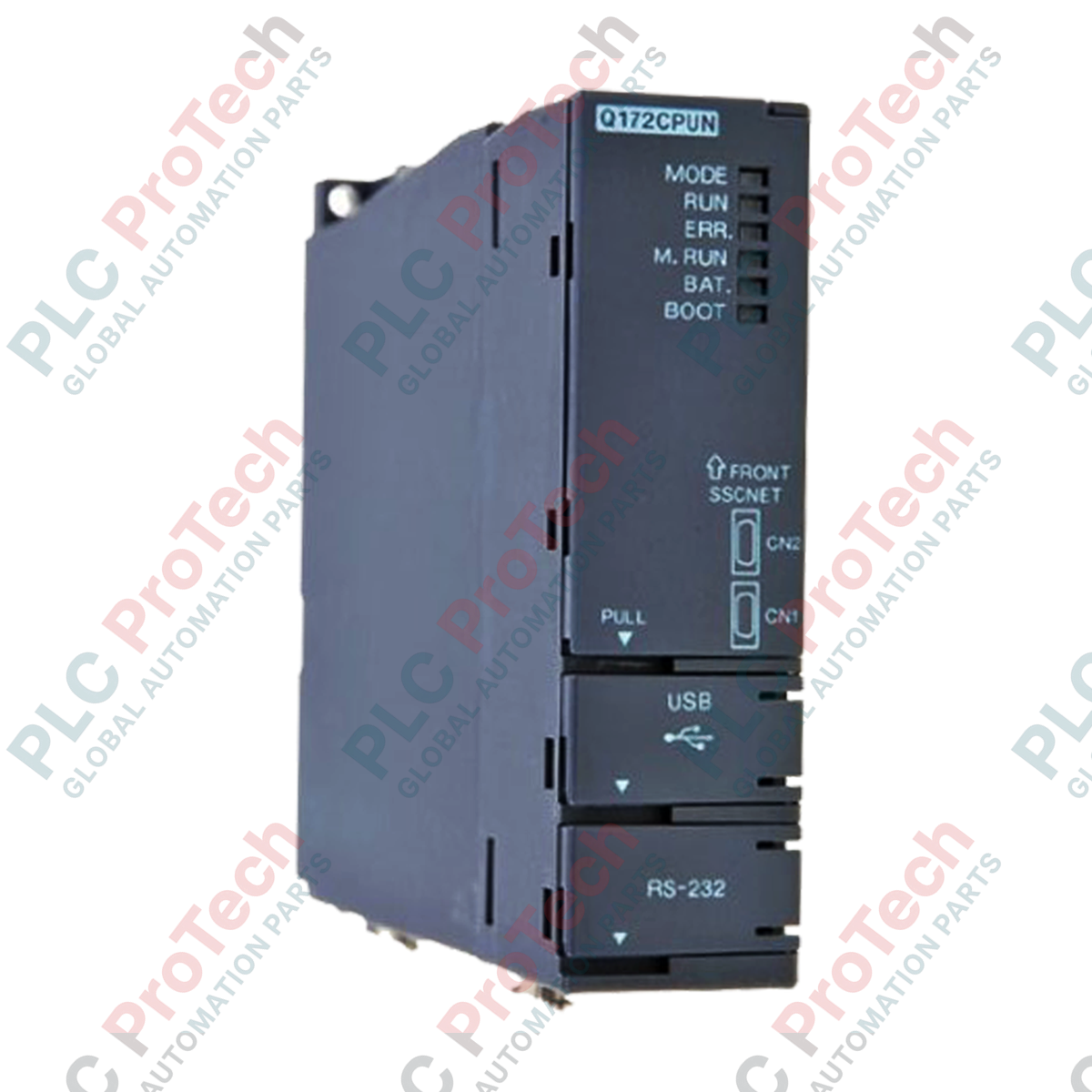
Engineered for high-performance multi-axis synchronization, the Mitsubishi Electric Q173CPUN serves as a dedicated motion CPU within the MELSEC Q Series platform. This controller seamlessly integrates on the same base unit alongside standard Q Series PLC CPUs, distributing processing loads to achieve precise synchronization of complex machinery. It supports advanced motion control tasks such as virtual axis configuration, electronic camming, and synchronized gear operations while relying on highly immune fiber-optic communication interfaces to interface with external servo amplifiers.
| Manufacturer | Mitsubishi Electric |
| Model | Q173CPUN |
| Series | MELSEC Q Series |
| Module Type | Motion Controller CPU Module |
| Number of Control Axes | Up to 32 axes |
| I/O Points | 8192 points |
| Program Capacity | 14k steps |
| Motion Network | SSCNET III (Fiber-Optic) |
| Operating Temperature | 0 to 55 degC |
| Storage Temperature | -25 to 75 degC |
| Shipping Weight (Calculated) | 3.0 kg |
| Package Dimensions (Calculated) | 150 mm x 120 mm x 100 mm |
| Interface Type | Physical Description & Function |
|---|---|
| SSCNET III Ports | Optical fiber connector sockets for high-speed synchronization communication to MR-J3/MR-J4 series servo amplifiers. |
| Multi-CPU Interface | High-speed backplane connector matching the MELSEC Q Series main base unit slot allocation. |
| USB Connection | Peripheral communication port for commissioning, configuration downloading, and real-time trace diagnostics. |
When migrating from older non-N models like the Q173CPU, verify the physical network layout. The standard Q173CPU uses copper-based SSCNET, while the Q173CPUN utilizes fiber-optic SSCNET III. This shift requires changing the communication cables to optical fiber and ensures the corresponding servo drives support SSCNET III protocols.
Backplane power calculation is critical. Because a motion controller CPU draws higher current from the backplane 5V supply than standard digital I/O modules, you must sum the current consumption of the PLC CPU, the Q173CPUN, and all host modules to prevent overload on the system power supply (e.g., Q61P vs Q63P).
Handle the SSCNET III optical fiber cables with extreme care during panel wiring. Maintaining a minimum bend radius of 25 mm is critical; exceeding this limit can lead to optical signal attenuation, causing mysterious communications failures or sporadic axis fault trips (such as code 32 or 10) during high-speed operation cycles.
| Product Image | Model Number / Title | Condition | Availability | Action |
|---|---|---|---|---|
|
Allen-Bradley 5069-L3100ERM CompactLogix 5380 Motion Controller | Original New | In Stock | View Details |
Global Express Shipping
Returns & Warranty
Orders are processed and delivered Monday-Friday (excluding public holidays).
For full eligibility, restocking fees, and international return details, please view our official Refund & Return Policy .
| Country of origin |
United States
|

Implement a 3-SPST switch XOR light circuit in LogixPro or RSLogix 500 using an internal relay bit. Includes truth tables, boolean equations, and verified.

Integrate Allen-Bradley CompactLogix, Caterpillar ATS, and generators into DeltaV DCS over Modbus RTU. Covers ProSoft MVI69-MCM, Miille DIN266 gateways.

ONS instruction fires but the OTE coil never latches in Studio 5000 because the one-shot is only true for one scan. Use OTL/OTU or seal-in logic instead.

Configure Allen-Bradley Kinetix 5500 servo drives on EtherNet/IP. Covers CIP Sync, IEEE 1588 V2 timing, Stratix selection, DLR topology, and HMI.

A moving-average filter is the sliding-window smoother most instrument engineers drop into DCS and PLC analog paths. Here is how the window works, how N and sample time set lag, and when a...

On Frame 5–9 gas turbines, GE Mark VI and Mark VIe run control as function-block application software. This article maps process, protection, and sequencing functions—and what Toolbox ST access...