1 von 1

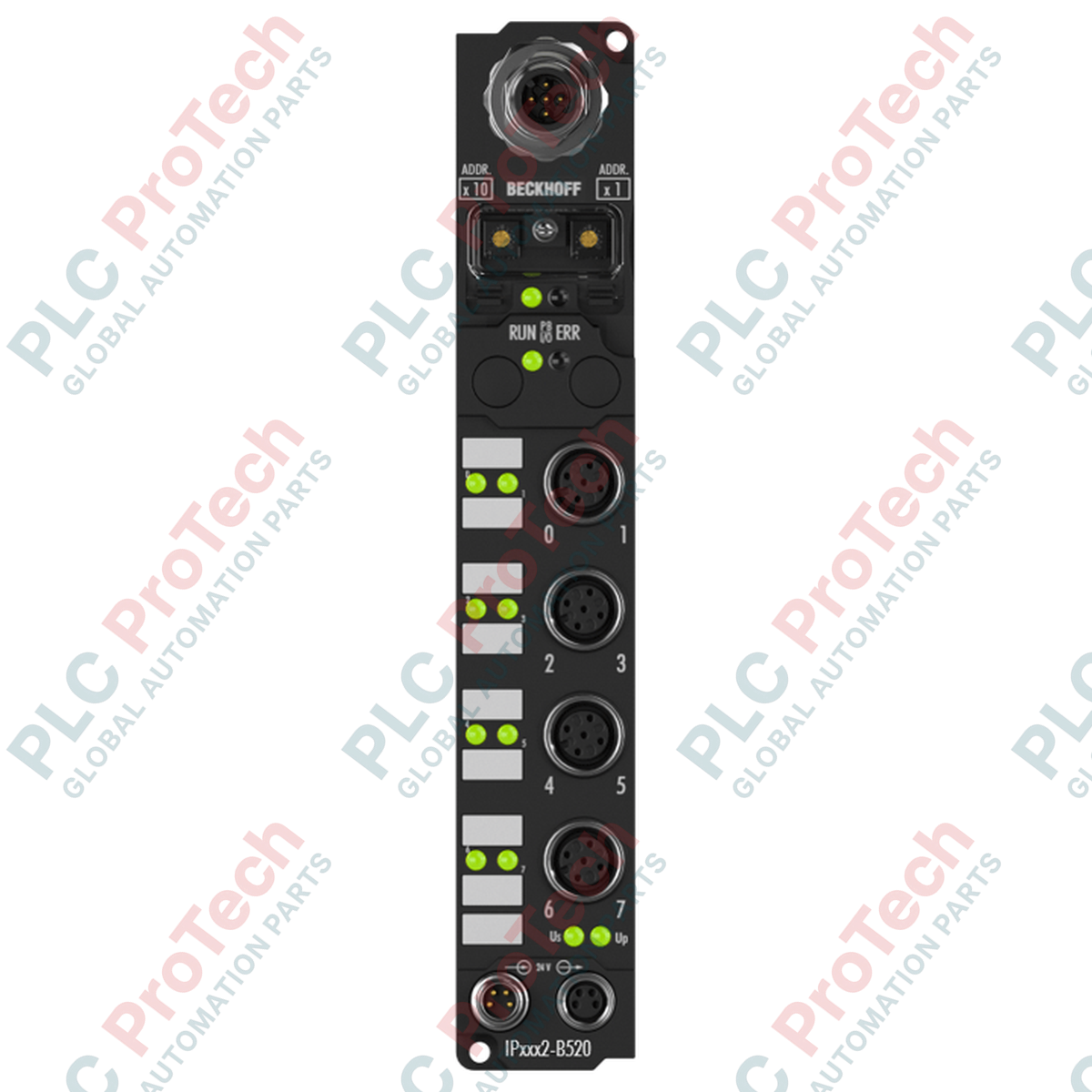
Beckhoff IP3312-B520 Fieldbus Box 2-Channel Thermocouple Input Module

Beckhoff IP3312-B520 Fieldbus Box 2-Channel Thermocouple Input Module

Nur noch 10 Artikel auf Lager verfügbar
  • Hersteller: BECKHOFF

  • Produkt-Nr.: IP3312-B520

  • Herkunftsland:Deutschland

  • Produkttyp: Fieldbus Box Modules

  • Zahlung: T/T, Western Union

  • Gewicht: 500g

  • Versandhafen: Xiamen

  • Garantie: 12 Monate

Menge
Vollständige Details anzeigen

Description

Designed for direct field deployment in harsh processing environments, the Beckhoff IP3312-B520 functions as a distributed industrial I/O station interfacing directly via the DeviceNet protocol. This Fieldbus Box module integrates temperature measurement capabilities by supporting up to two thermocouple inputs, eliminating the need for protective control cabinets. The device features automatic baud rate detection up to 500 kbaud and uses premium M12 and M8 connector interfaces to guarantee reliable signal transmission and robust physical connectivity under high mechanical stress. Configuration is managed seamlessly through the KS2000 software environment or directly via controller-based explicit messaging.

Features

  • Direct Field Mounting: IP65, IP66, and IP67 protection ratings permit installation directly on machinery without control enclosures.
  • DeviceNet Integration: Supports bit strobe, polling, cyclic, and change of state (COS) communication modes.
  • Automatic Baud Rate Detection: Automatically identifies and synchronizes with network speeds up to 500 kbaud.
  • Robust Electrical Isolation: Provides 500 V galvanic isolation between the control voltage and the fieldbus network.
  • Diagnostic Capabilities: Real-time monitoring and status feedback through KS2000 configuration software.

Applications

  • Thermal Processing Systems: Temperature monitoring in industrial ovens, kilns, and heat treatment lines.
  • Injection Molding Machinery: Direct-on-machine mounting for nozzle and barrel temperature acquisition.
  • Heavy Industrial Manufacturing: Plant-floor distributed temperature acquisition where cabinet space is unavailable.
  • Automotive Assembly: Distributed sensing along conveyor lines with DeviceNet infrastructure.

Technical Specifications

Specification Parameter Value / Rating
Manufacturer Beckhoff Automation
Model Identifier IP3312-B520
Fieldbus Interface DeviceNet (1 x M12 plug, 5-pin)
Data Transfer Rate Automatic detection up to 500 kbaud
Control Voltage Supply 24 V DC (-15% / +20%)
Box Current Consumption 45 mA + sensor load (maximum 0.5 A)
Electrical Isolation 500 V (Control voltage to fieldbus)
Ingress Protection Rating IP65 / IP66 / IP67 (conforms to EN 60529)
Operating Temperature Range 0 to +55 degC
Storage Temperature Range -25 to +85 degC
Vibration/Shock Resistance Conforms to EN 60068-2-6 / EN 60068-2-27
EMC Standards Conforms to EN 61000-6-2 / EN 61000-6-4
Approvals CE, UL
Shipping Weight (Calculated) 2.0 kg

Connections and Interfaces

Port / Connection Connector Type Functional Assignment
DeviceNet Bus Interface 1 x M12 plug, 5-pin Shielded network communication line
Power Feed-In 1 x M8 male socket, 4-pin Incoming 24 V DC control voltage and ground
Power Downstream 1 x M8 female socket, 4-pin Power distribution loop to subsequent modules

Empirical Engineering Insights

Alternative Models & Compatibility

The IP3312-B520 module operates on DeviceNet configurations. When upgrading older networks or replacing modules within legacy industrial rings, ensure that your Master/Scanner configuration files (EDS) are correctly matched to firmware revisions. If converting a system to EtherCAT or PROFINET, equivalent fieldbus box modules must be chosen from the EP or EQ series respectively, as the IP series physical layers are dedicated to their specific fieldbus options (B520 for DeviceNet, B310 for PROFIBUS).

Application Pitfalls & Engineering Notes

Thermocouple signals are highly vulnerable to electromagnetic interference (EMI). While the IP3312-B520 boasts robust EMC immunity conforming to EN 61000-6-2, running thermocouple extension wires alongside heavy-duty variable frequency drive (VFD) output cables can distort temperature readings. Avoid looping sensor cables and maintain separate routing pathways. Additionally, ensure all unused M12 and M8 ports are sealed with industrial protective caps to preserve the IP67 ingress rating.

Commissioning & Wiring Tips

During initial installation, ensure that DeviceNet terminating resistors are correctly placed at both physical ends of the trunk line (typically 121 ohms, 1/4 watt). When routing power through the M8 downstream port, calculate the total cumulative current of all linked sensors and modules. Exceeding the 0.5 A limit can lead to voltage drops, triggering low-power diagnostic faults on downstream sensors.

Installation Guidelines

CRITICAL WARNING: Disconnect all power sources before initiating hardware installation or cable assembly. Contact with energized components can cause equipment damage or severe electrical shock. Ensure that the 24 V DC control supply is fully de-energized and verification of zero energy state is performed prior to working on the network.
1

Mount the Fieldbus Box to a flat, vibration-resistant surface using two M4 screws through the integrated mounting ears.

2

Connect the incoming 24 V DC power supply to the 4-pin M8 male connector. Ensure polarities match precisely.

3

If looping power to other nodes, connect the downstream M8 female port using shielded 4-core cable.

4

Connect the DeviceNet network trunk line to the 5-pin M12 fieldbus connector. Verify termination resistors are active if this unit is at the network end.

5

Configure the node address and bus parameters using the KS2000 software tool or via the PLC configuration environment.

What fieldbus protocol does the IP3312-B520 module use?

This module uses the DeviceNet protocol, supporting transmission rates up to 500 kbaud with auto-baud rate detection.

Does this module require a physical control cabinet?

No, with its IP65/66/67 ratings, it is designed for direct machine mounting in environments exposed to dust, moisture, and water spray.

What is the maximum auxiliary current allowed through the unit?

The box supply current is 45 mA, and the maximum current consumption including attached sensors is limited to 0.5 A.

How do you configure the DeviceNet parameters on this unit?

Configuration can be carried out using the Beckhoff KS2000 software suite or through explicit messaging protocols from the main controller.

Globaler Expressversand

  • Standardlieferung: 4-6 Werktage via DHL, FedEx und UPS.
  • Expressversand: Versand am selben Tag für vorrätige Bestellungen, die vor 14:00 Uhr (GMT+8) aufgegeben werden.
  • Weltweite Abdeckung: Wir bedienen über 150 Länder, einschließlich schneller Lieferung nach Saudi-Arabien und in die VAE.

Rückgaben & Garantie

  • 30-Tage-Garantie: Rückgaben werden für vorrätige Produkte in originaler, werkversiegelter Verpackung akzeptiert.
  • 12-Monats-Garantie: Jede Industriekomponente ist durch unsere professionelle technische Garantie abgesichert.

Bestellungen werden Montag bis Freitag bearbeitet und geliefert (außer an Feiertagen).


Für vollständige Anspruchsvoraussetzungen, Wiedereinlagerungsgebühren und internationale Rückgabedetails, sehen Sie bitte unsere offizielle Seite ein Rückerstattungs- & Rückgabebedingungen .

TECHNICAL SPECIFICATIONS

Country of origin
Deutschland

Kürzlich angesehene Produkte

Technisches Wissen

Elektrische Antriebe zur Ablösung von Fluidkraftsystemen: Ein praktischer Leitfaden für die industrielle Automatisierung

Dieser Artikel erklärt, wie integrierte elektrische Antriebe, wie die e-Actuator-Serie von SMC, die industrielle Bewegungssteuerung revolutionieren, indem sie herkömmliche pneumatische und...

Mathematische Operationen mit OpenPLC für industrielle Automatisierungsanwendungen

Dieser Artikel erklärt, wie SPS-Systeme grundlegende mathematische Operationen wie Addition, Subtraktion, Multiplikation, Division, Modulo und Exponentiation in der industriellen Automatisierung...

Fortgeschrittene Boolesche Logik mit FBD-SPS-Programmierung: Praktische industrielle Anwendungen über die Grundlogik hinaus

Der Artikel erklärt mehrere erweiterte Boolesche Logikfunktionen, die in der SPS-Programmierung über die grundlegenden AND-, OR- und NOT-Operationen hinaus verwendet werden. Er behandelt, wie...

Boolesche Logik in der SPS-Programmierung: Verständnis von FBD-Logikgattern

Boolesche Logik ist die Grundlage jedes SPS-Programms. Von einfachen Maschinensteuerungen bis hin zu komplexen industriellen Automatisierungssystemen bestimmen Logikgatter, wie Steuerungen auf sich...

Umfassender Leitfaden zu industriellen Firewalls und OT-Netzwerksegmentierung

Industrielle Firewalls spielen eine entscheidende Rolle in der OT-Cybersicherheit, indem sie SPS-, DCS- und SCADA-Netzwerke durch Segmentierung, Ein- und Ausgangskontrolle sowie IDS/IPS-Integration...

Leitfaden für Roboter-Greifer: Von der schonenden Handhabung bis zur Schwerlastautomatisierung

Moderne robotische Greifer entwickeln sich über traditionelle mechanische Greifbacken hinaus. Von gecko-inspirierten Haftsystemen und weichen, lebensmittelechten Greifern bis hin zu KI-gestützten...