Beschreibung
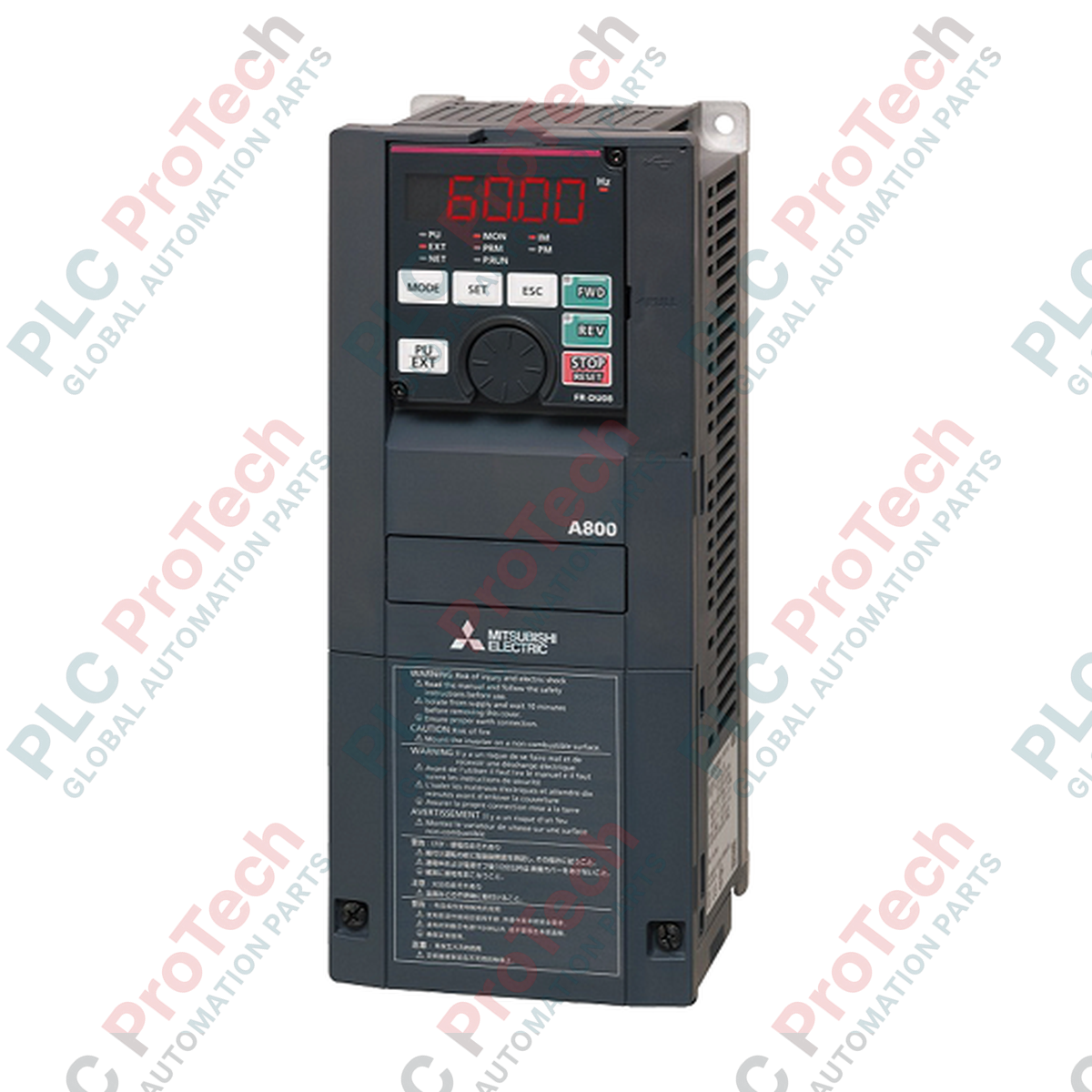
Der für industrielle Schwerlasten mit hohem Drehmoment entwickelte Frequenzumrichter Mitsubishi Electric FR-A840-3.7K bietet eine präzise Vektordrehzahlregelung innerhalb der FREQROL-A-800-Serie. Dieser leistungsstarke Umrichter unterstützt vier unterschiedliche Belastungsklassen (SLD, LD, ND und HD), sodass Systemintegratoren die Motorantriebskapazität je nach Lastprofil von 2,2 kW bis 5,5 kW skalieren können. Der FR-A840-3.7K wird mit einer dreiphasigen Versorgung von 380 bis 500 VAC betrieben und verfügt über eine fortschrittliche sensorlose Vektorregelung, eine sensorlose PM-Vektorregelung sowie eine integrierte RS-485-Kommunikation, die eine hervorragende Drehzahlstabilität, ein hohes Drehmoment bei niedrigen Drehzahlen und eine nahtlose Integration in Automatisierungssysteme ermöglicht.
Hauptmerkmale
-
Vier Überlastklassen: Konfigurierbar für die Profile Super Light Duty (SLD), Light Duty (LD), Normal Duty (ND) und Heavy Duty (HD), um spezifischen Anwendungsanforderungen gerecht zu werden.
-
Fortschrittliche Regelalgorithmen: Unterstützt die echte sensorlose Vektorregelung, die sensorlose PM-Vektorregelung und die Vektorregelung (mit optionaler Rückmeldekarte) für maximale Motorleistung.
-
Umfangreiche Netzwerkintegration: Integrierter RS-485-Anschluss mit Erweiterungskompatibilität für CC-Link, CC-Link IE Field, DeviceNet, PROFIBUS-DP und Modbus RTU.
-
Hohes Anlaufmoment: Liefert im Heavy-Duty-Modus (HD) unter echter sensorloser Vektorregelung bei 0,3 Hz ein Anlaufmoment von bis zu 250 %.
-
Integrierte Sicherheitsfunktionen: Zweikanalige sichere Drehmomentabschaltung (STO) gemäß Sicherheitsnormen für die Schutzfunktion eines Not-Halts.
Anwendungen
-
Förderanlagen und Materialhandhabung: Nutzung eines hohen Anlaufmoments und einer schnellen Verzögerungsregelung.
-
Pumpen- und Lüftersteuerung: Energieoptimierung durch den integrierten Algorithmus zur optimalen Erregungsregelung.
-
Extruder und Zentrifugen: Leistungsstarke Drehzahlregelung mit Wiederherstellung bei kontinuierlichen Laständerungen.
-
Hebezeuge und Krane: Präzise Lastpositionierung durch PWM mit hoher Trägerfrequenz und sequenzielle Ansteuerung der mechanischen Bremse.
Technische Daten
| Parameter |
Wert / Spezifikation |
| Hersteller |
Mitsubishi Electric |
| Modellnummer |
FR-A840-3.7K |
| Serie |
FREQROL-A 800 |
| Eingangsspannung / Frequenz |
Dreiphasig, 380 bis 500 VAC, 50 Hz / 60 Hz |
| Zulässige Spannungsschwankung |
323 bis 550 VAC, 50 Hz / 60 Hz |
| Kapazität für Normal Duty (ND) |
3,7 kW (Nennstrom: 9,0 A) |
| Kapazität für Super Light Duty (SLD) |
5,5 kW (Nennstrom: 12,6 A) |
| Kapazität für Heavy Duty (HD) |
2,2 kW (Nennstrom: 6,0 A) |
| Ausgangsspannungsbereich |
Dreiphasig, 380 bis 500 VAC |
| Ausgangsfrequenzbereich |
0,2 bis 590 Hz (Vektor-/sensorloser Grenzwert: 400 Hz) |
| Überlaststrom-Nennwert (ND) |
150 % für 60 Sekunden, 200 % für 3 Sekunden (bei 50 °C) |
| Kühlmethode |
Zwangsluftkühlung |
| Schutzart des Gehäuses |
IP20 (geschlossene Bauart) |
| Betriebstemperatur |
-10 bis +50 °C (LD/ND/HD ohne Vereisung); -10 bis +40 °C (SLD) |
| Lagertemperatur |
-20 bis +65 °C |
| Nettogewicht |
3,3 kg (7,28 lbs) |
| Versandgewicht |
4,4 kg (9,70 lbs) |
Anschlüsse und Schnittstellen
| Klemmenbezeichnung |
Signaltyp / Zuordnung |
Elektrische Spezifikation |
| R/L1, S/L2, T/L3 |
Wechselstromeingang |
Dreiphasig, 380 bis 500 VAC, 50/60 Hz |
| U, V, W |
Motoranschlüsse |
Dreiphasiger, modulierter Wechselstrom |
| Klemme 2 |
Analoger Frequenzsollwerteingang für Spannungssignal |
0 bis 5 VDC, 0 bis 10 VDC (wählbar) |
| Klemme 4 |
Analoger Frequenzsollwerteingang für Stromsignal |
4 bis 20 mA (oder 0 bis 20 mA) |
| Klemme 1 |
Zusätzlicher Analogeingang (Frequenzoffset) |
-10 bis +10 VDC oder -5 bis +5 VDC |
| 12 Steuerklemmen |
Konfigurierbare Kontakteingänge (Mehrfachgeschwindigkeit, Reset, STO) |
Optisch isolierte 24-VDC-Logik |
Empirische Erkenntnisse aus der Praxis
Alternative Modelle & Kompatibilität
Der FR-A840-3.7K ist der direkte technische Nachfolger der älteren Modelle FR-A740-3.7K. Er verfügt über identische physische Befestigungsmuster, bietet jedoch eine verbesserte Ausführung des Vektoralgorithmus. Beim Aufrüsten eines Systems können die Parameter älterer Umrichter extrahiert und über die integrierte USB-Host-Schnittstelle mit der Software Mitsubishi FR Configurator2 in den neueren Umrichter geladen werden. Die Eigenschaften der Phasenüberwachung sollten jedoch überprüft werden, um geringfügige Abstimmungsabweichungen bei Lasten mit hoher Trägheit zu vermeiden.
Anwendungshinweise & technische Hinweise
Beim Betrieb in der Leistungsklasse Super Light Duty (SLD) müssen Ingenieure besondere Vorsicht walten lassen. Während SLD die Dauer-Ausgangsstromkapazität für Lasten mit variablem Drehmoment (Pumpen und Lüfter) auf 12,6 A erhöht, sinkt die zulässige Umgebungstemperatur im Betrieb auf maximal 40 °C (im Vergleich zu 50 °C bei den Standardkonfigurationen ND und HD). Wird ein für SLD konfiguriertes Gerät in einem unbelüfteten Außenschaltschrank aufgestellt, kann dies zu einer schnellen thermischen Leistungsreduzierung und Fehlern (E.THT oder E.TBM) führen, wenn die Umgebungstemperatur im Schaltschrank 40 °C überschreitet.
Tipps zur Inbetriebnahme und Verdrahtung
Stellen Sie sicher, dass die Hardware-Schiebeschalter am Klemmenblock des Steuerkreises vor dem Anlegen der Steuerspannung entsprechend dem vorgesehenen Signaltyp konfiguriert sind. Wenn Sie Klemme 4 für einen 4- bis 20-mA-Stromeingang konfigurieren, prüfen Sie, dass Parameter 267 auf „0“ (Anfangswert) eingestellt ist und sich der Eingangswahlschalter in der Position „I“ befindet. Wenn der Schalter beim Anlegen eines Stromschleifeneingangs auf „V“ (Spannung) steht, kann dies die Analogeingangsschaltung beschädigen.
Installationsrichtlinien
KRITISCHE WARNUNG: HOCHSPANNUNGSGEFAHR
Bevor Sie Verdrahtungs- oder Wartungsarbeiten an diesem Frequenzumrichter durchführen, trennen Sie die primäre AC-Versorgung und warten Sie mindestens 10 Minuten. Verwenden Sie ein kalibriertes Gleichspannungs-Voltmeter, um zu bestätigen, dass die LED für die Ladung des DC-Zwischenkreises erloschen ist und die Spannung zwischen den Klemmen P/+ und N/- unter 30 VDC gesunken ist. Die Nichtbeachtung der Entladezeiten kann zu tödlichen Stromschlägen oder zur Zerstörung des Geräts führen.
1
Montageausrichtung: Installieren Sie den Umrichter senkrecht auf einer flachen, nicht brennbaren Montageplatte. Stellen Sie oberhalb und unterhalb des Kühlluftauslasses mindestens 50 mm Freiraum sicher, um eine optimale erzwungene Konvektionsströmung aufrechtzuerhalten.
2
Strom- und Erdungsanschlüsse: Schließen Sie die Phaseneingangsleitungen (L1, L2, L3) und die Motorausgangsleitungen (U, V, W) mit den empfohlenen Ringkabelschuhen an. Stellen Sie sicher, dass die Schutzerdungsklemme (PE) direkt über einen niederimpedanten Kupferleiter mit der Haupterdungsschiene des Schaltschranks verbunden ist.
3
Steuerungsabschirmung: Führen Sie alle Steuer- und Analogsignalkabel durch separate Kabelkanäle, die von den Hochleistungs-Eingangs- und -Ausgangskabeln isoliert sind. Erden Sie die Geflechtschirme der Steuerleitungen nur an der Erdungsplatte auf der Umrichterseite, um Erdschleifen zu vermeiden.