Beschreibung
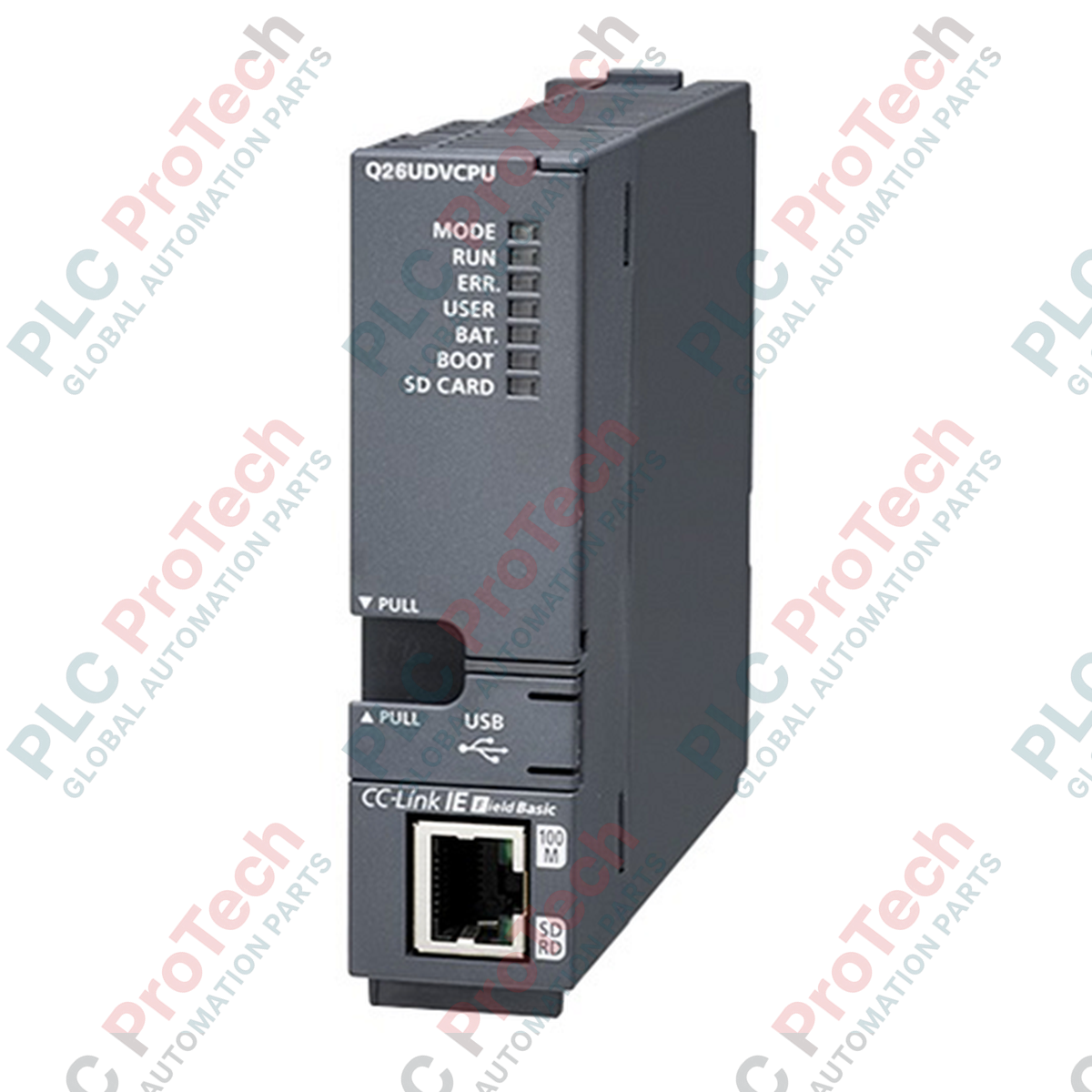
Die für die Hochgeschwindigkeitsausführung von Sequenzen und die nahtlose Integration in Betriebsnetzwerke entwickelte Mitsubishi Electric Q03UDVCPU dient als leistungsstarke Zentraleinheit innerhalb der Automatisierungsplattform der MELSEC-Q-Serie. Diese universelle Hochgeschwindigkeits-CPU erfüllt die anspruchsvollen Anforderungen komplexer Fertigungssysteme und bietet eine extrem schnelle Befehlsausführung von 1,9 ns für grundlegende LD-Operationen. Über den integrierten RJ45-Ethernet-Anschluss ermöglicht das Modul eine zuverlässige Kommunikation auf Geräteebene, diagnostische Telemetrie und Programmierzugriff, ohne dass dedizierte Netzwerkschnittstellen erforderlich sind. Seine Architektur unterstützt eine umfangreiche Programmspeicherkapazität von 30.000 Schritten sowie eine flexible Speichererweiterung durch SD/SDHC-Karten und eignet sich damit ideal für datenintensive Protokollierung und die Koordination präziser Bewegungssteuerungen in modernen industriellen Architekturen.
Funktionen
-
Ultrahochgeschwindigkeitsverarbeitung: Erreicht eine Ausführungszeit von 1,9 ns für grundlegende LD-Befehle und 3,9 ns für MOV-Befehle, um die SPS-Zykluszeiten zu minimieren.
-
Integrierte Ethernet-Schnittstelle: Der integrierte 10/100-Mbit/s-RJ45-Anschluss unterstützt bis zu 16 gleichzeitige Socket-Verbindungen, MC Protocol und MELSOFT-Verbindungen.
-
Flexible Speicherarchitektur: Bietet eine Programmspeicherkapazität von 120 KB und 192 KB Standard-RAM, erweiterbar durch zusätzliche SRAM-Kassetten.
-
Integrierte SD/SDHC-Unterstützung: Der integrierte Kartensteckplatz unterstützt gängige Speichermedien mit bis zu 32 GB für sichere Datenprotokollierung, Rezeptverwaltung und automatisierte Systemsicherungen.
-
Mehrsprachige Programmierung: Vollständig kompatibel mit Structured Text (ST), Funktionsbausteinen, SFC (MELSAP 3) und herkömmlicher Kontaktplanlogik.
Anwendungen
- Hochgeschwindigkeits-Verpackungssysteme mit synchronisierten Mehrachsen.
- Verfolgung von Automobilmontagelinien und Handhabungszellen für Komponenten.
- Dezentralisierte Wasseraufbereitungsinfrastruktur mit Telemetriesystemen.
- Präzisionsmaschinen für die thermische Halbleiterverarbeitung und Indizierung.
Technische Daten
| Parameter |
Spezifikationswert |
| Hersteller |
Mitsubishi Electric |
| Modellcode |
Q03UDVCPU |
| Steuerungsmethode |
Ausführung von gespeicherten Programmzyklen |
| Programmspeicherkapazität |
30.000 Schritte (120 KB) |
| LD-Befehlsverarbeitungsgeschwindigkeit |
1,9 ns |
| Physische E/A-Punkte |
4096 Punkte |
| Standard-RAM / ROM |
192 KB / 1025,5 KB |
| Interne Stromaufnahme (5 VDC) |
0,58 A (Basiseinheit) / 0,60 A (mit SRAM-Kassette) |
| Unterstützte Speichermedien |
SD/SDHC-Speicherkarte (bis zu 32 GB) |
| Integrierte Anschlüsse |
RJ45-Ethernet, Mini-USB, SD-Kartensteckplatz |
| Betriebsumgebungstemperatur |
0 bis 55 °C |
| Nettogewicht |
0,20 kg |
| Abmessungen (B x H x T) |
27,4 mm x 98 mm x 115 mm |
| Versandgewicht (berechnet) |
1,20 kg |
Erfahrungsbasierte technische Erkenntnisse
Alternative Modelle und Kompatibilität
Die Q03UDVCPU ist die Hochgeschwindigkeits-Weiterentwicklung der älteren Q03UDECPU. Beachten Sie beim Aufrüsten bestehender Legacy-Systeme, dass die V-Serie über einen integrierten SD/SDHC-Kartensteckplatz statt der älteren CompactFlash- oder PCMCIA-Kartenoptionen verfügt. Damit Systemlogik und Aufgabenverteilung korrekt kompiliert werden, muss Ihr Engineering-Team den Ziel-SPS-Typ in GX Works2 (Version 1.98C oder höher) oder GX Works3 auf „Q03UDV“ aktualisieren, bevor ein Code-Download durchgeführt wird.
Typische Anwendungsprobleme und technische Hinweise
Der Programmspeicher ist zwar nichtflüchtig, doch die Speicherung verriegelter Parameter, Register (D, W) und der Daten der internen Systemuhr ist von der Lithium-Pufferbatterie Q6BAT abhängig. In Umgebungen mit dauerhaft über 45 °C liegenden Umgebungstemperaturen beschleunigt sich die Batteriealterung. Es wird dringend empfohlen, das Sonderregister SD8005 (Batterie-schwach-Flag) über Ihr SCADA-System oder ein lokales HMI zu überwachen, um vorbeugende Wartungsmaßnahmen vor einem Datenverlust zu planen.
Tipps für Inbetriebnahme und Verdrahtung
Für eine zuverlässige Ethernet-Verbindung muss die industrielle RJ45-Verkabelung geschirmt (S/FTP) sein und mit Abstand zu Hochspannungs-Ausgangskabeln von Umrichtern verlegt werden. Prüfen Sie bei der Konfiguration der integrierten Ethernet-Parameter in Ihrer GX-Programmiersoftware nochmals, dass der IP-Adressbereich nicht mit aktiven IP-Routen in Ihrem Unternehmensnetzwerk kollidiert. Außerdem sollten Sie den Funktionserdungsanschluss (FG) der Basiseinheit stets direkt mit einer niederimpedanten Erdung verbinden, um vor hochfrequentem transientem Schaltstörrauschen zu schützen.
Installationsrichtlinien
KRITISCHER SICHERHEITSHINWEIS
Trennen Sie stets alle elektrischen Hauptversorgungen, die die Rückwandbusbaugruppe speisen (z. B. die Hauptbasiseinheiten Q38B oder Q312B), bevor Sie das Q03UDVCPU-Modul einsetzen oder entfernen. Der Versuch, einen Hot-Swap durchzuführen oder die CPU zu handhaben, während die Versorgungseinheit aktiv ist, führt zu einer sofortigen Beschädigung der Rückwandbus-Schnittstelle und möglicherweise zum Ausfall benachbarter E/A-Module.
1
Stellen Sie sicher, dass das auf der Basiseinheit installierte Hauptversorgungsmodul vollständig ausgeschaltet ist, und überprüfen Sie dies mit einem kalibrierten Voltmeter.
2
Richten Sie den unteren Haken der Q03UDVCPU an der Modulführungsöffnung an Position Steckplatz 0 der MELSEC-Q-Serie-Basiseinheit aus.
3
Drücken Sie die Oberseite des Moduls fest in Richtung Rückwandbus, bis die obere Verriegelung sicher einrastet, und ziehen Sie anschließend die Befestigungsschraube des Moduls (M3) mit einem Drehmoment von 0,36 bis 0,48 N-m an.
4
Setzen Sie bei Bedarf die SD-Karte ein, prüfen Sie, ob die Speicherkartensperre aktiviert ist, und schließen Sie das geschirmte RJ45-Kommunikationskabel an den integrierten Ethernet-Port an, bevor Sie die Steuerspannung wieder einschalten.