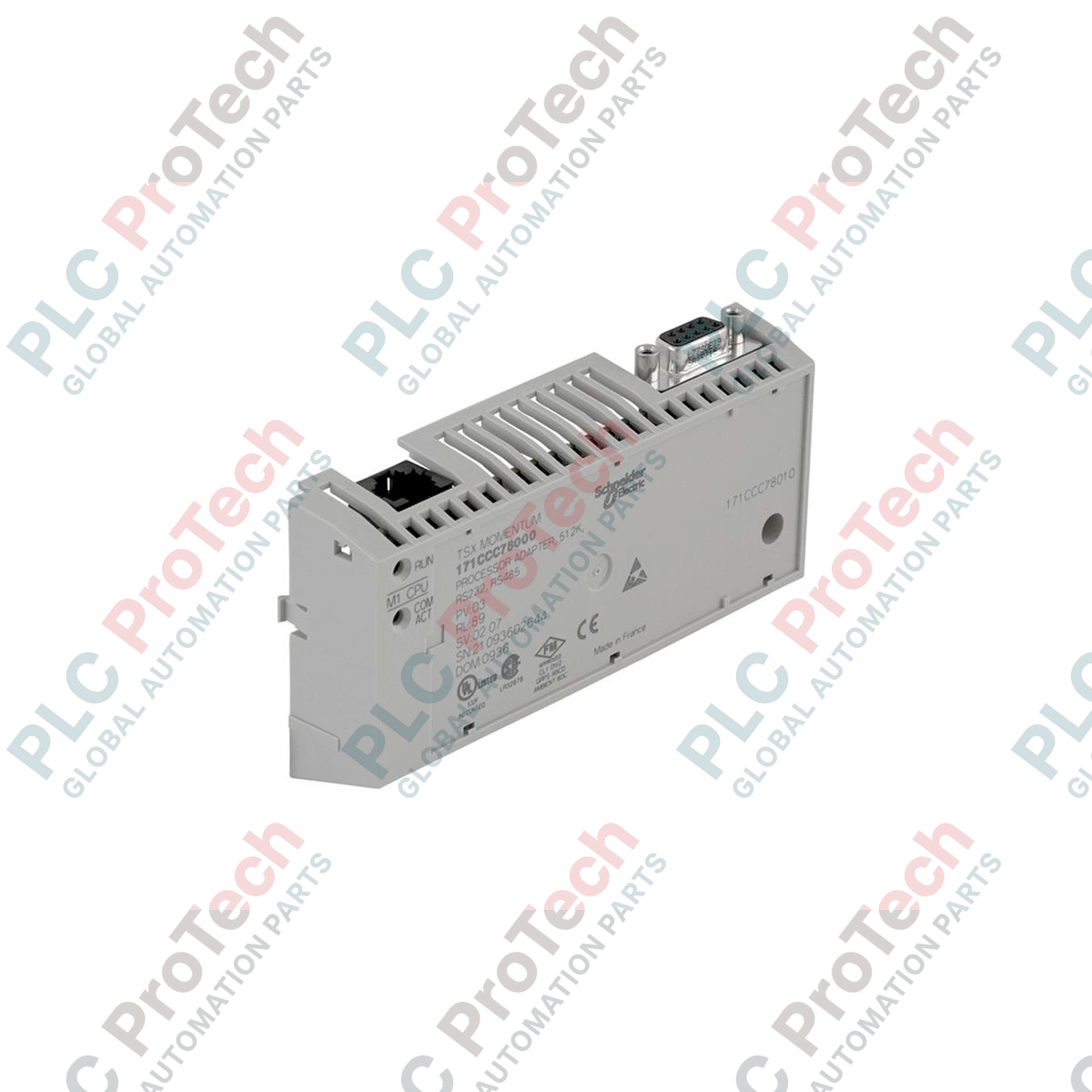
Présentation
Le 171CCS78000 est un adaptateur processeur M1 haute performance de la famille Modicon Momentum de Schneider Electric, conçu pour fournir une intelligence centralisée aux topologies d’E/S distribuées. Fonctionnant à une fréquence d’horloge de 20 MHz, cet adaptateur processeur est conçu pour se clipser sur n’importe quelle base d’E/S Momentum, transformant un simple bloc d’E/S en un automate programmable industriel (API) pleinement fonctionnel.
Doté de deux ports de communication Modbus, le 171CCS78000 excelle dans la mise en réseau multi-appareils, permettant une communication simultanée avec des panneaux HMI, des variateurs de vitesse ou des systèmes de supervision. Principalement déployé dans les secteurs de la fabrication, des eaux usées et de la manutention des matériaux, ce module est un atout essentiel pour maintenir les systèmes industriels hérités. Bien qu’en phase de retrait, sa fiabilité éprouvée et ses capacités de contrôle déterministe en font un composant vital pour les gestionnaires d’installations souhaitant préserver leurs infrastructures d’automatisation existantes sans réingénierie coûteuse.
Configuration technique
Le 171CCS78000 sert de « cerveau » central pour la plateforme modulaire Momentum, intégrant la puissance de traitement avec un réseau flexible :
-
Double connectivité Modbus : Équipé de deux ports Modbus RS485 indépendants, facilitant un échange de données efficace et une mise en réseau peer-to-peer dans des architectures complexes.
-
Cœur de traitement à 20 MHz : Offre une vitesse de calcul suffisante pour des logiques de complexité moyenne, des boucles PID et un rafraîchissement rapide des E/S.
-
Conception modulaire « clip-on » : Élimine le besoin d’un backplane ; l’adaptateur se monte directement sur les bases d’E/S, réduisant considérablement l’espace nécessaire dans l’armoire.
-
Programmation standardisée : Entièrement compatible avec les logiciels de programmation hérités de Schneider Electric, garantissant une intégration fluide de la logique pour les utilisateurs Momentum existants.
-
Efficacité matérielle : Dimensions compactes et conception légère (0,22 kg) permettant un montage haute densité dans de petits coffrets ou des boîtiers de jonction distribués.
Caractéristiques techniques
| Caractéristique |
Détails de la spécification |
| Modèle |
171CCS78000 |
| Marque |
Schneider Electric (Modicon) |
| Série |
Modicon Momentum |
| Vitesse du processeur |
20 MHz |
| Ports de communication |
2 x Modbus RS485 |
| Type de module |
Adaptateur processeur M1 |
| Statut du produit |
Phase de retrait (support hérité disponible) |
| Poids net |
0,22 kg |
| Dimensions (cm) |
18 x 26 x 6 (emballé) |
| Code douanier |
85389091 |
FAQ techniques
Le 171CCS78000 peut-il être utilisé comme contrôleur autonome ?
Oui, lorsqu’il est clipsé sur une base d’E/S Momentum, il fonctionne comme un API autonome. Il ne nécessite pas de rack ou de module d’alimentation séparé, car il tire son alimentation via la base d’E/S.
Quelle est la longueur maximale de câble pour les ports Modbus ?
Pour les ports Modbus RS485, la longueur maximale du segment est de 1200 mètres (environ 4000 pieds) sans répéteur, à condition d’utiliser un câble blindé torsadé de haute qualité et correctement terminé.
Existe-t-il un remplacement direct pour ce module en phase de retrait ?
Bien que Schneider Electric ait évolué vers la série Modicon M221/M241, il n’existe pas de remplacement « clip-on » direct compatible avec les bases d’E/S Momentum. Maintenir un stock d’unités 171CCS78000 est la solution la plus économique pour soutenir les installations Momentum existantes.
Guide d’ingénierie et d’installation
Câblage et polarisation des ports de communication
Lors de l’utilisation des deux ports Modbus, assurez-vous que le réseau est correctement polarisé et terminé avec des résistances de 120 Ohms aux extrémités physiques du bus. Une terminaison incorrecte sur un système processeur à 20 MHz peut entraîner des erreurs CRC intermittentes et des alarmes « État du module ». Pour les environnements à forte interférence, utilisez toujours des câbles blindés et mettez la terre du blindage en un seul point.
Considérations thermiques et de montage
Étant donné que le 171CCS78000 se monte directement sur la base d’E/S, il s’appuie sur cette base pour son intégrité structurelle. Assurez-vous que les languettes de verrouillage sont bien engagées. Dans les applications à forte vibration, nous recommandons des ancrages supplémentaires sur rail DIN de chaque côté de l’ensemble. Évitez d’installer le module dans des zones exposées à la lumière directe du soleil ou à proximité de sources de chaleur importantes, car une chaleur excessive peut dégrader la précision de l’oscillateur 20 MHz.
Protection de la mémoire
En tant qu’adaptateur M1 hérité, vérifiez la batterie interne ou la sauvegarde par condensateur lors des opérations de maintenance régulières. Si le module est hors tension pendant de longues périodes sans batterie viable, le programme utilisateur peut être perdu, nécessitant un rechargement depuis les fichiers sources d’origine.