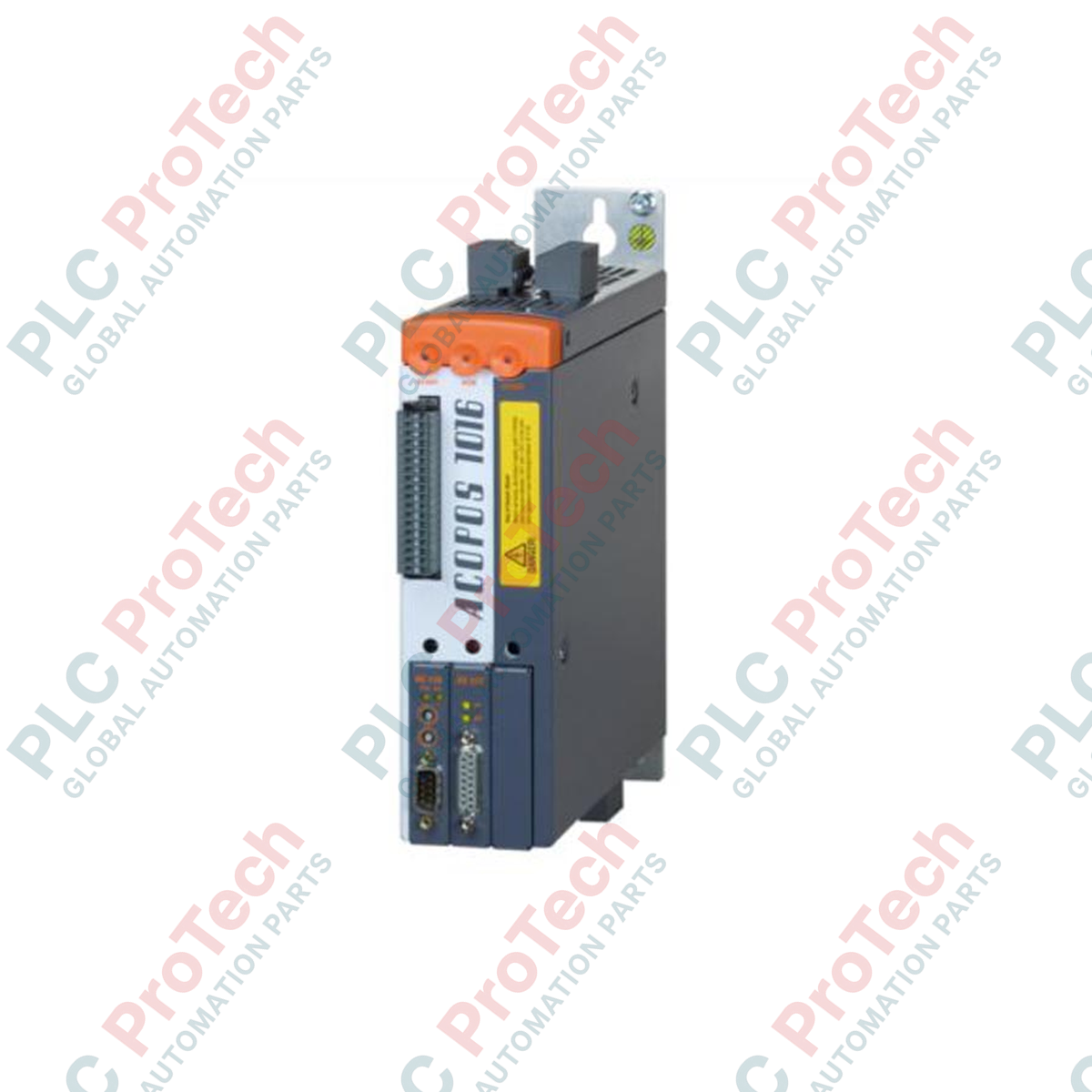
Présentation du produit
Le 8V1016.00-2 (8V1016.00-2) est un servo-variateur compact et très efficace de la série B&R ACOPOS, conçu pour offrir un contrôle de mouvement haute précision pour des applications industrielles de petite taille. Conçu pour la flexibilité, ce variateur supporte une large plage de tension d’alimentation secteur de 230 VAC à 480 VAC, ce qui en fait un choix polyvalent adapté aux normes électriques mondiales. Dans des secteurs tels que la robotique pick-and-place, les machines d’étiquetage et l’emballage pharmaceutique précis, le 8V1016.00-2 offre des performances dynamiques exceptionnelles avec une charge installée de 2,1 kVA. En intégrant 3 emplacements pour modules enfichables, il permet une extension facile des interfaces de communication et des systèmes d’encodeurs, garantissant que le variateur peut s’adapter aux exigences évolutives de l’automatisation tout en conservant une faible empreinte et en réduisant la complexité globale du système.
Configuration technique
Le 8V1016.00-2 est construit sur une étape de puissance haute performance capable de fréquences de commutation jusqu’à 20 kHz. Il intègre un filtre de ligne conforme à la norme EN 61800-3 Catégorie C3, qui supprime efficacement les interférences électromagnétiques et assure un fonctionnement stable en environnement industriel. Le variateur gère l’énergie de manière efficace, avec un courant d’appel maximal de seulement 2 A et une dissipation de puissance de 110 W à charge nominale. Pour la logique et le contrôle, l’unité nécessite une alimentation 24 VDC, consommant un maximum de 1,47 A plus le courant requis pour un frein de maintien moteur. Le matériel supporte une longueur maximale de câble moteur de 15 mètres et peut délivrer des fréquences jusqu’à 598 Hz, offrant la bande passante nécessaire pour les moteurs brushless DC et les moteurs synchrones AC à grande vitesse.
Caractéristiques techniques
| Caractéristique |
Spécification |
| Modèle |
8V1016.00-2 |
| Marque |
B&R (Bernecker + Rainer) |
| Type de produit |
Servo-variateur ACOPOS |
| Tension d’entrée secteur |
3x 230 VAC à 480 VAC (plus ou moins 10 pour cent) |
| Charge installée |
Max. 2,1 kVA |
| Fréquence de commutation nominale |
10 kHz (configurable 5/10/20 kHz) |
| Courant de sortie max. |
1,3 A |
| Puissance de crête |
2 kW |
| Puissance continue |
130 W |
| Tension de commande |
24 VDC (plus 25 % / moins 20 %) |
| Emplacements d’extension |
3 (pour modules enfichables) |
| Filtre de ligne intégré |
Oui (Catégorie C3) |
| Dissipation de puissance |
110 W |
| Poids |
2,5 kg |
| Poids à l’expédition |
4,0 kg |
FAQ techniques
Comment la fréquence de commutation configurable affecte-t-elle les performances du variateur ?
Le 8V1016.00-2 permet des fréquences de commutation de 5, 10 ou 20 kHz. Les fréquences plus élevées (20 kHz) offrent un mouvement moteur plus fluide et un fonctionnement plus silencieux, mais augmentent la dissipation thermique. Les fréquences plus basses (5 kHz) réduisent les pertes thermiques dans le variateur mais peuvent accroître le bruit audible et les ondulations de courant dans le moteur.
Quelle est l’importance de l’« intervalle de mise sous tension » pour ce variateur ?
L’intervalle de mise sous tension doit être supérieur à 10 secondes. Cette durée permet au circuit interne de limitation du courant d’appel de refroidir et de se réinitialiser. Un cycle d’alimentation secteur répété plus rapidement que toutes les 10 secondes peut entraîner une défaillance prématurée des résistances de charge ou du relais interne.
Des filtres externes sont-ils nécessaires pour la conformité CE ?
Comme le 8V1016.00-2 intègre un filtre de ligne conforme à la norme EN 61800-3 Catégorie C3, des filtres externes supplémentaires ne sont généralement pas nécessaires pour les installations industrielles standard (Second Environnement). Cependant, pour les applications en zones résidentielles (Premier Environnement), un filtrage supplémentaire peut être requis.
Guide d’ingénierie et d’installation
-
Gestion thermique : Assurez-vous que le variateur est monté verticalement dans l’armoire de commande. Avec une dissipation de puissance de 110 W, un flux d’air adéquat est obligatoire. Si plusieurs variateurs sont montés en rangée, maintenez l’espacement latéral minimum spécifié pour éviter un effet de cascade thermique pouvant déclencher une erreur de « surtempérature ».
-
Blindage des câbles moteur : Pour maintenir la conformité EMI et éviter les interférences de signal, utilisez uniquement des câbles moteur blindés d’une longueur maximale de 15 mètres. Le blindage doit être connecté à la plaque de terre du variateur à l’aide d’une pince de contact à 360 degrés. Évitez la mise à la terre en « queue de cochon », inefficace aux hautes fréquences de commutation (10-20 kHz) utilisées par le système ACOPOS.
-
Considérations sur la résistance de freinage : La dissipation de 110 W est calculée sans résistance de freinage externe. Pour les applications avec charges à forte inertie ou décélérations fréquentes, une résistance de freinage externe doit être connectée pour gérer l’énergie régénérative et éviter les erreurs de « surtension sur le bus DC ».