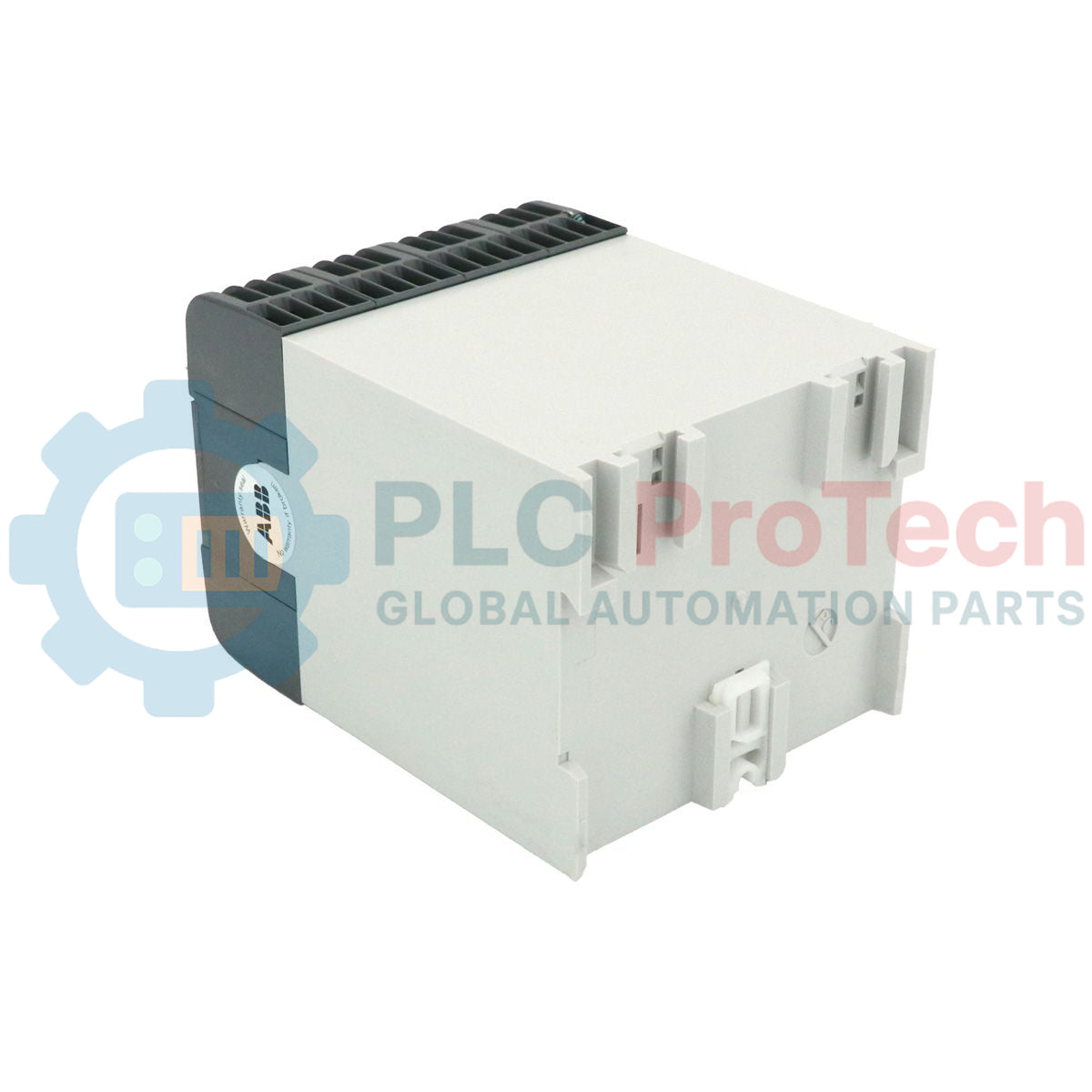
Description
Conçu pour les installations de sécurité des machines décentralisées et à nœuds multiples, le ABB 2TLA020070R1700 (Pluto B46 v2) offre une commande programmable robuste sur un ensemble polyvalent de 46 canaux d’entrée et de sortie intégrés. Ce contrôleur de sécurité compact évite le recours à de nombreux relais de sécurité à fonction unique en intégrant divers dispositifs de sécurité — notamment des arrêts d’urgence, des barrières immatérielles et des dispositifs de verrouillage de sécurité — au sein d’un réseau unique à bus de sécurité. Fonctionnant avec une alimentation nominale de 24 V CC, le Pluto B46 v2 utilise le Pluto Safety Bus propriétaire pour une communication fiable entre modules, permettant une intelligence distribuée sûre jusqu’aux niveaux réglementaires les plus élevés.
Caractéristiques principales
-
Réseau d’E/S haute densité : doté de 46 points fonctionnels, comprenant 24 entrées de sécurité dédiées, 16 sorties sans sécurité intégrée/entrées de sécurité à double usage, 4 sorties relais de sécurité isolées et 2 sorties transistorisées de sécurité côté haut.
-
Diagnostics multiprotocoles : prend en charge la surveillance transparente de l’état et les communications standard via MODBUS ASCII, Pluto Safety Bus (basé sur CAN) et les protocoles StatusBus.
-
Performances de sécurité certifiées : conçu pour satisfaire à des classifications de sécurité rigoureuses, avec un niveau de performance pouvant atteindre e (PL e) selon EN ISO 13849-1 et un niveau d’intégrité de sécurité 3 (SIL 3) conformément à EN 62061.
-
Extension simplifiée du système : plusieurs contrôleurs Pluto peuvent être mis en réseau via le bus de sécurité, permettant un échange de données simplifié et une segmentation de sécurité entre armoires sans matériel supplémentaire.
Applications
-
Protection complexe des machines : surveillance de plusieurs barrières immatérielles de sécurité, scanners laser et interrupteurs de portes verrouillées.
-
Systèmes de sécurité distribués : synchronisation des zones de sécurité sur les convoyeurs longs, les lignes de conditionnement et les cellules d’assemblage.
-
Machines industrielles lourdes : commande de sécurité des presses, cellules robotisées et systèmes de manutention nécessitant des sorties relais hautement fiables.
Spécifications techniques
| Paramètre |
Spécification |
| Fabricant |
ABB |
| Référence / SKU |
2TLA020070R1700 |
| Série de modèles |
Pluto B46 v2 |
| Tension d’alimentation nominale |
24 V CC |
| Capacité totale d’E/S |
46 canaux |
| Entrées de sécurité |
24 entrées dédiées (configurables jusqu’à 40 au total) |
| Sorties relais de sécurité |
4 sorties relais à contact sec à commande individuelle |
| Sorties transistorisées de sécurité |
2 sorties statiques PNP à commande individuelle |
| Sorties sans sécurité intégrée |
16 sorties (configurables en entrées de sécurité) |
| Protocoles pris en charge |
Pluto Safety Bus, MODBUS ASCII, StatusBus |
| Niveaux de sécurité |
SIL 3 (EN 62061), PL e (EN ISO 13849-1), catégorie 4 |
| Méthode de montage |
Rail DIN de 35 mm (standard symétrique) |
| Dimensions du produit |
120 x 90 x 84 mm |
| Poids net |
0,65 kg |
| Poids d’expédition (calculé) |
0,70 kg (avec emballage en boîte) |
Observations techniques empiriques
Modèles alternatifs et compatibilité
Le Pluto B46 v2 constitue une amélioration directe par rapport aux anciennes générations matérielles v1. Bien qu’il assure une rétrocompatibilité logicielle complète dans l’environnement Pluto Manager, les bus de sécurité utilisant plusieurs générations nécessitent une harmonisation des micrologiciels. Vérifiez que tous les nœuds hérités du réseau utilisent un micrologiciel à jour afin d’éviter les codes de défaut de synchronisation sur le Pluto Safety Bus basé sur CAN.
Pièges d’application et remarques techniques
Lors de la configuration des 16 sorties polyvalentes non à sécurité intégrée en tant qu’entrées à sécurité intégrée, portez une attention particulière à la demande totale de courant et aux chemins de fuite. Si des dispositifs de sécurité inductifs ou de longues liaisons câblées sont utilisés, le couplage capacitif peut provoquer des indications transitoires de défaut. Dans les applications soumises à de fortes vibrations, il est recommandé d’inspecter périodiquement les clips de retenue du rail DIN afin d’éviter un échauffement localisé des bornes d’alimentation.
Conseils de mise en service et de câblage
Installez toujours des résistances de terminaison standard de 120 ohms aux deux extrémités physiques de la ligne principale du Pluto Safety Bus. Pour une immunité optimale aux parasites dans les environnements fortement perturbés par les interférences électromagnétiques (par exemple à proximité de variateurs de fréquence), utilisez un câble à paires torsadées à double blindage pour les lignes CAN et raccordez le blindage à la terre fonctionnelle en un seul point de mise à la terre centralisé.
Directives d’installation
AVERTISSEMENT CRITIQUE : Mettez hors tension toutes les sources d’alimentation principales, auxiliaires et de commande avant toute tentative d’installation, de montage mécanique ou de câblage de cet appareil. Une isolation incomplète de l’alimentation peut entraîner une électrocution grave, une défaillance du matériel ou un démarrage intempestif de la machine. Veillez à purger complètement toute énergie électrique ou pneumatique stockée dans les actionneurs connectés.
-
1
Encliquetez fermement le Pluto B46 v2 sur un rail DIN standard de 35 mm, à l’intérieur d’une armoire de commande présentant un indice de protection IP54 ou supérieur. Maintenez un dégagement latéral minimal de 10 mm par rapport aux sources de chaleur adjacentes.
-
2
Câblez les lignes d’alimentation de commande dédiées en 24 V CC à l’aide de conducteurs en cuivre prévus pour au moins 75 °C, en garantissant une alimentation stable et exempte de parasites.
-
3
Connectez les dispositifs d’entrée de sécurité requis, en respectant la polarité correcte et les options de test par impulsions définies dans la configuration de votre logiciel Pluto Manager.
-
4
Connectez le relais de sécurité et les sorties statiques aux principaux éléments de commande de votre machine (par exemple, les bobines de contacteurs ou les circuits d’arrêt sécurisé du couple).
-
5
Mettez le contrôleur sous tension, connectez-vous via l’interface de programmation, téléchargez la logique applicative certifiée et exécutez un test complet de validation fonctionnelle.