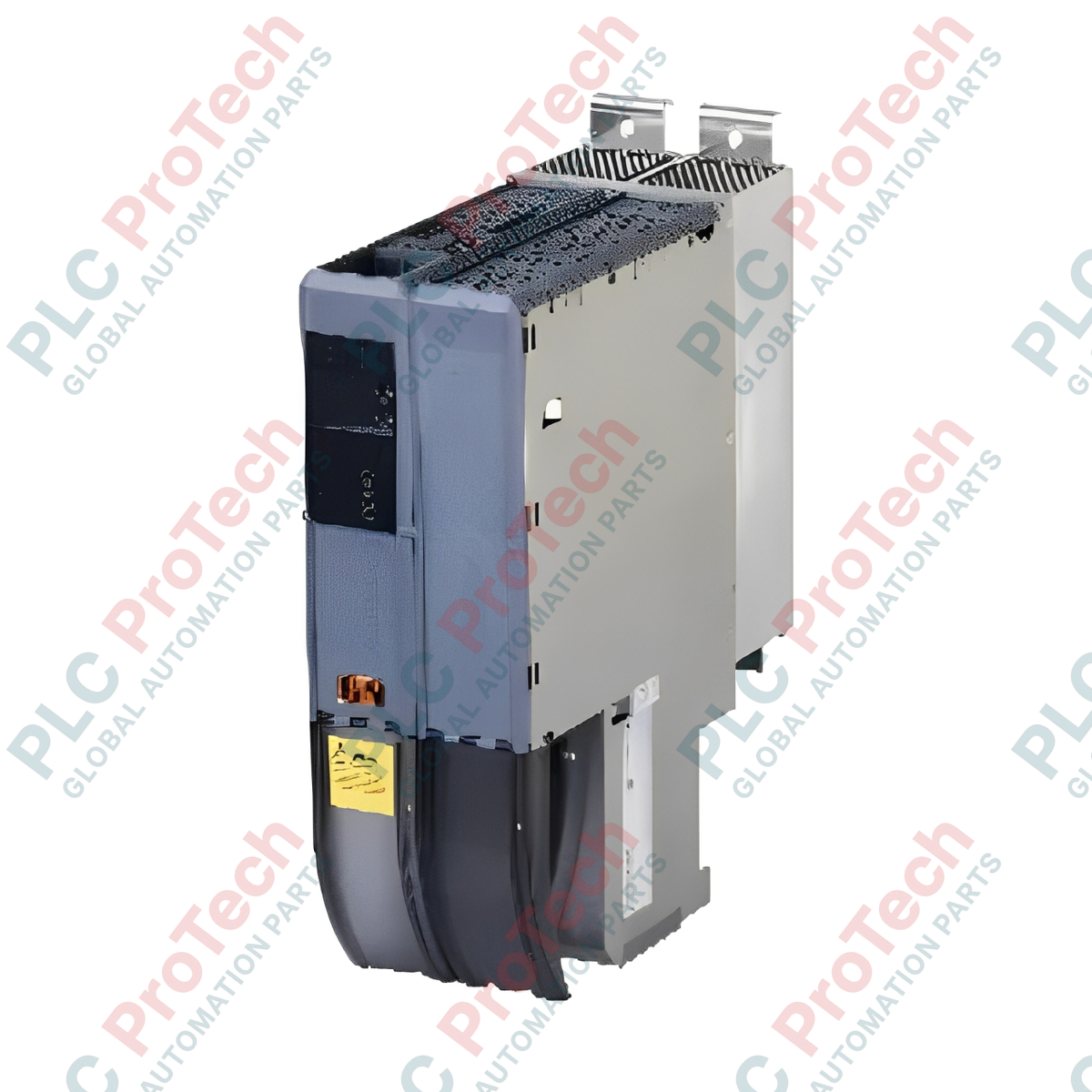
Vue d'ensemble de l'infrastructure d'alimentation centralisée
Le 8BVP0440HW00.000-1 (8BVP0440HW00.000-1) est un module d'alimentation intelligent haute capacité et haute tension conçu par B&R Industrial Automation comme matrice énergétique de base pour la plateforme d'entraînement modulaire ACOPOSmulti. Évalué pour un courant de sortie continu robuste de 44 A et configuré pour un montage mural standard, ce bloc d'alimentation principal redresse les lignes d'alimentation AC entrantes en un circuit intermédiaire CC stable et à haute efficacité de 750 VCC. Dans des applications exigeantes de contrôle de mouvement multi-axes à grande échelle — telles que les lignes d'emballage robotisées, les équipements industriels de soufflage, les presses à emboutissage métallique à grande vitesse et les réseaux d'assemblage automobile — le 8BVP0440HW00.000-1 préserve une stabilité absolue de la tension du bus et réduit les temps d'arrêt imprévus grâce à une topologie frontale dynamique et régénérative. Il équilibre activement l'énergie sur le bus interne du backplane, récupérant l'énergie de freinage des axes en décélération et la redistribuant nativement aux axes moteurs.
Profilage thermique & dynamique de la fréquence de commutation
Le module utilise des matrices de commutation à semi-conducteurs avancées dont l'efficacité et la dissipation thermique sont étroitement liées à la fréquence porteuse configurée :
-
Réseau énergétique 750 VCC : Génère et maintient un bus CC haute tension conçu pour alimenter simultanément plusieurs tranches d'onduleurs secondaires via un lien de bus en cuivre intégré.
-
Profil de fréquence de commutation à 5 kHz : Assure une haute efficacité électrique avec un facteur de dépendance thermique de 1,11 kW/K à partir d'un seuil ambiant de 40 °C. Ce réglage minimise les pertes de commutation sous des courants continus élevés.
-
Profil de fréquence de commutation à 10 kHz : Offre une filtration ultra-lisse de la sortie CC et réduit les harmoniques acoustiques des bobines, fonctionnant avec un facteur thermique de 0,35 kW/K à partir de -10 °C.
-
Allocation dynamique de la consommation d'énergie : Gère une consommation de puissance logique de base de 25 watts, s'adaptant dynamiquement pour prendre en charge les charges auxiliaires du Slot Option 1 ($P_{SLOT1}$), du Slot Option 2 ($P_{SLOT2}$), de la sortie externe 24 VCC ($P_{24\text{ V Out}}$) et de l'ensemble ventilateur de refroidissement obligatoire 8BVF ($P_{Fan8BVF...}$).
Paramètres critiques d'ingénierie
L'aperçu des spécifications suivantes détaille les limites mécaniques, électriques et environnementales vérifiées pour l'ingénierie système et l'intégration en armoire :
| Paramètre |
Spécifications |
| Modèle |
8BVP0440HW00.000-1 |
| Marque |
B&R Industrial Automation |
| Origine |
Autriche |
| Classification du module |
Alimentation active série ACOPOSmulti |
| Capacité de courant continu |
44 ampères |
| Tension de sortie nominale |
750 VDC |
| Puissance d'entrée de contrôle interne |
25 VDC (+/- 1,6 %) | Capacité d'entrée : 4,7 microfarads |
| Consommation maximale de la logique interne |
Variables des cartes 25 W + module ventilateur + slot |
| Variante de l'architecture système |
Interface de plaque de fond de panier ACOPOSmulti |
| Configuration de montage |
Montage mural (grille à bride verticale) |
| Limites d'humidité relative |
Fonctionnement : 5 à 85 % | Stockage : 5 à 95 % (sans condensation) |
| Poids net du matériel |
Environ 5,50 kg |
| Poids d'expédition |
6,50 kg |
Base de connaissances techniques & questions fréquentes
Quels avantages fonctionnels spécifiques l'alimentation active 750 VDC offre-t-elle par rapport aux redresseurs à diode passifs standard ?
Les redresseurs passifs standard ne permettent qu'un flux d'énergie unidirectionnel du réseau vers l'entraînement, dissipant l'énergie de freinage excédentaire sous forme de chaleur perdue via des résistances de freinage dynamiques volumineuses. Le 8BVP0440HW00.000-1 dispose d'un front-end IGBT actif et contrôlé qui supporte un flux d'énergie bidirectionnel. Lorsque des axes servo à forte inertie décélèrent rapidement, le module d'alimentation agit comme un onduleur, synchronisant et renvoyant de l'énergie propre dans le réseau AC principal de l'installation, réduisant ainsi la consommation totale d'énergie.
Comment les métriques de dissipation thermique à 5 kHz et 10 kHz influencent-elles la conception de l'armoire de commande ?
Le choix de la fréquence de commutation modifie directement la charge thermique à l'intérieur de l'enceinte électrique. Fonctionner à 5 kHz réduit la génération de commutation, permettant au matériel de supporter en toute sécurité des températures ambiantes allant jusqu'à 40 °C avant de nécessiter des courbes de dérating du courant. Passer à 10 kHz offre une fluidité de positionnement haute performance mais déplace l'empreinte de dissipation thermique, ce qui signifie que les calculs de dérating doivent commencer beaucoup plus tôt pour protéger les composants internes contre la surchauffe.
Pourquoi une capacité interne de 4,7 microfarads est-elle spécifiée pour l'alimentation de la logique de commande ?
L'alimentation 25 VDC alimente le cœur du processeur interne, les pilotes de porte et l'électronique des cartes optionnelles. La capacité intégrée de 4,7 microfarads agit comme un filtre haute fréquence, lissant les chutes de tension locales causées par des demandes de commutation soudaines ou du bruit entrant sur la ligne 25 V. Cela permet aux boucles de contrôle de l'entraînement de fonctionner de manière déterministe sans risque de coupures logiques.
Mise en service sur site et consignes de sécurité
-
Installation verticale de l'armoire et modules de ventilation : Montez le module d'alimentation de 5,50 kg strictement en orientation verticale sur un sous-panneau métallique plat et incombustible. Comme cette unité dépend d'un bloc ventilateur mécanique de la série 8BVF pour la gestion thermique par air forcé, maintenez un espace de sécurité clair d'au moins 100 mm au-dessus et en dessous du châssis du module. Surveillez l'air ambiant interne de l'armoire pour vous assurer qu'il reste dans les spécifications d'usine.
-
Spécifications de couple pour les barres omnibus DC haute tension : Lors de la liaison des barres omnibus en cuivre 750 VDC partagées entre l'alimentation et les tranches d'onduleur adjacentes, serrez toutes les vis de retenue aux limites de couple exactes définies dans le manuel B&R. Une résistance de contact élevée due à des fixations lâches provoquera des points chauds extrêmes et des risques d'arc haute tension. Ne travaillez jamais sur les connexions des barres omnibus avant qu'un multimètre numérique ne vérifie que le bus DC est complètement déchargé en dessous de 42 VDC après la coupure de l'alimentation.
-
Séparation des câbles d'alimentation et de commande du secteur : Faites passer les lignes d'entrée secteur AC lourdes et les barres omnibus de sortie 750 VDC à travers des conduits de câbles haute puissance dédiés. Gardez tous les signaux de commande basse tension, les lignes d'encodeur et les lignes d'alimentation logique 25 VDC séparés d'au moins 250 mm. Connectez toutes les blindages des câbles d'alimentation solidement au sous-panneau à l'aide de pinces de mise à la terre à faible impédance pour détourner en toute sécurité le bruit en mode commun loin des réseaux de communication à proximité.