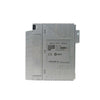
Présentation du produit
Le X20AI2622 (X20AI2622) est un module d'entrée analogique haute précision du système B&R X20, conçu pour l'acquisition de signaux haute résolution dans des environnements industriels exigeants. Ce module multifonction dispose de 2 entrées analogiques pouvant être configurées individuellement pour mesurer soit la tension ($\pm$10 V), soit le courant (0 à 20 mA / 4 à 20 mA). Avec une résolution de 12 bits et des capacités avancées de filtrage, le X20AI2622 est un composant essentiel pour la surveillance de variables critiques de processus telles que la pression, la température et le débit dans des secteurs comme la fabrication pharmaceutique, l’usinage CNC de précision et l’automatisation des centrales électriques. Son design compact en tranche X20 permet une intégration fluide dans les empilements d’E/S existants, offrant une acquisition de données à haute densité avec une consommation d’énergie minimale.
Configuration technique
L’architecture matérielle du X20AI2622 a été conçue pour la polyvalence et la faible consommation d’énergie, ne tirant que 0,01 W du bus interne. Il dispose de deux canaux indépendants capables de gérer des signaux de tension bipolaires ou des boucles de courant unipolaires, offrant une flexibilité pour divers types de capteurs. Le module inclut une diagnostic complète de l’état, avec des voyants LED dédiés pour la fonction E/S de chaque canal, l’état de fonctionnement global et le statut du module. Pour les mesures de courant, le module offre une faible résistance d’entrée afin d’assurer la précision du signal, tandis que les mesures de tension bénéficient d’une haute impédance d’entrée pour éviter la charge du signal. L’intégration de filtres numériques permet de supprimer les interférences à 50/60 Hz, garantissant des lectures stables dans des environnements électriquement bruyants.
Caractéristiques techniques
| Caractéristique |
Spécification |
| Modèle |
X20AI2622 |
| Marque |
B&R (Bernecker + Rainer) |
| Type de module |
Module d'entrée analogique |
| Nombre d’entrées |
2 (Multifonction) |
| Plages d’entrée (Tension) |
-10 V à +10 V |
| Plages d’entrée (Courant) |
0 à 20 mA ou 4 à 20 mA |
| Résolution |
12 bits |
| Consommation électrique (Bus) |
0,01 W |
| Consommation interne E/S |
0,8 W |
| Indicateurs d’état |
E/S par canal, statut du module, état de fonctionnement |
| Dimensions |
Largeur standard module X20 |
| Poids à l’expédition |
2,0 kg |
FAQ techniques
Comment basculer entre les mesures de tension et de courant sur le X20AI2622 ?
Le mode de mesure pour chaque canal est configuré via le logiciel B&R Automation Studio. Aucun cavalier physique n’est nécessaire sur le module ; le matériel ajuste automatiquement le circuit d’entrée interne en fonction des paramètres définis dans la configuration E/S de votre projet.
Quel est l’avantage de la résolution 12 bits pour la détection industrielle ?
Une résolution de 12 bits offre 4 096 pas distincts sur la plage de signal. Pour un signal de 4 à 20 mA, cela permet au module de détecter des variations aussi faibles qu’environ 0,0039 mA, garantissant un contrôle haute précision pour des boucles de processus sensibles comme le positionnement de vannes proportionnelles ou la mesure de poids.
Ce module peut-il détecter un fil coupé dans une boucle de capteur 4 à 20 mA ?
Oui. Lorsqu’il est configuré pour la plage 4 à 20 mA, le module peut détecter si le signal descend en dessous du seuil de 4 mA. Cette condition est signalée via les registres de diagnostic du module au PLC, permettant une identification immédiate des circuits ouverts ou des défaillances de capteurs.
Guide d’ingénierie et d’installation
-
Blindage et suppression des interférences : Pour maintenir la précision de la conversion analogique-numérique 12 bits, utilisez toujours des câbles blindés à paires torsadées. Le blindage doit être connecté à la terre fonctionnelle (FE) via les bornes de blindage du système X20. Ceci est particulièrement important lorsque les lignes de signal passent à proximité de variateurs de fréquence (VFD) ou de bancs de relais haute tension.
-
Choix du bornier : Le X20AI2622 est généralement utilisé avec un bornier 12 broches (par exemple, X20TB12). Assurez-vous que le point de référence commun pour les boucles de courant est correctement câblé selon le schéma de câblage B&R afin d’éviter les boucles de masse pouvant introduire des erreurs de décalage dans la mesure.
-
Dissipation thermique et montage : Bien que le module consomme très peu d’énergie (0,8 W interne), il doit être monté horizontalement autant que possible pour faciliter la convection naturelle. Dans les racks à haute densité, évitez de placer le module analogique immédiatement à côté de modules de sortie numérique à fort courant afin d’éviter que la dérive thermique n’affecte la précision analogique.