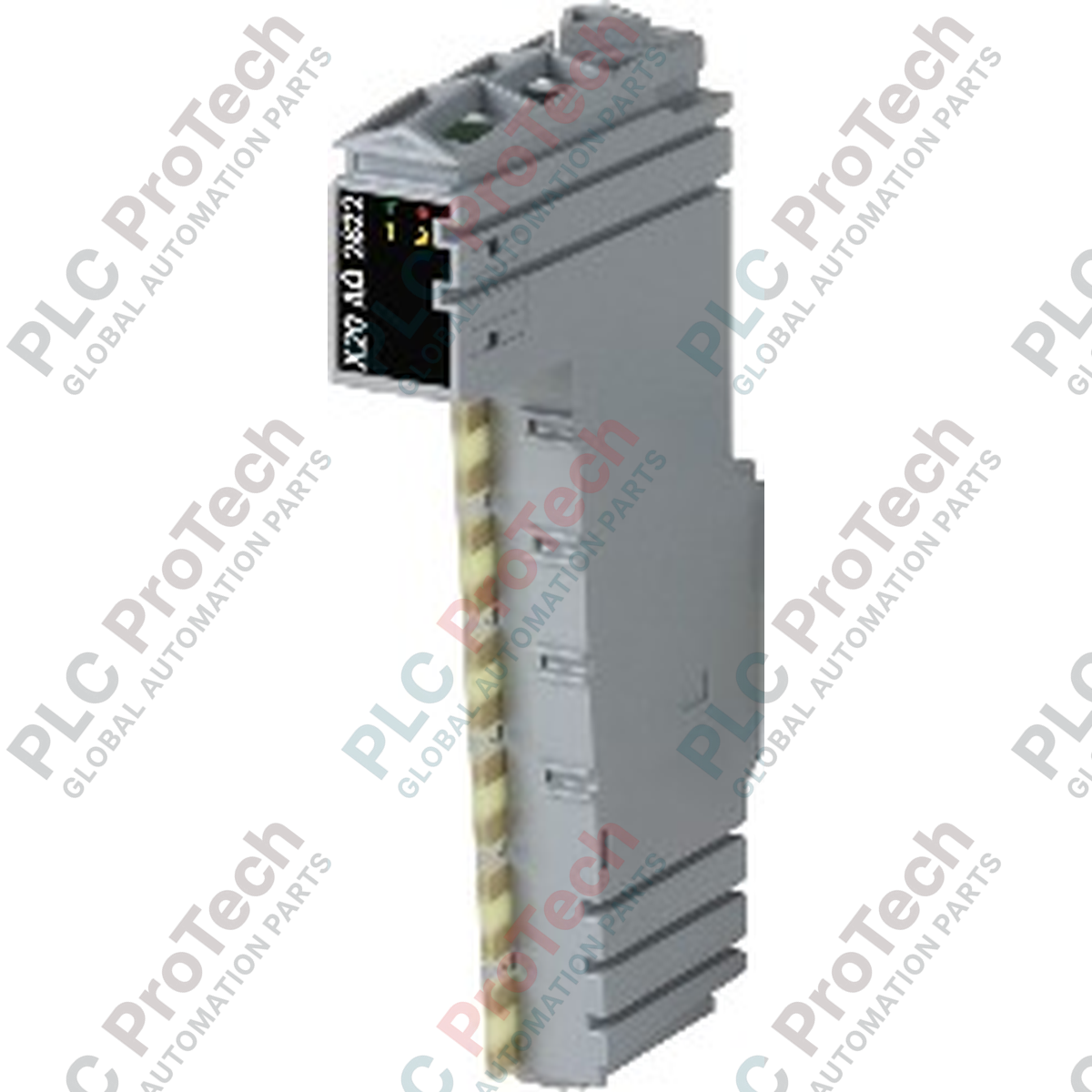
Présentation du produit
Le X20AO2622 (X20 AO 2622) est un module de sortie analogique 2 canaux haute précision du système B&R X20, conçu pour une interface de signal polyvalente dans des architectures d'automatisation industrielle complexes. Ce module permet de piloter des signaux de tension (±10 V) et de courant (0 à 20 mA / 4 à 20 mA), offrant aux ingénieurs la possibilité d'interfacer une grande variété d'actionneurs, tels que des valves proportionnelles, des variateurs de fréquence et des régulateurs de processus. Avec sa résolution de 13 bits et son isolation électrique intégrée entre le canal et le bus, le X20AO2622 garantit l'intégrité du signal et une immunité au bruit dans des environnements électriques difficiles, courants dans les applications de traitement chimique, de traitement de l'eau et de contrôle de mouvement.
Configuration technique
L'architecture du module est conçue pour la flexibilité et un traitement rapide des signaux, utilisant une configuration logicielle pour les types de canaux.
-
Support double signal : Les utilisateurs peuvent basculer entre sorties tension et courant simplement en utilisant différentes connexions aux bornes, éliminant ainsi le besoin de modules matériels distincts pour différents types de signaux.
-
Conversion haute vitesse : Dispose d’un temps de conversion de 200 μs pour toutes les sorties, associé à un filtre passe-bas du premier ordre (fréquence de coupure 10 kHz) pour fournir des signaux analogiques lisses et stables.
-
Protection intégrée : Les sorties sont protégées contre les courts-circuits avec une limitation de courant jusqu’à ±40 mA, et le module intègre un relais d’activation interne pour gérer le comportement au démarrage et éviter les signaux erratiques lors de la mise sous tension du système.
-
Intégrité de l’isolation : Offre une isolation électrique de 500 V_{eff} entre les canaux de sortie et le bus système interne, protégeant le backplane des transitoires côté terrain.
Spécifications techniques
| Caractéristique |
Détails |
| Modèle |
X20AO2622 |
| Marque |
B&R Industrial Automation |
| Code ID |
0x1BA2 |
| Canaux de sortie |
2 analogiques (tension ou courant) |
| Plage de sortie |
±10 V, 0 à 20 mA, 4 à 20 mA |
| Résolution |
13 bits (avec signe) |
| Temps de conversion |
200 μs |
| Résistance de charge (tension) |
≥ 1 kΩ |
| Résistance de charge (courant) |
Max. 600 Ω (Rév. ≥ J0) |
| Température de fonctionnement (horizontal) |
-25 à 60 °C |
| Dissipation de puissance (interne) |
1,1 W |
| Indice de protection |
IP20 |
| Poids à l’expédition |
2,0 kg |
FAQ
Comment sélectionner la sortie tension ou courant sur ce module ?
La sélection se fait par le câblage physique aux bornes spécifiques du bloc de jonction X20. Une configuration logicielle est également nécessaire pour définir le type de canal et la plage (±10 V, 4-20 mA, etc.) afin de correspondre à la connexion physique.
Quels blocs de jonction et modules bus sont compatibles avec cette unité ?
Le X20AO2622 est conçu pour être utilisé avec les blocs de jonction X20TB06 (6 broches) ou X20TB12 (12 broches). Il doit être monté sur un module bus X20BM11 pour s’interfacer avec le backplane du système X20. Ces éléments doivent être commandés séparément.
Comment la résolution diffère-t-elle entre les modes tension et courant ?
La résolution du convertisseur numérique est de 13 bits incluant le signe. Plus précisément, pour la tension, elle est de ±12 bits (1 LSB = 2,441 mV). Pour le courant, elle est de 12 bits (1 LSB = 4,883 μA).
Directives d’ingénierie et considérations environnementales
-
Câblage du bloc de jonction : Assurez-vous que les signaux sont connectés aux bornes correctes selon le schéma de câblage B&R. Utiliser une borne incorrecte pour une boucle de courant configurée en tension (ou inversement) peut empêcher la sortie du signal ou déclencher une erreur du module.
-
Déclassement thermique en altitude : Pour les installations situées à plus de 2000 mètres d’altitude, la température ambiante maximale de fonctionnement doit être réduite de 0,5 °C pour chaque 100 mètres supplémentaires afin d’assurer une dissipation thermique adéquate.
-
Sécurité au démarrage : Le relais d’activation interne garantit que les sorties restent dans un état sûr pendant la phase de démarrage du module. Vérifiez que la LED « Module Run » est verte fixe avant de vous fier au signal de sortie analogique pour un contrôle de processus critique.
-
Caractéristiques du filtre : Le filtre passe-bas intégré à 10 kHz est suffisant pour la plupart des applications industrielles ; cependant, pour les boucles de mouvement à grande vitesse, le temps de stabilisation de 1 ms doit être pris en compte dans le réglage de la boucle PID du contrôleur.